
Method for breeding and planting morning glory with high ornamental value, disease resistance and high yield
A morning glory and ornamental technology, applied in the field of breeding morning glory and its cultivation, can solve the problems of undiscovered morning glory, single color of variety, low seed yield, etc., and achieve excellent ornamental properties, large number of blooms, The effect of strong disease resistance
- Summary
- Abstract
- Description
- Claims
- Application Information
AI Technical Summary
Problems solved by technology
Method used
Image

Examples
Embodiment 1
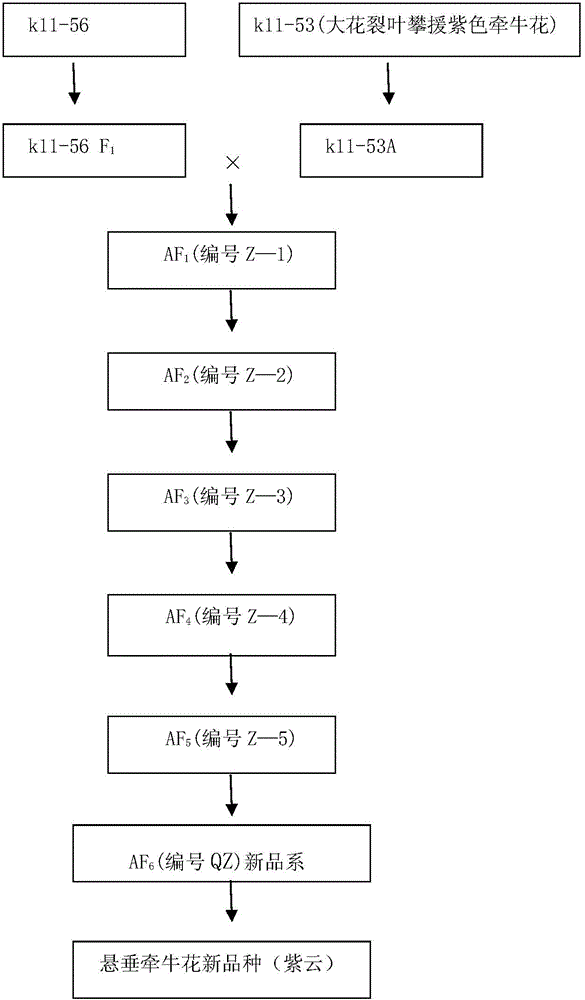
[0045] Such as figure 1 As shown, the present embodiment selects and breeds disease-resistant, high-yield morning glory by the following methods:
[0046] 1. Selection of parental materials: in the seeding fields of large-flowered white pendant morning glory (K11-56) and purple (K11-53) climbing morning glory, the number of blooms is large and the rate of seed setting is high. No powdery mildew disease as the goal of single plant selection.
[0047] 2. These individual plants were selected in the same year, and each individual plant was self-crossed after marking, and F 1 generation seeds.
[0048] 3. In the two varieties of F 1 In the plant population after planting the generation seeds, continue to select individual plants with the goal of having more flowers, high seed setting rate, and no powdery mildew disease, and use the individual plants selected from K11-56 as the female parent, and use A(K11 -53) The selected single plant is used as the male parent for interspeci...
Embodiment 2
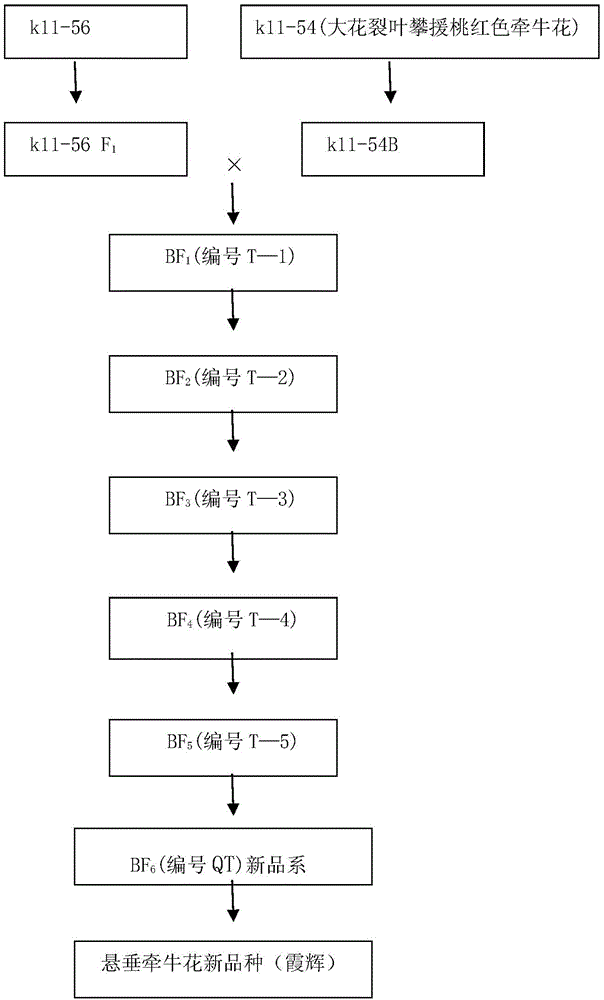
[0068] Such as figure 2 As shown, the present embodiment selects and breeds disease-resistant, high-yield morning glory by the following methods:
[0069] 1. Selection of parental materials: in the seeding field of large-flowered white hanging morning glory (K11-56) and pink (K11-54) climbing morning glory, the number of blooms is large and the rate of seed setting is high. , no powdery mildew disease as the target breeding single plant.
[0070] 2. These individual plants were selected in the same year, and each individual plant was self-crossed after marking, and F 1 generation seeds.
[0071] 3. In the two varieties of F 1 In the plant population after the planting of generation seeds, continue to select single plants with the goal of having more flowers, high seed setting rate, and no powdery mildew disease, and use the single plants selected from K11-56 as female parents, and respectively use B(K11 -54) The selected single plant is used as the male parent for intersp...
PUM
 Login to View More
 Abstract
Description
Claims
Application Information
 Login to View More