

Magnetic pirarubicin nano-drug composite
A pirarubicin and magnetic technology, which is applied in the field of magnetic pirarubicin nano-pharmaceutical composition to treat bladder cancer, can solve problems such as inability to withstand infusion chemotherapy, lack of targeting of chemotherapy drugs, and killing of bladder epithelial cells, and achieve Reduce toxic and side effects, good dispersibility
- Summary
- Abstract
- Description
- Claims
- Application Information
AI Technical Summary
Problems solved by technology
Method used
Image

Examples
Embodiment 1
[0030] Example 1 Preparation of Magnetic THP Nano-Preparation
[0031] 1) Magnetic Fe 3 o 4 Preparation of nanoparticles:
[0032] With reference to the method of J MagnMagn Mater, 2006, 302 (2): 397-404, which is incorporated by reference in its entirety, the preparation of magnetic Fe 3 o 4 Nanoparticles, the specific preparation process is as follows:
[0033] Under nitrogen protection, 8.14 g of ferric chloride hexahydrate and 3.00 g of ferrous chloride tetrahydrate were dissolved in 30 mL of deionized water, and 0.85 mL of 12 mol / L hydrochloric acid solution was added. Add the above solution dropwise to 250 mL of 1.5 mol / L sodium hydroxide solution, stir for 30 min, collect the precipitate, wash with deionized water three times, and dry in vacuum to obtain Fe with an average particle size of about 40 nm. 3 o 4 nanoparticles.
[0034] 2) Aminated Fe 3 o 4 preparation:
[0035] Under the protection of nitrogen, the 0.1g Fe obtained in step 1) 3 o 4 Nanoparticles...
Embodiment 2
[0038] Example 2 Characterization of Magnetic THP Nano-Preparations
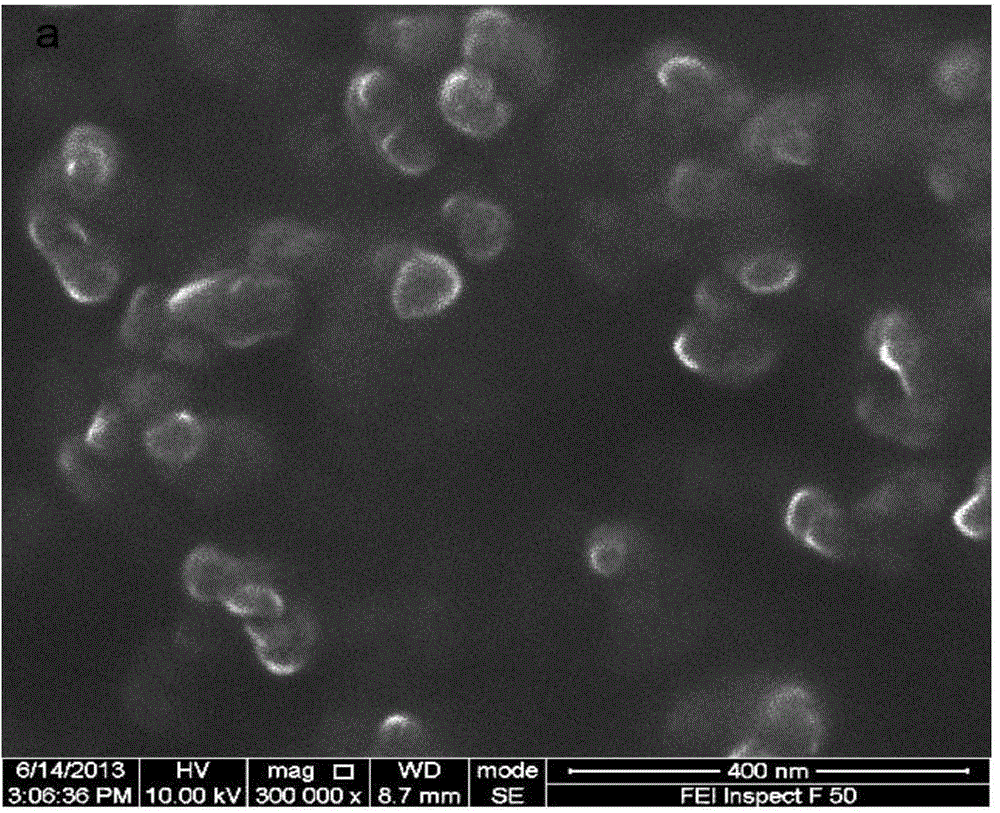
[0039] Observation by scanning electron microscopy (Inspect F50, FEI, USA) of magnetic Fe 3 o 4 The shape of nanoparticles, the nanoparticles with a particle size of about 40nm, the particle size distribution is relatively uniform, see Figure 1a .
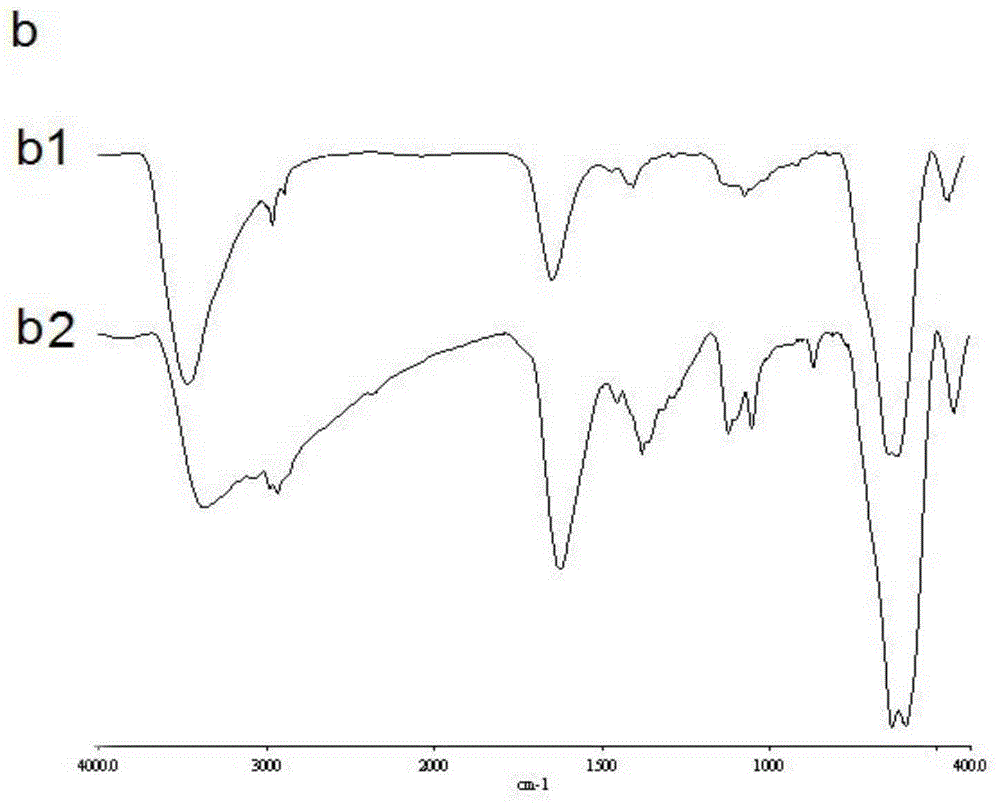
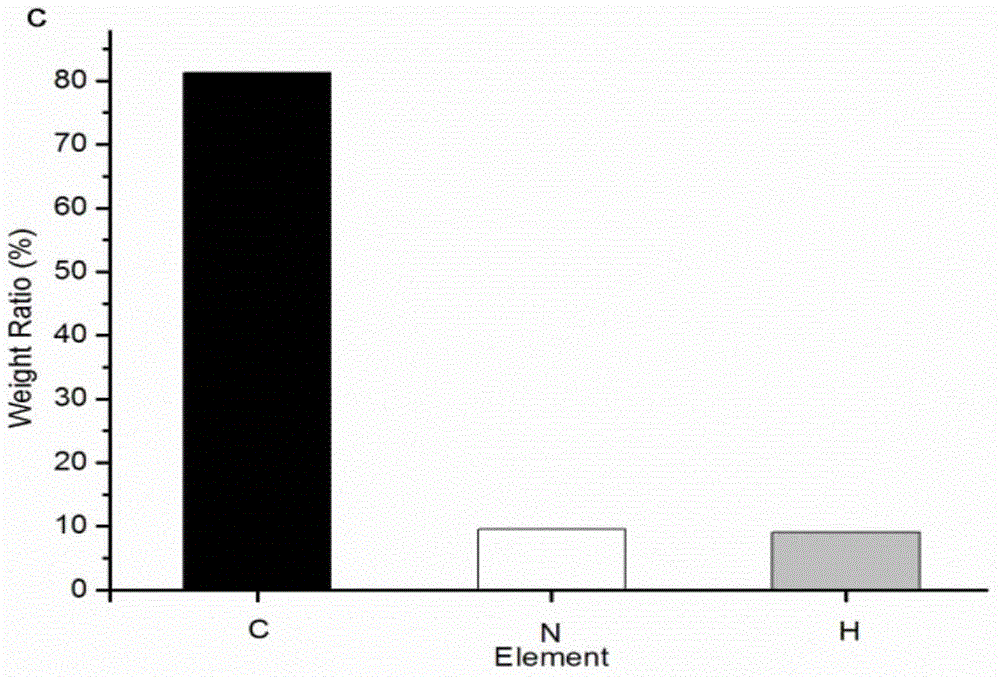
[0040] Aminated Fe was scanned using a Fourier transform infrared spectrometer (Spectrum GX, Perkin Elmer, USA) 3 o 4 ,See Figure 1b 1 ,exist Figure 1b 1 Medium, 3431cm -1 and 1630cm -1 It is the characteristic absorption peak of N-H, which proves that the magnetic nano-Fe 3 o 4 The surface is modified by 3-aminopropyltriethoxysilane, and the surface is rich in active amino groups; determine the infrared spectrum of the magnetic THP nano drug composition, see Figure 1b 2 ,exist Figure 1b 2 Medium, 3000cm -1 Three weaker absorption peaks appear nearby, which are the absorption peaks of C-H on the benzene ring. 1620cm -1 The left and right pea...
Embodiment 3
[0046] Example 3 Determination of Stability of Magnetic THP Nano-Preparations
[0047] Weigh 0.0039g of magnetic THP nano-preparations, ultrasonically disperse them in PBS buffers with pH 7.4, 6.0, and 5.7, place them in dialysis bags, seal them, and immerse the whole in 50mL of PBS buffers with the same pH, at 37°C After standing still at 0.5 h, 1.0 h, 1.5 h, and 2 h, 2 mL of the solution was taken to measure the concentration of THP in it with a UV-Vis spectrophotometer (Lambda900, Perkin Elmer, USA). In addition, under the stirring condition of 700rpm, the THP concentration at the same time point was measured. The drug residue rate was calculated separately.
[0048] Figure 3 shows the THP drug residual rate of magnetic THP nanocomposites in PBS buffer with different pH values under static state and stirring state. The results show that the magnetic THP nano-preparation or composition is pH=7.4 under normal physiological conditions ( Figure 3a ) in the buffer solution...
PUM
 Login to View More
 Abstract
Description
Claims
Application Information
 Login to View More