
Rapid biological remediation method for alkali spots
A bioremediation and rapid technology, applied in the direction of soil preparation methods, applications, agricultural machinery and tools, etc., can solve the problems of high input cost and slow effect, and achieve the effects of low cost, increased land productivity, and wide adaptability
- Summary
- Abstract
- Description
- Claims
- Application Information
AI Technical Summary
Problems solved by technology
Method used
Image

Examples
Embodiment 1
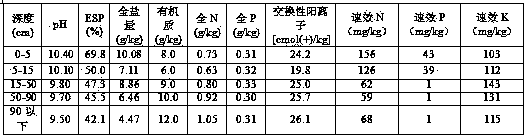
[0013] The improved alkali spot test in this example is located in the grassland in the soda saline soil area of Lootou Village, Tuogu Township, Zhaozhou County, Songnen Plain. Alkaline spots of different sizes are distributed, and the soil properties are shown in Table 1.
[0014] Table 1 Basic soil properties of alkali spots
[0015]
[0016] The specific operation links of this embodiment are as follows:
[0017] (1) From July 3 to 5, use chicken manure and fresh Leymus chinensis to compost and cover the alkali spots. According to the weight ratio of fresh grass and chicken manure of 3:7, the thickness of the tile is 40cm, and the compost is covered.
[0018] (2) On August 12-13, remove the compost, leave the decomposed manure and soil with a thickness of 10cm, shallowly turn 0-15cm, and mix well.
[0019] (3) Sowing began on August 16, with 6 grams of Leymus chinensis seeds and 1.5 grams of Alpine grass seeds per square meter, covered with 1-2 cm of soil.
Embodiment 2
[0021] The improved alkali spot test in this example is located in the grassland in the soda saline soil area of Lootou Village, Tuogu Township, Zhaozhou County, Songnen Plain. Alkaline spots of different sizes are distributed, and the soil properties are shown in Table 1. The specific operation links are as follows:
[0022] (1) From July 3rd to 5th, use chicken manure and fresh alfalfa to cover the alkali spots with compost. According to the weight ratio of fresh grass and chicken manure of 3:7, the thickness of the tile is 40cm, and the compost is covered.
[0023] (2) On August 12-13, remove the compost, leave the decomposed manure and soil with a thickness of 8cm, shallowly turn 0-15cm, and mix well.
[0024] (3) Sowing began on August 16, with 6 grams of Leymus chinensis seeds and 1.5 grams of Alpine grass seeds per square meter, covered with 1-2 cm of soil.
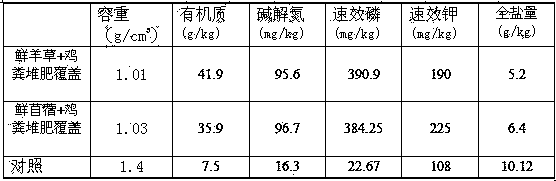
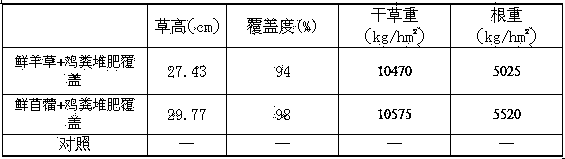
[0025] The field application results of Example 1 and Example 2 show that after improvement, soil bulk densi...
Embodiment 3
[0032] The improved alkali spot test of this example is located in the soda saline soil grassland of Taifeng Village, Yongle Town, Zhaozhou County, Songnen Plain, where there are alkali spots of different sizes and no grass growing, with a pH of 10.03. The specific operation links are as follows:
[0033] (1) On July 5-6, use cow dung and fresh alfalfa to cover the alkali spots with compost. According to the weight ratio of fresh grass and cow dung of 3:7, the compost thickness is 40cm, and the compost is covered.
[0034] (2) On August 10-11, remove the excess compost, leave the decomposed manure and soil with a thickness of 8cm, shallowly turn 0-8cm, and mix well.
[0035] (3) Sowing started on August 12, sowing 6 grams of Leymus chinensis seeds and 1.5 grams of Alpine grass seeds per square meter, covering the soil with 1-2 cm.
[0036] The field application effect of Example 3 shows that after the improvement, the soil bulk density and soil salinity are significantly red...
PUM
 Login to View More
 Abstract
Description
Claims
Application Information
 Login to View More