
Electrolyte corrosion inhibitor for aluminum-air cell, electrolyte and preparation method
An air battery and electrolyte technology, applied in the field of electrolyte corrosion inhibitors, alkaline electrolytes and their preparation, can solve the problems of composite corrosion inhibitors with complex components, waste of materials and resources, and non-compliance with environmental protection requirements. Reach the effect of reducing hydrogen evolution self-corrosion rate, reducing aluminum anode polarization, and improving discharge performance
- Summary
- Abstract
- Description
- Claims
- Application Information
AI Technical Summary
Problems solved by technology
Method used
Image

Examples
Embodiment 1
[0035] The aluminum-air battery electrolyte mother solution in this embodiment is 4 mol / L sodium hydroxide solution, the corrosion inhibitor is sodium thiosulfate, and the concentration in the electrolyte is 0.005 mol / L. The preparation method of the electrolytic solution is as follows: prepare a sodium hydroxide solution with a concentration of 4 mol / L, cool to room temperature, add accurately weighed sodium thiosulfate, stir and dissolve completely.
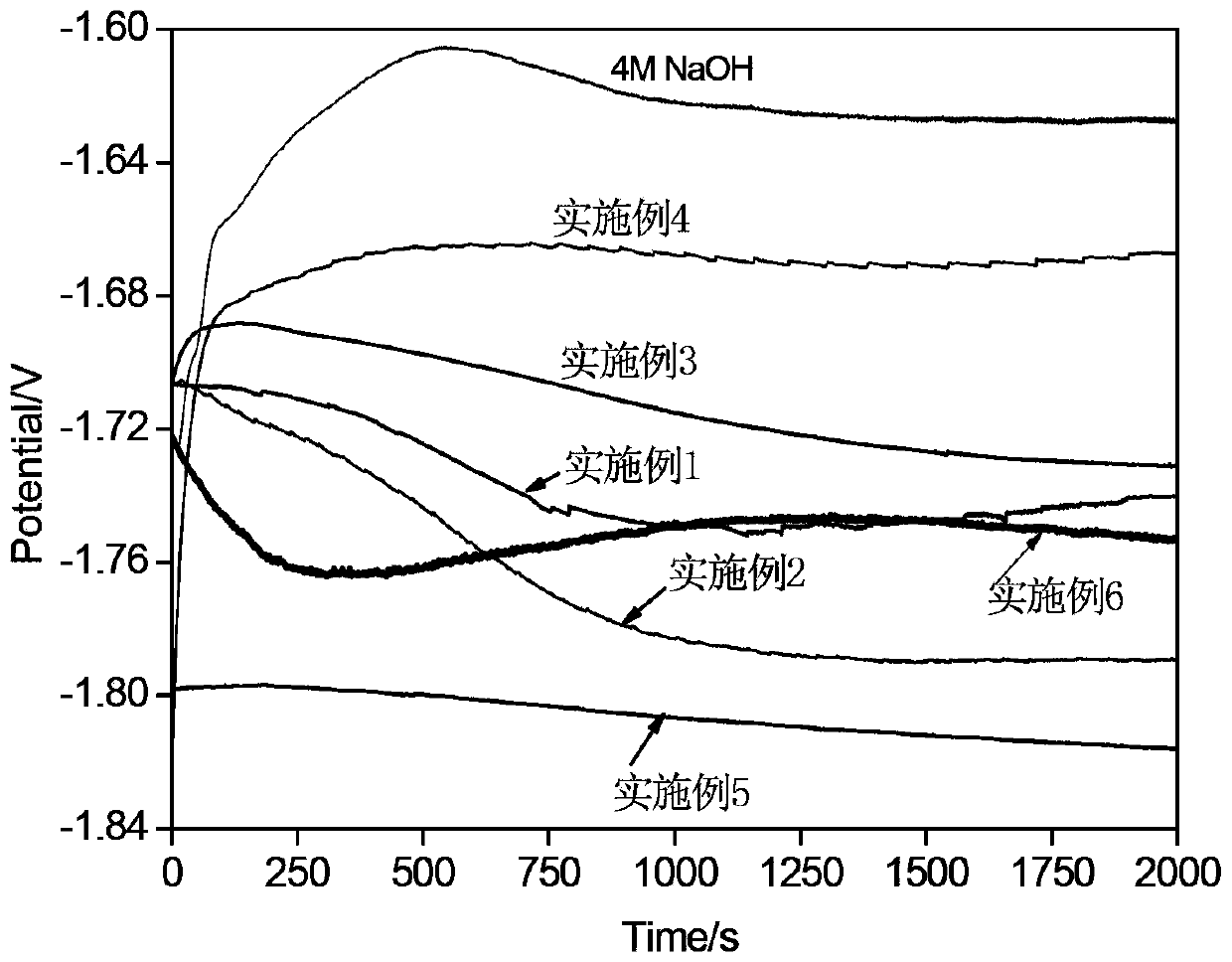
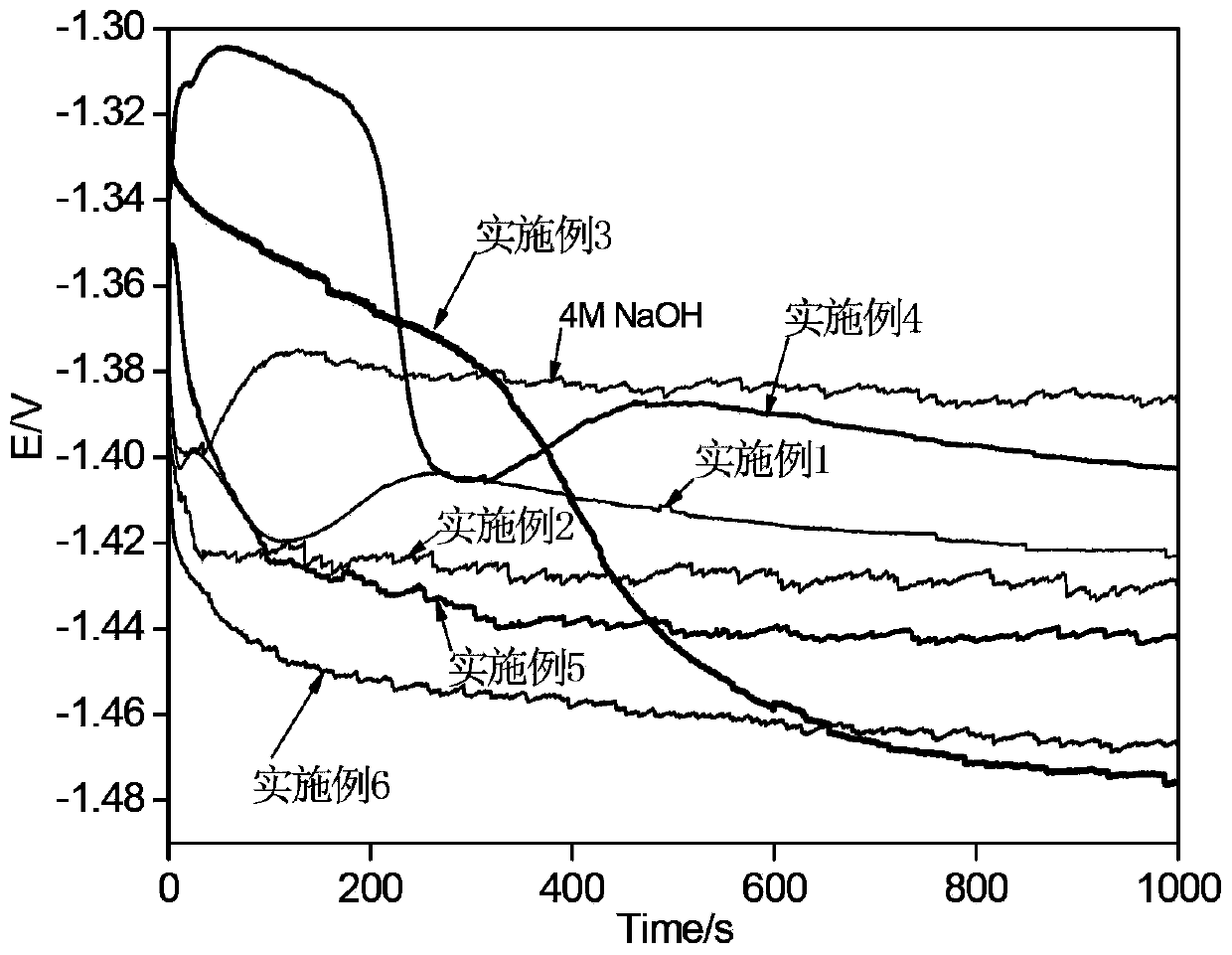
[0036] The static self-corrosion rate of the Al-0.1Sn-0.1Ga aluminum anode alloy in the electrolyte prepared in this embodiment was tested by the gas collection method, and the test time was 30 minutes. The results are shown in Table 1 below. Using a three-electrode system to test the open circuit potential of the Al-0.1Sn-0.1Ga aluminum anode alloy in the above electrolyte and at 25°C, 100mA / cm 2 The working potential curve under the current density, the results are detailed in figure 1 , figure 2 . The self-corrosion rat...
Embodiment 2
[0039] The electrolyte mother solution for the aluminum-air battery in this embodiment is 4 mol / L sodium hydroxide solution, the corrosion inhibitor is sodium thiosulfate, and the concentration in the electrolyte is 0.01 mol / L. The preparation method of the electrolytic solution is as follows: prepare a sodium hydroxide solution with a concentration of 4 mol / L, cool to room temperature, add accurately weighed sodium thiosulfate, stir and dissolve completely.
[0040] The static self-corrosion rate of the Al-0.1Sn-0.1Ga aluminum anode alloy in the electrolyte prepared in this embodiment was tested by the gas collection method, and the test time was 30 minutes. The results are shown in Table 1 below. Using a three-electrode system to test the open circuit potential of the Al-0.1Sn-0.1Ga aluminum anode alloy in the above electrolyte and at 25°C, 100mA / cm 2 The working potential curve under the current density, the results are detailed in figure 1 , figure 2 . The self-corros...
Embodiment 3
[0043] The electrolyte mother solution for the aluminum-air battery in this embodiment is 4 mol / L sodium hydroxide solution, the corrosion inhibitor is sodium thiosulfate, and the concentration in the electrolyte is 0.05 mol / L. The preparation method of the electrolytic solution is as follows: prepare a sodium hydroxide solution with a concentration of 4 mol / L, cool to room temperature, add accurately weighed sodium thiosulfate, stir and dissolve completely.
[0044] The static self-corrosion rate of the Al-0.1Sn-0.1Ga aluminum anode alloy in the electrolyte prepared in this embodiment was tested by the gas collection method, and the test time was 30 minutes. The results are shown in Table 1 below. Using a three-electrode system to test the open circuit potential of the Al-0.1Sn-0.1Ga aluminum anode alloy in the above electrolyte and at 25°C, 100mA / cm 2 The working potential curve under the current density, the results are detailed in figure 1 , figure 2 . The self-corros...
PUM
 Login to View More
 Abstract
Description
Claims
Application Information
 Login to View More