Nematicidal compound containing fluensulfone and thiacloprid

A technology of fluthiazol and nematicides, which is applied in the field of pesticide compounding, can solve the problems that no nematicides have been reported before, and achieve the effects of delaying the resistance of key insects and reducing production costs and use costs

CN104542674AInactive Publication Date: 2015-04-29HAILIR PESTICIDES & CHEM GRP
0 Cites 2 Cited by

Patent Information

Authority / Receiving Office
CN · China
Patent Type
Applications(China)
Current Assignee / Owner
Publication Date
2015-04-29
Estimated Expiration
Not applicable · inactive patent

Smart Images

  • Figure 1
    Figure 1
  • Figure 2
    Figure 2
  • Figure 3
    Figure 3
Patent Text Reader

Abstract

The invention relates to a nematicidal compound containing fluensulfone and thiacloprid. The effective component of the nematicidal compound is compounded through the fluensulfone and the thiacloprid, wherein the mass ratio of the fluensulfone to the thiacloprid is (1-25):(25-1), the mass ratio of the effective components of the fluensulfone and thiacloprid in the preparation accounts for 1-80 percent, and the rest is auxiliary components allowed and accepted in pesticide. The nematicidal compound provided by the invention can be missible oil, a suspending agent, a wettable powder, an aqueous solution, water dispersible granules, emulsion in water, microemulsion in water, granules and microcapsuls in dosage forms, and is mainly used for preventing and treating insect pests such as nematoid of solanaceous vegetables, cucurbitaceous vegetables, lettuce, and other leaf vegetables.
Need to check novelty before this filing date? Find Prior Art

Description

technical field

[0001] The invention relates to the technical field of pesticide compounding, in particular to a nematocidal composition containing fluthiazol and thiacloprid. Background technique

[0002] Nematodes belong to the nematode class Nematodes, and they are small in size and can be observed under a microscope. There are about 3,000 species of nematodes that are harmful to plants, most of which live in the soil, and some are parasitic in plants. Nematodes spread through soil or seeds, can damage the root system of plants, or invade the organs of the aboveground parts, affect the growth and development of crops, and indirectly spread diseases caused by other microorganisms, causing great economic losses. The use of pesticides to control nematodes is an effective method commonly used in modern agriculture. It is generally used for soil treatment or seed treatment. There are two types of nematicides: volatile and non-volatile. The former acts as fumigation and the la...

Examples

Embodiment

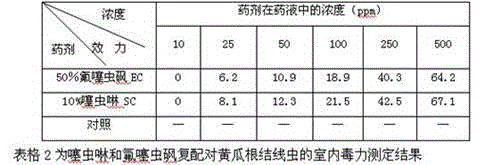
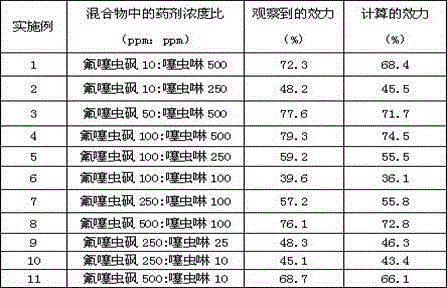
[0032] Example: Combined toxicity test of different ratios of fluthiazol and thiacloprid.

[0033] Test target: Cucumber root-knot nematode

[0034] The evaluation method is the liquid immersion method. Dissolve the original drug with acetone first, distribute the appropriate amount of active ingredients into several different proportions according to the results of the preliminary experiment, and then use acetone to dilute each treatment into several concentration gradients for use. Inject 100 ul into each well of a 96-well plate, then add an equal amount of root-knot nematode suspension, place in a dark place at 25° C. for one week, and count the number of surviving and dead nematodes in each well with a microscope.

[0035] Calculation method of drug efficacy: Mortality rate (%)=number of dead insects / (number of surviving insects+number of dead insects)×100.

[0036] The expected potency (i.e. theoretical control effect, %) of the active ingredient mixture was determined ...