Petroleum pollution marine ecological environment evaluation method based on metagenome technology

A technology for oil pollution and ecological environment, applied in special data processing applications, instruments, electrical digital data processing, etc., can solve the problems of inability to comprehensively and accurately evaluate the response changes of oil spill pollutants to the degree of damage to marine ecosystems, and achieve a short cycle , the effect of a large amount of data

CN104715165AInactive Publication Date: 2015-06-17BC P INC CHINA NAT PETROLEUM CORP +1
3 Cites 9 Cited by

Patent Information

Authority / Receiving Office
CN · China
Patent Type
Applications(China)
Current Assignee / Owner
Publication Date
2015-06-17
Estimated Expiration
Not applicable · inactive patent

Smart Images

  • Figure 1
    Figure 1
  • Figure 2
    Figure 2
  • Figure 3
    Figure 3
Patent Text Reader

Abstract

The invention provides a petroleum pollution marine ecological environment evaluation method based on a metagenome technology. The method comprises the steps that seawater samples are collected; extraction and sequencing of metagenome DNA are carried out on the samples; effective sequence data statistical analysis and optimal sequence data statistical analysis are carried out on the sequenced data; OTU-based analysis is carried out through mothur and chopseq software; Alpha-diversity analysis is carried out and comprises analysis on the flora abundance, flora diversity and sequencing coverage rate; the dilution curve analysis is carried out; taxonomic analysis and community structure analysis are carried out; Heatmap clustering analysis is carried out, and the sample microflora structure and the population quantity parameter value are obtained and used for evaluating pollution similarity and perniciousness in different samples. The method can objectively evaluate the extent of damage to an ecological system from spilling oil pollutants and the response changes of the ecological system to the spilling oil pollutants.
Need to check novelty before this filing date? Find Prior Art

Description

technical field

[0001] The invention relates to a method for evaluating the marine ecological environment of oil pollution based on macrogene technology, and belongs to the technical field of evaluating the ecological environment of oil pollution. Background technique

[0002] Marine oil pollution is a global problem, and it is also one of the most serious coastal pollution problems in my country. With the increasing business of offshore crude oil exploitation and ocean transportation of crude oil, marine oil spill accidents occur frequently. Among the oil spills caused by ship accidents in the past 20 years, there were about 1780 accidents with oil spills of more than 7 tons, of which 458 were major oil spills of more than 700 tons. With the occurrence of the most serious oil spill accident in the history of the United States—the "Deepwater Horizon" platform oil spill accident, marine oil spill pollution has become the focus of attention in the field of marine development ...

Examples

Embodiment 1

[0086] 1. Sample collection:

[0087] A total of 20 points on the coastline around the Dalian 7.16 accident sea area were selected for collection. The samples were oil-polluted seawater, and each sample was collected in 50ml. After collection, it was stored at a low temperature of 4°C for subsequent metagenomic DNA extraction.

[0088] 2. Extraction of metagenomic DNA

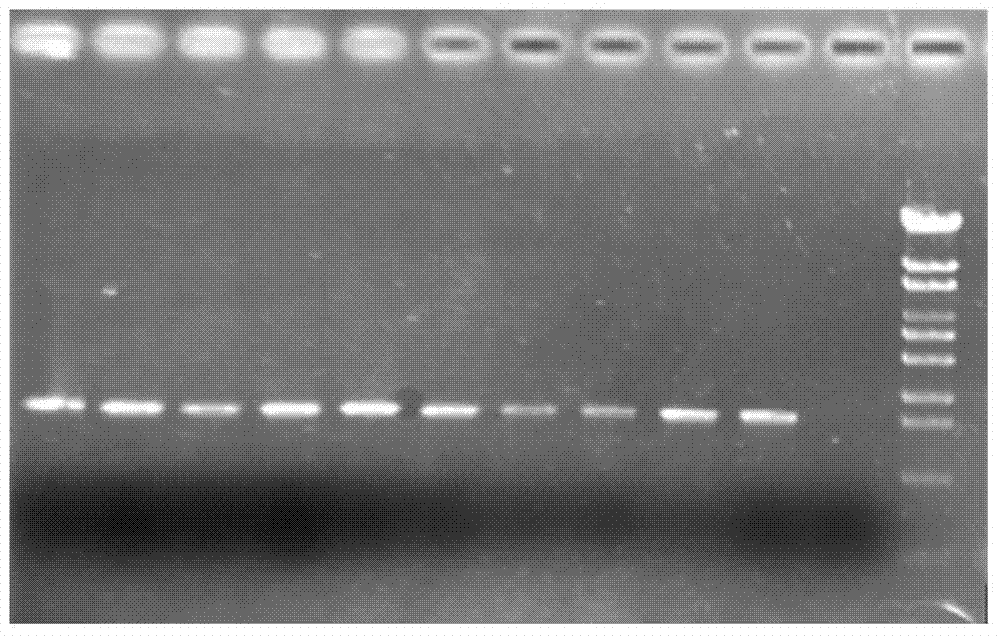
[0089] Centrifuge at 6000rpm, 4°C for 15min to collect microorganisms in seawater, discard the supernatant, use the Tiangen Metagenome Extraction Kit to extract the total DNA, and use 27F and 1495R primers to perform PCR amplification of the 16S rRNA gene. The specific operation is carried out according to the instructions .

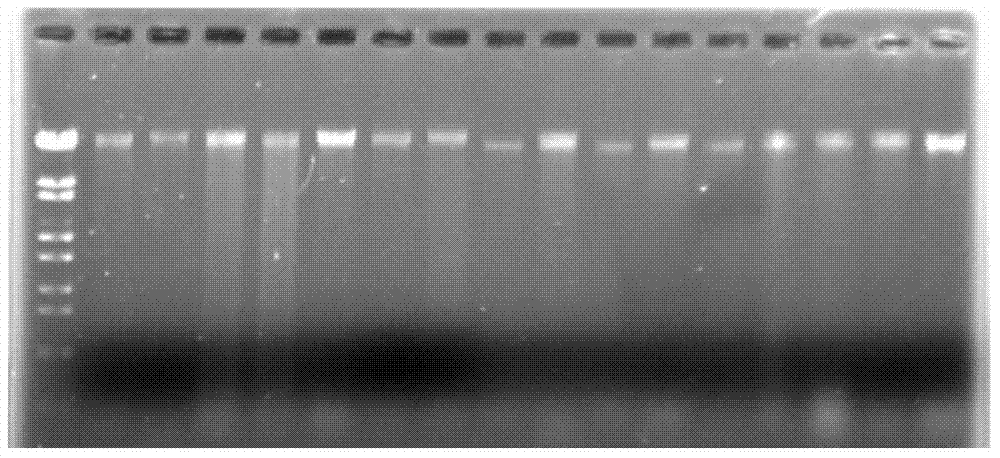
[0090] figure 1 It is the metagenomic DNA electrophoresis pattern of some samples in the present invention. The lanes in the figure, from left to right, lane 1 is 1Kb Marker, and lanes 2-17 are samples 1, 2, 6, 5, 4, 7, 8, and 9, respectively. , 13, 11, 15, 17, 17, 19, 21, 4 total DNA....