Deformation Decomposition Method of Cube Elements Satisfied Complete Orthogonality and Mechanical Equilibrium Conditions

A technology with complete orthogonal and balanced conditions, applied in instrumentation, design optimization/simulation, calculation, etc., can solve problems such as inability to quantitatively identify, not found, etc.

CN105677971BActive Publication Date: 2018-11-30ZHENGZHOU UNIV
2 Cites 0 Cited by

Patent Information

Authority / Receiving Office
CN · China
Patent Type
Patents(China)
Current Assignee / Owner
Publication Date
2018-11-30

Smart Images

  • Figure 1
    Figure 1
  • Figure 2
    Figure 2
  • Figure 3
    Figure 3
Patent Text Reader

Abstract

A cube unit deformation decomposition method meeting complete orthogonality and mechanical equilibrium conditions comprises the first step that spatial deformation of a 8-node cube unit is composed of rigid body displacement in the X direction, rigid body displacement in the Y direction, rigid body displacement in the Z direction, tension and compression deformation in the X direction, tension and compression deformation in the Y direction, tension and compression deformation in the Z direction, X-axis bending deformation in an XOY plane, Y-axis bending deformation in the XOY plane, Y-axis bending deformation in a YOZ plane, Z-axis bending deformation in the YOZ plane, X-axis bending deformation in an XOZ plane, Z-axis bending deformation in the XOZ plane, shear deformation in the XOY plane, shear deformation in the YOZ plane, shear deformation in the XOZ plane, rigid body rotation displacement in the XOY plane, rigid body rotation displacement in the YOZ plane, rigid body rotation displacement in the XOZ plane and X-axis reverse bending deformation. Based on the method, an engineering designer can conveniently decompose ductile deformation (such as tension and compression deformation and bending deformation) and brittle deformation (such as shear deformation and torsion deformation) of a structure according to finite element analysis and laboratory test and field test data.
Need to check novelty before this filing date? Find Prior Art

Description

technical field

[0001] The invention relates to a recognition method for spatial structure deformation and mode shape. Background technique

[0002] At present, with the help of commercial finite element software, laboratory tests, simulation or on-site testing, etc., the deformation, stress, and strain of various engineering structures under the action of the environment can be accurately analyzed; the deformation here is the structure in the The comprehensive response under the external action, the stress and strain here are the reaction values ​​on the micro-elements of the structure.

[0003] However, on the one hand, structural designers are more concerned about the ratio of ductile deformation to brittle deformation in structural deformation; because brittle deformation should be avoided as much as possible in design. On the other hand, the response value of the micro-element may be difficult to describe the deformation essence of the macrostructure; for example, the ...

Examples

Embodiment Construction

[0131] Theoretical derivation of the invention: Williams [1] etc. think that the motion and deformation of the block can be regarded as the superposition of the motion and deformation of the rigid body of the block under certain conditions. Zhang Canhui [2] It is pointed out that in the case of small deformation, the spatial deformation of the eight-node cube element can be decomposed into 3 rigid body line displacements, 3 rigid body rotational displacements, 3 tension and compression deformations, 6 bending deformations, 3 shear deformations, 3 There are 24 basic forms of reverse bending deformation and 3 torsional shear deformations.

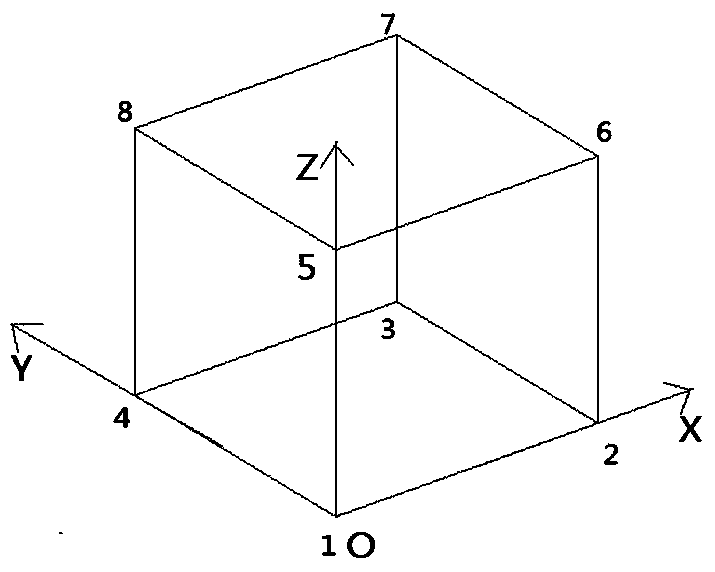
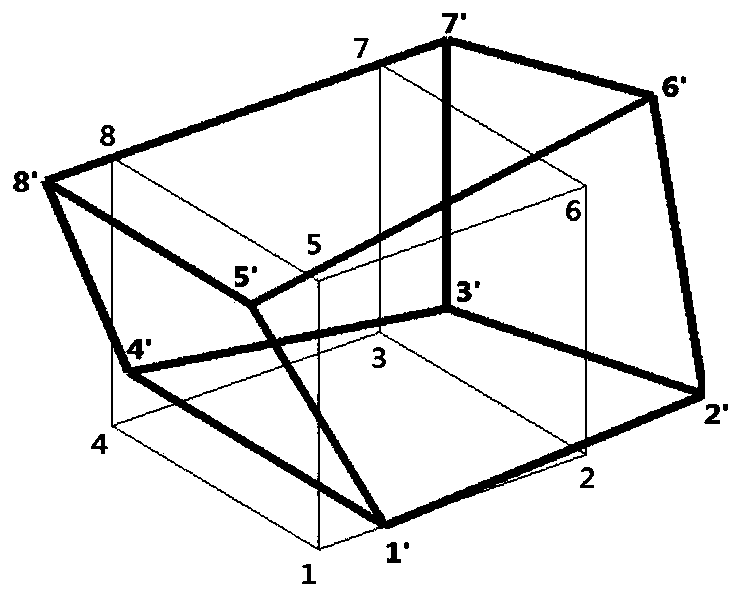
[0132] Such as figure 1 , 2 As shown, set by figure 1 The 8-node cube element shown in the figure can be deformed arbitrarily as figure 2 shown. Subtract the coordinate value before deformation from the coordinate value after deformation to form the deformation vector of the node coordinates of the cube unit:

[0133] d e =(x' 1 -x ...