
Method of using nuclear power plant cooling tower waste heat to heat sea light raw water and reduce warm water discharge
A technology for cooling towers and nuclear power plants, applied in the field of nuclear power, can solve the problems of increasing operating costs, increasing the total water intake and production scale of seawater desalination systems, and achieving the effects of increasing water temperature, reducing equipment investment, and reducing energy consumption for system operation
- Summary
- Abstract
- Description
- Claims
- Application Information
AI Technical Summary
Problems solved by technology
Method used
Image

Examples
Embodiment Construction
[0018] The specific implementation manners of the present invention will be further described in detail below in conjunction with the accompanying drawings.
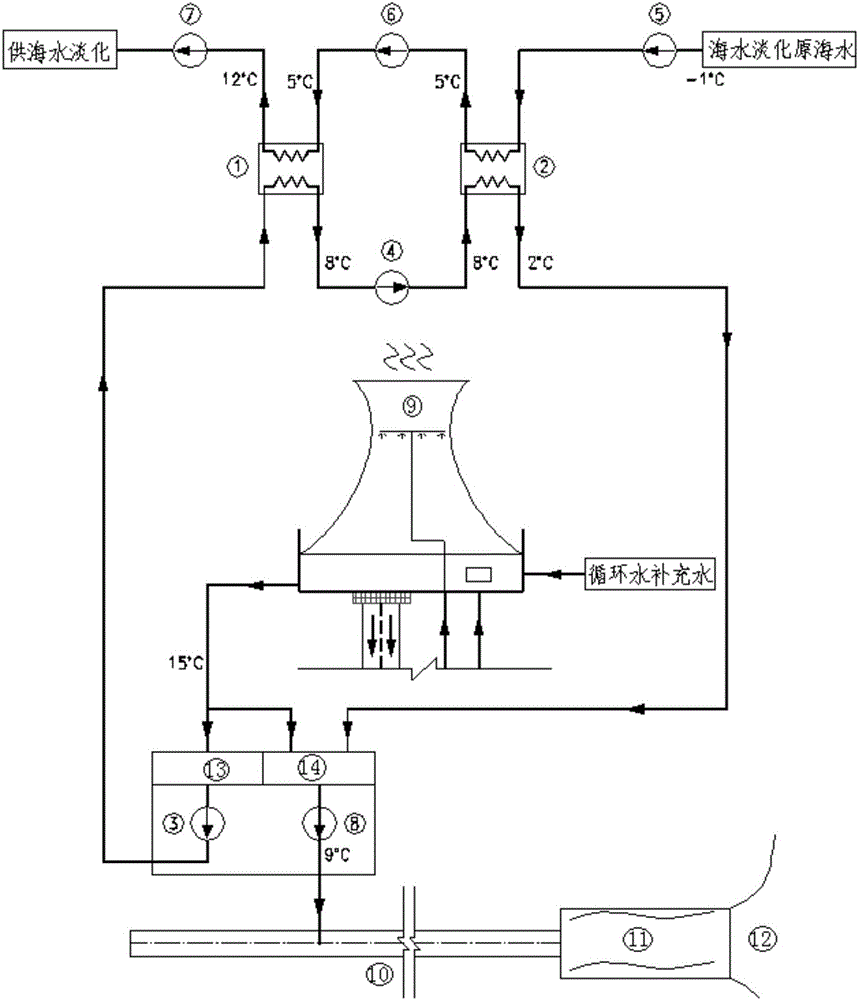
[0019] Such as figure 1 Shown, is the method for heating desalinated raw water with waste heat from a cooling tower of a nuclear power plant of the present invention and reducing temperature emission, comprising the following steps:
[0020] 1) A heat exchange system is arranged between the cooling tower 9 and the raw seawater, and two sets of heat exchange tubes are arranged in the heat exchange system;
[0021] 2) The water inlet end of one group of heat exchange tubes is connected with the cooling tower circulating water drainage end, and the water outlet end is connected with the sea 12 through the mixing tank 14, the drainage pump 8, the open drainage channel 10, and the tidal river section 11;
[0022] 3) The water inlet end of another group of heat exchange tubes is connected with the original seawater, and the w...
PUM
 Login to View More
 Abstract
Description
Claims
Application Information
 Login to View More