
A Method for Tracing the Temperature Difference and Density Flow in Stratified Reservoirs
A technology of density flow and reservoir with temperature difference, applied in special data processing applications, instruments, electrical digital data processing, etc., can solve density changes, it is difficult to distinguish the trajectory of density flow, and the movement law of mixed solution cannot fully reflect the temperature difference Problems such as reflow movement rules, to achieve the effect of ensuring accuracy
- Summary
- Abstract
- Description
- Claims
- Application Information
AI Technical Summary
Problems solved by technology
Method used
Image

Examples
Embodiment 1
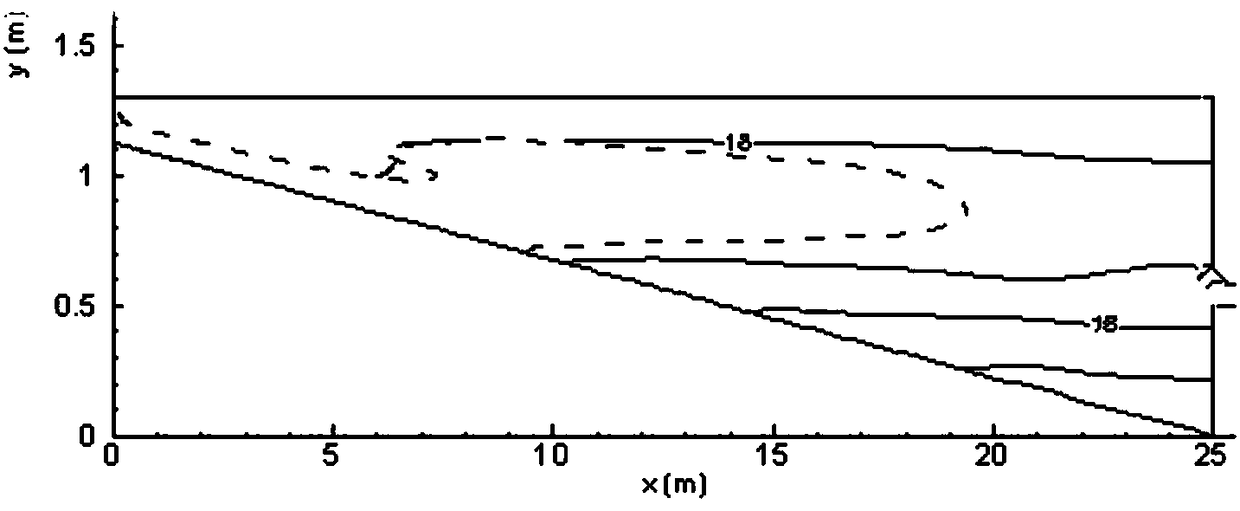
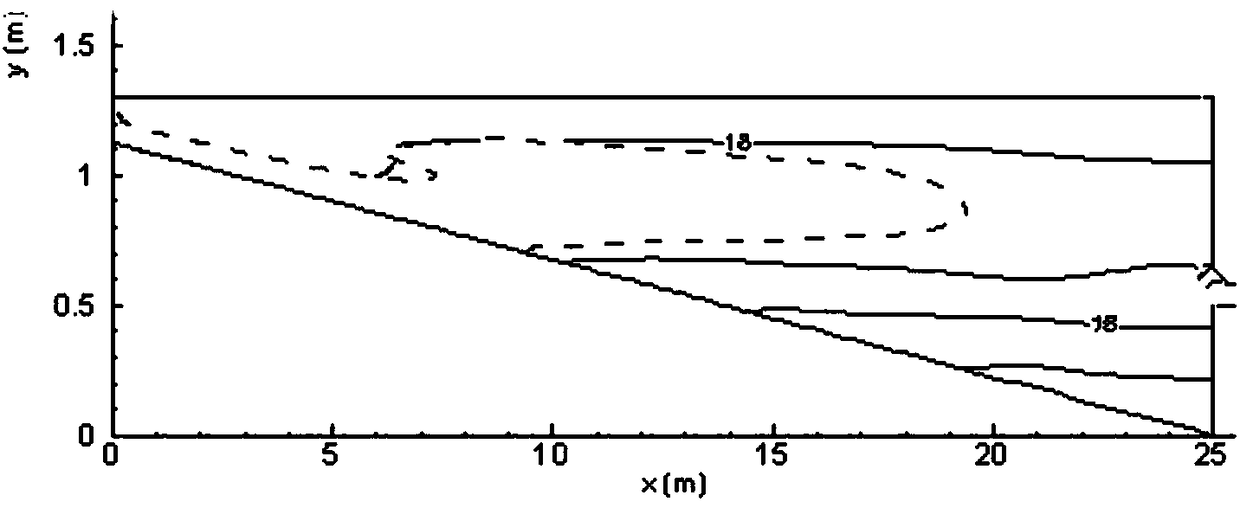
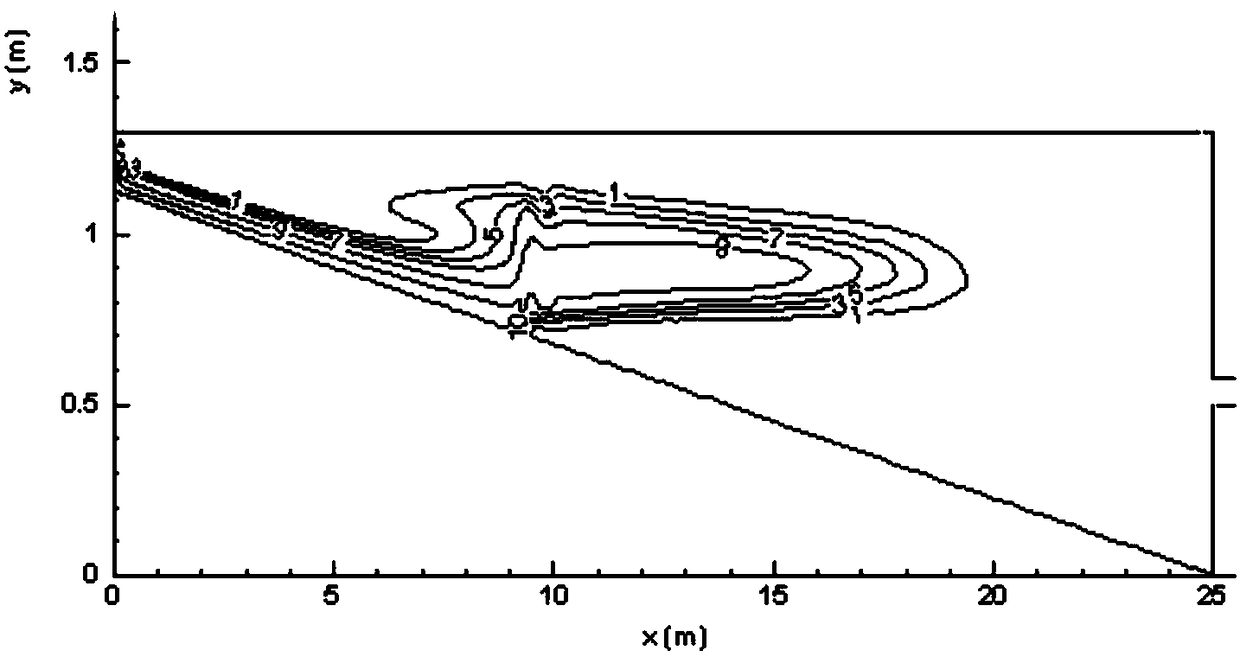
[0025] Embodiment one: if Figure 1-5 As shown, it mainly includes the following steps:
[0026] Step 1: According to the actual topography of the reservoir, collect the water depth and the length and width of the liquid surface at each location of the reservoir to establish a reservoir model diagram suitable for numerical calculation, and divide the reservoir model diagram into grid-like graphics and store them in the computer ;
[0027] Step 2: Create the basic equations involved in the process of water flow, including: continuity equation, momentum equation, energy equation, and select the k-εRNG turbulence model for calculation;
[0028] Step 3: Set the physical and thermodynamic properties of the incoming water body in software such as ansys or fluent software according to the actual situation of the incoming water body, including density, specific heat, thermal conductivity, thermal expansion coefficient, and viscosity coefficient; figure 2 The water temperature distr...
Embodiment 2
[0036] Embodiment two: the steps of the present invention are as follows:
[0037] Step 1: According to the actual topography of the reservoir, collect the water depth and the length and width of the liquid surface at each location of the reservoir to establish a reservoir model diagram suitable for numerical calculation, and divide the reservoir model diagram into grid-like graphics and store them in the computer ;
[0038] Step 2: Create the basic equations involved in the process of water flow, including: continuity equation, momentum equation, energy equation, and select the k-εRNG turbulence model for calculation;
[0039] Step 3: Set the physical and thermodynamic properties of the incoming water body in software such as ansys or fluent software according to the actual situation of the incoming water body, including density, specific heat, thermal conductivity, thermal expansion coefficient, and viscosity coefficient;
[0040] Step 4: Add a small amount of any other sol...
Embodiment 3
[0044] Embodiment three: the first step: according to the actual topography of the reservoir, the water depth of each location of the reservoir and the length and width data of the liquid surface are collected to establish a reservoir model diagram suitable for numerical calculation, and the reservoir model diagram is divided into grid-like graphics stored in a computer;
[0045] Step 2: Create the basic equations involved in the process of water flow, including: continuity equation, momentum equation, energy equation, and select the k-εRNG turbulence model for calculation;
[0046] Step 3: Set the physical and thermodynamic properties of the incoming water body in software such as ansys or fluent software according to the actual situation of the incoming water body, including density, specific heat, thermal conductivity, thermal expansion coefficient, and viscosity coefficient;
[0047] Step 4: Add a small amount of any other solution as a tracer in the incoming stream, such ...
PUM
 Login to View More
 Abstract
Description
Claims
Application Information
 Login to View More