
A method and device for obtaining a Bessel beam based on cross-phase modulation
A technology of cross-phase modulation and Bessel beam, applied in the field of nonlinear optics, can solve the problems of high price, large optical distortion, non-adjustable central bright spot, etc., and achieve the effect of reducing operation difficulty, simple experimental device and simple realization.
- Summary
- Abstract
- Description
- Claims
- Application Information
AI Technical Summary
Problems solved by technology
Method used
Image

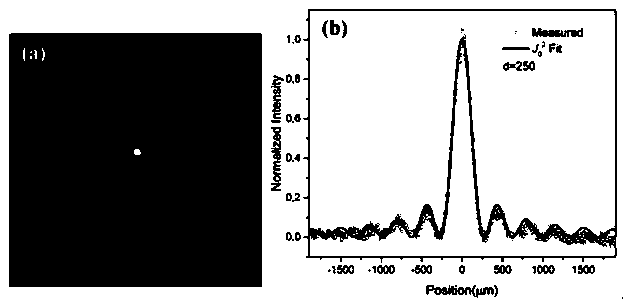
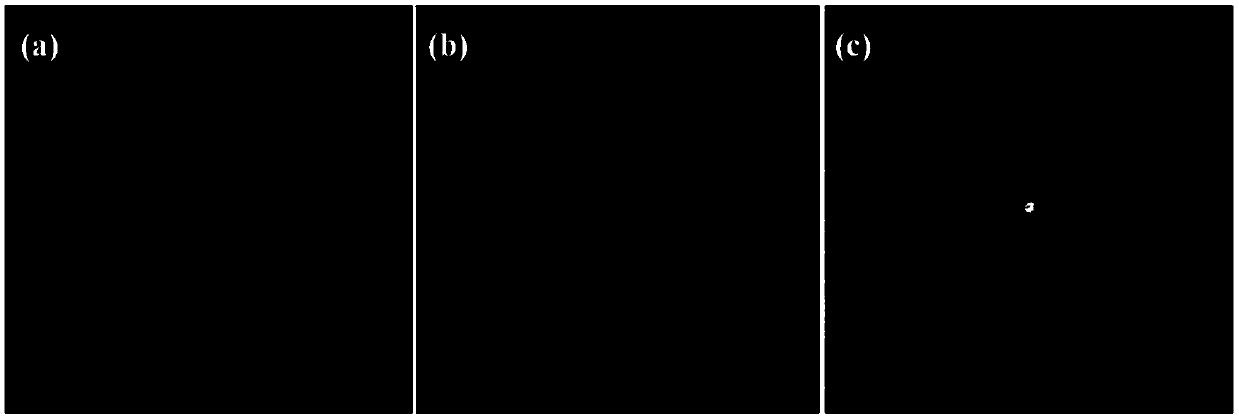
Examples
Embodiment 1
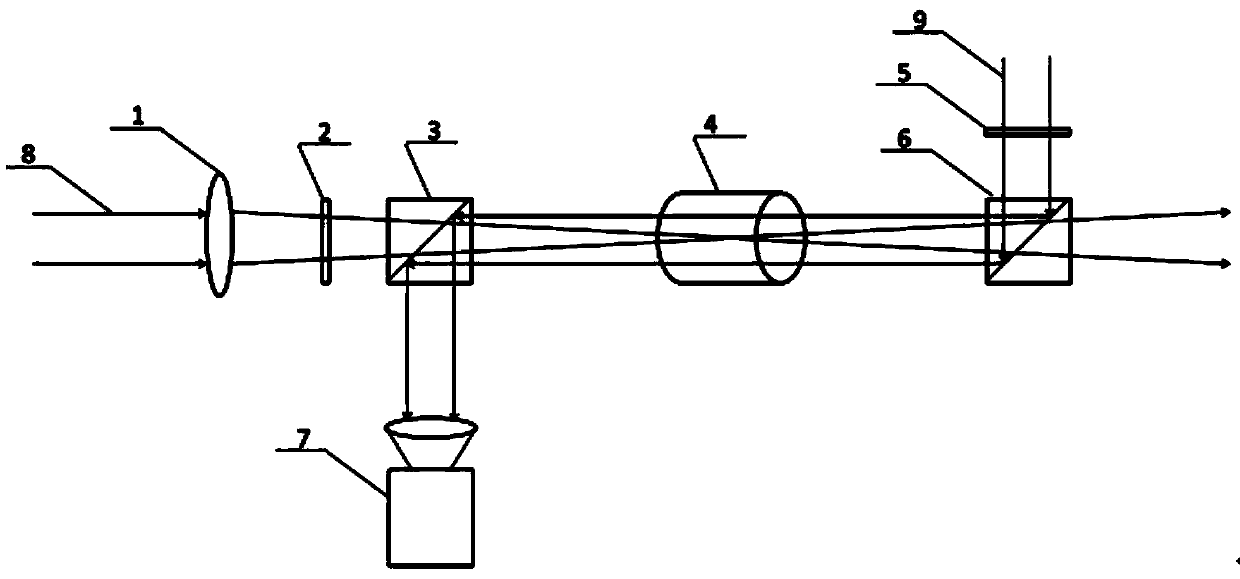
[0049] Prepare the test device as follows:
[0050] There are 2 lasers, the continuously tunable ring titanium sapphire laser (Matisse TR) emits the light as the modulated laser beam; the external cavity semiconductor laser emits the light as the modulated laser beam.
[0051] Convex lens 1, focal length 500mm.
[0052] 2 half-wave plates.
[0053] Two polarizing beam-splitting cubes.
[0054] Nonlinear medium, rubidium (Rb) atomic pool.
[0055] CCD for imaging.
[0056] Such as figure 1 As shown, the specific steps of using the method of the present invention to obtain a hollow beam are as follows:
[0057] Step 1: Focus the modulated laser beam 8 emitted by the tunable annular titanium sapphire (Matisse TR) laser with the convex lens 1 to obtain a Gaussian beam with a waist spot size of 172 μm, and set the waist spot position as the coordinate origin; The Gaussian beam is focused in the nonlinear medium 4 after passing through the first half-wave plate 2 and the first...
PUM
| Property | Measurement | Unit |
|---|---|---|
| refractive index | aaaaa | aaaaa |
Abstract
Description
Claims
Application Information
 Login to View More