Liquid phase detection method for fatty acid residues in amino acid surfactants
What is AI technical title?
AI technical title is built by PatSnap AI team. It summarizes the technical point description of the patent document.
A technology of surfactants and amino acids, which is applied in the field of analysis and detection, can solve the problems of large relative molecular mass and high boiling point, and achieve the effects of short time consumption, high accuracy and improved sensitivity
Active Publication Date: 2019-04-30
GUANGZHOU TINCI MATERIALS TECH
View PDF1 Cites 1 Cited by
Summary
Abstract
Description
Claims
Application Information
AI Technical Summary
This helps you quickly interpret patents by identifying the three key elements:
Problems solved by technology
Method used
Benefits of technology
Problems solved by technology
However, there are great limitations in the determination of fatty acid components with high boiling point, large relative molecular mass and non-volatile
Method used
the structure of the environmentally friendly knitted fabric provided by the present invention; figure 2 Flow chart of the yarn wrapping machine for environmentally friendly knitted fabrics and storage devices; image 3 Is the parameter map of the yarn covering machine
View more
Image
Smart Image Click on the blue labels to locate them in the text.
Viewing Examples
Smart Image
Click on the blue label to locate the original text in one second.
Reading with bidirectional positioning of images and text.
Smart Image
Examples
Experimental program
Comparison scheme
Effect test
Embodiment 1
[0036] This embodiment is used to illustrate the liquid phase detection method of fatty acid residue in a kind of cocoyl glycinate potassium of the present invention, comprises the steps:
[0037] (1) Reagent preparation:
[0038] Standard solution 1: Prepare acetone solutions containing 500mg / L caprylic acid, capric acid, lauric acid, myristic acid, palmitic acid and stearic acid;
[0039] Standard solution 2: Prepare acetone solutions containing 200mg / L caprylic acid, capric acid, lauric acid, myristic acid, palmitic acid and stearic acid respectively;
[0040] Standard solution 3: Prepare acetone solutions containing 100 mg / L caprylic acid, capric acid, lauric acid, myristic acid, palmitic acid and stearic acid;
[0041] Standard solution 4: prepare acetone solutions containing 50 mg / L caprylic acid, capric acid, lauric acid, myristic acid, palmitic acid and stearic acid;
[0042] Standard solution 5: Prepare acetone solutions containing 25mg / L caprylic acid, capric acid,...
Embodiment 2
[0074] This embodiment is used to illustrate the liquid phase detection method of fatty acid residue in a kind of cocoyl alaninate sodium of the present invention, and detection step is consistent with embodiment 1, repeats no more.
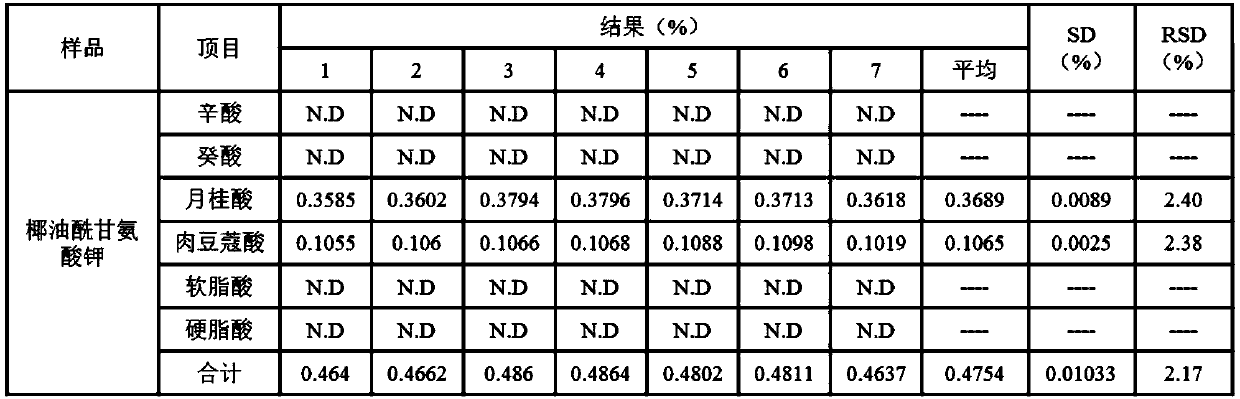
[0075] The fatty acid residual repeatability data measured in the same batch of cocoyl alanine sodium are as follows:
[0076]
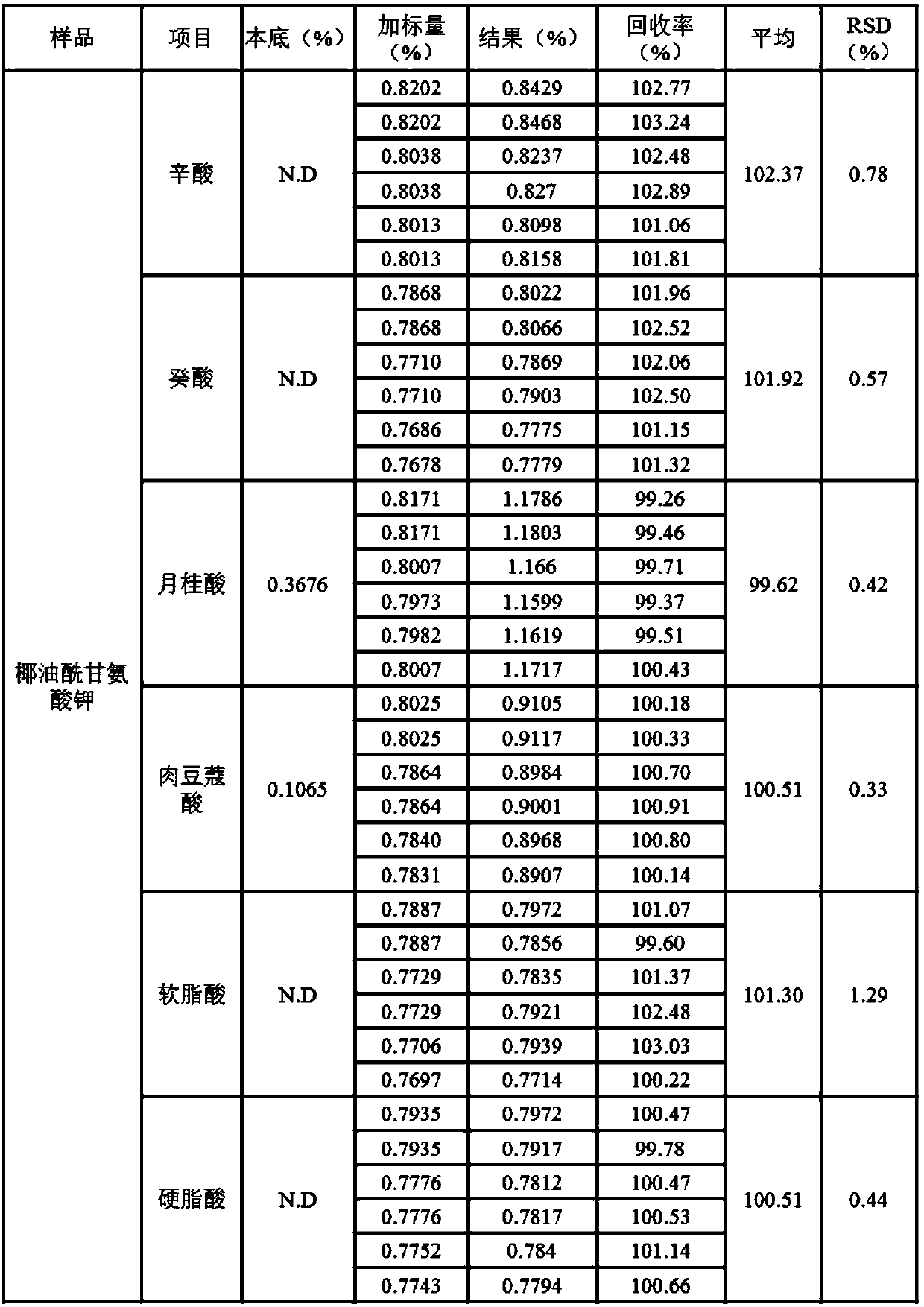
[0077] The data of recovery rate of standard addition are as follows:
[0078]
the structure of the environmentally friendly knitted fabric provided by the present invention; figure 2 Flow chart of the yarn wrapping machine for environmentally friendly knitted fabrics and storage devices; image 3 Is the parameter map of the yarn covering machine
Login to View More
PUM
Property
Measurement
Unit
concentration
aaaaa
aaaaa
Login to View More
Abstract
The invention discloses a method for detecting fatty acid residue in an amino acid surfactant; the method comprises: acidifying the surfactant with an inorganic acid; extracting organic matters by using C18 SPE (solid phase extraction) micro-column, and eluting the organic matters from the micro-column by using an organic solvent; using 2-bromoacetophenone solution and organic amine as derivatization reagents to carry out derivatization and eluting to obtain organic matters; carrying out HPLC (high performance liquid chromatography) analysis. The method of the invention is low in time consumption, simple to perform, high in accuracy, independent of fatty acid type, and applicable to the fatty acid residue detection for all amino acid surfactants.
Description
technical field [0001] The invention relates to the technical field of analysis and detection, in particular to a liquid-phase detection method for fatty acid residues in amino acid surfactants. Background technique [0002] The most widely used amino acid surfactants on the market are mainly anionic. It is very mild and has excellent foaming ability, and is widely used in personal care products such as shampoos, body washes, and facial cleansers. Suitable for sensitive skin, the skin feels soft and comfortable after use. [0003] At present, the industry adopts Schotten-Baunmann (Schotten-Baunmann) condensation method to produce amino acid surfactants, that is, fatty acyl chlorides and amino acids are reacted in alkaline water / hydrophilic organic solvent mixed phase to obtain fatty acyl amino acid salts. Then the fatty acylamino acid is separated by acidification with inorganic acid, and then neutralized with alkali to become a relatively pure fatty acylamino acid salt. ...
Claims
the structure of the environmentally friendly knitted fabric provided by the present invention; figure 2 Flow chart of the yarn wrapping machine for environmentally friendly knitted fabrics and storage devices; image 3 Is the parameter map of the yarn covering machine
Login to View More
Application Information
Patent Timeline
Application Date:The date an application was filed.
Publication Date:The date a patent or application was officially published.
First Publication Date:The earliest publication date of a patent with the same application number.
Issue Date:Publication date of the patent grant document.
PCT Entry Date:The Entry date of PCT National Phase.
Estimated Expiry Date:The statutory expiry date of a patent right according to the Patent Law, and it is the longest term of protection that the patent right can achieve without the termination of the patent right due to other reasons(Term extension factor has been taken into account ).
Invalid Date:Actual expiry date is based on effective date or publication date of legal transaction data of invalid patent.



 Login to View More