
Method for constructing half adder and half subtracter based on interaction between cyanine dye and metal ions
A technology of metal ions and cyanine dyes, applied in the field of constructing half-adders and half-subtractors based on the interaction between cyanine dyes and metal ions, to achieve the effect of reducing the size of the computer, overcoming overheating and cross-interference, and improving the computing speed
- Summary
- Abstract
- Description
- Claims
- Application Information
AI Technical Summary
Problems solved by technology
Method used
Image

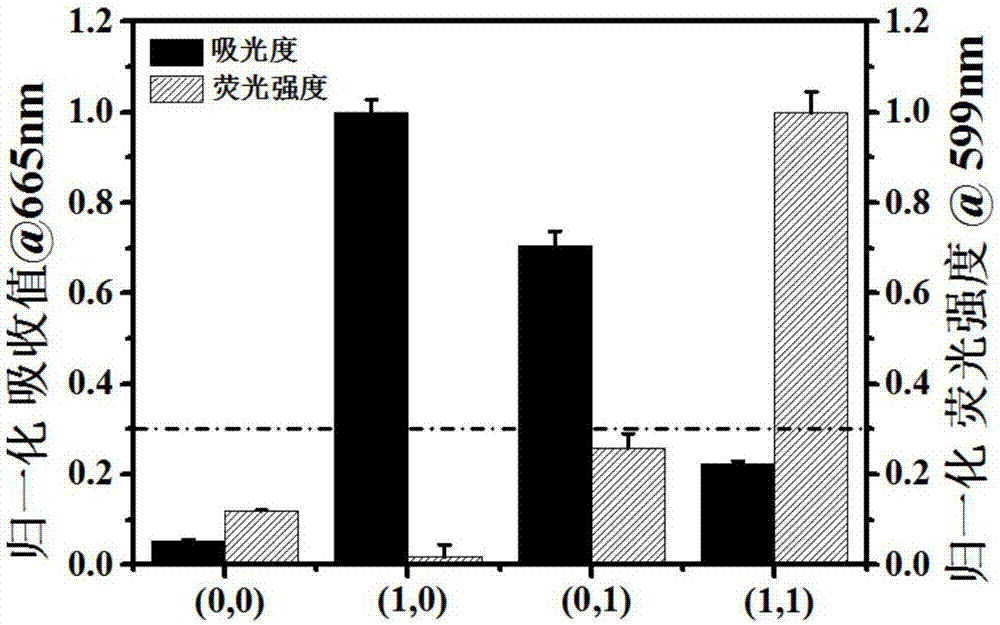
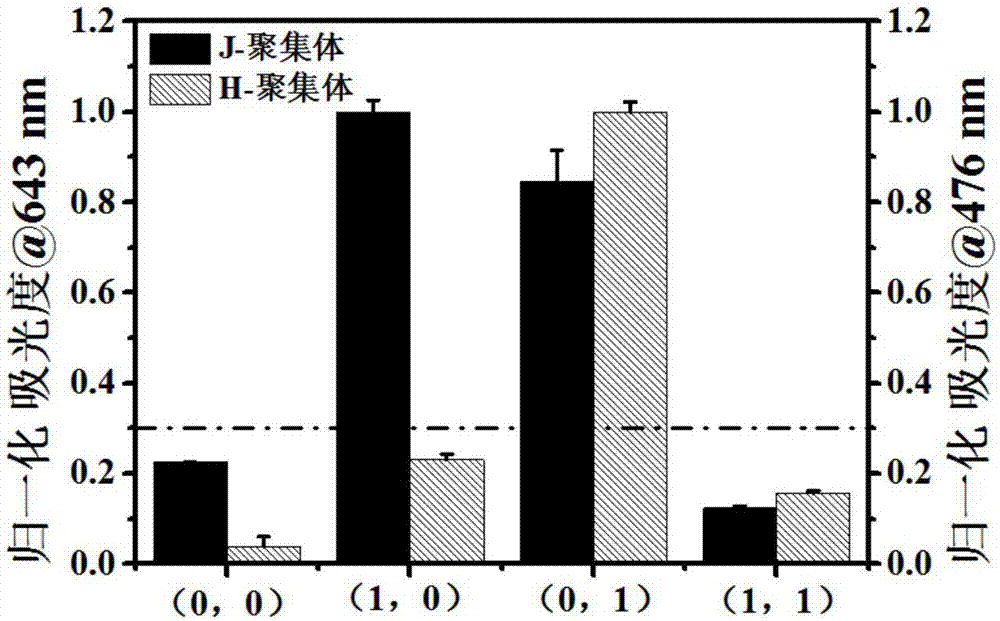
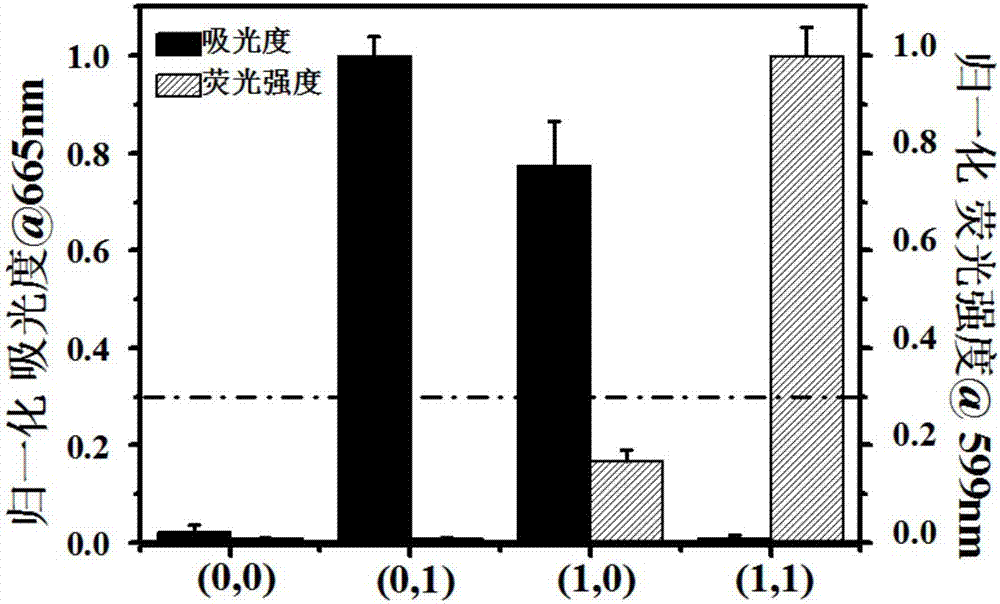
Examples
Embodiment 1
[0032] (1) Build a half adder
[0033] Take four EP tubes, numbered 1, 2, 3 and 4, and do the following:
[0034] Add 30 μL to tube 1 with a concentration of 50×10 -6 mol / L DNA duplex, and then add 20 μL concentration of 100×10 -6 mol / L cyanine dye I solution, finally add 5×10 -3 mol / L, Tris-HCl buffer solution with pH=8.5, make the solution volume 1mL to obtain solution 1;
[0035] Add 30 μL to the No. 2 tube with a concentration of 50×10 -6 mol / L DNA double strand and 10 μL KCl solution with a concentration of 0.5 mol / L, and then add 20 μL with a concentration of 100×10 -6 mol / L cyanine dye I solution, finally add 5×10 -3 mol / L, Tris-HCl buffer solution with pH=8.5, make the solution volume 1mL to obtain solution 2;
[0036] Add 30 μL to the No. 3 tube with a concentration of 50×10 -6 mol / L DNA duplex, and then add 20 μL concentration of 100×10 -6 mol / L cyanine dye I solution, finally add 5×10 -3 mol / L, Tris-HCl buffer solution with pH=4.0, make the solution volume ...
Embodiment 2
[0075] (1) Build a half adder
[0076] Take four EP tubes, numbered 1, 2, 3 and 4, and do the following:
[0077] Add 30 μL to the No. 1 tube with a concentration of 100×10 -6 mol / L DNA duplex, and then add 20 μL concentration of 200×10 -6 mol / L cyanine dye III solution, finally add 10×10 -3 mol / L, Tris-HCl buffer solution with pH=8.5, make the solution volume 1mL to obtain solution 1;
[0078] Add 30 μL to tube 2 with a concentration of 100×10 -6 mol / L DNA double strand and 20 μL KCl solution with a concentration of 1.0 mol / L, and then add 20 μL with a concentration of 200×10 -6 mol / L cyanine dye III solution, finally add 10×10 -3 mol / L, Tris-HCl buffer solution with pH=8.5, make the solution volume 1mL to obtain solution 2;
[0079] Add 30 μL to tube 3 with a concentration of 100×10 -6 mol / L DNA duplex, and then add 20 μL concentration of 200×10 -6 mol / L cyanine dye III solution, finally add 10×10 -3 mol / L, Tris-HCl buffer solution with pH=4.0, make the solution vol...
PUM
 Login to View More
 Abstract
Description
Claims
Application Information
 Login to View More