Self-adaptive feedforward active noise reduction method based on neural network, computer readable storage medium and electronic equipment

A technology of active noise reduction and neural network, applied in the field of electronic equipment, adaptive feedforward active noise reduction, and computer-readable storage media, to achieve good control, accurate estimation, and improvement of harmonic and intermodulation distortion effects

CN110889197AActive Publication Date: 2020-03-17COSONIC INTELLIGENT TECH CO LTD
5 Cites 4 Cited by

Patent Information

Authority / Receiving Office
CN · China
Patent Type
Applications(China)
Current Assignee / Owner
Publication Date
2020-03-17

Smart Images

  • Figure 1
    Figure 1
  • Figure 2
    Figure 2
  • Figure 3
    Figure 3
Patent Text Reader

Abstract

The invention relates to a self-adaptive feedforward active noise reduction method based on a neural network, a computer readable storage medium and electronic equipment. The method is used for improving conditions of harmonic waves and intermodulation distortion generated by a link, and comprises the following steps: constructing a first neural network model, and based on an adaptive feedforwardactive noise reduction architecture, taking the constructed first neural network model as a feedforward filter in the architecture; and / or constructing a second neural network model, based on the adaptive feedforward active noise reduction architecture, using the second neural network model as a secondary channel estimate S '(z) in the architecture.
Need to check novelty before this filing date? Find Prior Art

Description

technical field

[0001] The invention relates to earphone noise reduction, in particular to an adaptive feedforward active noise reduction method based on a neural network, a computer-readable storage medium, and an electronic device. Background technique

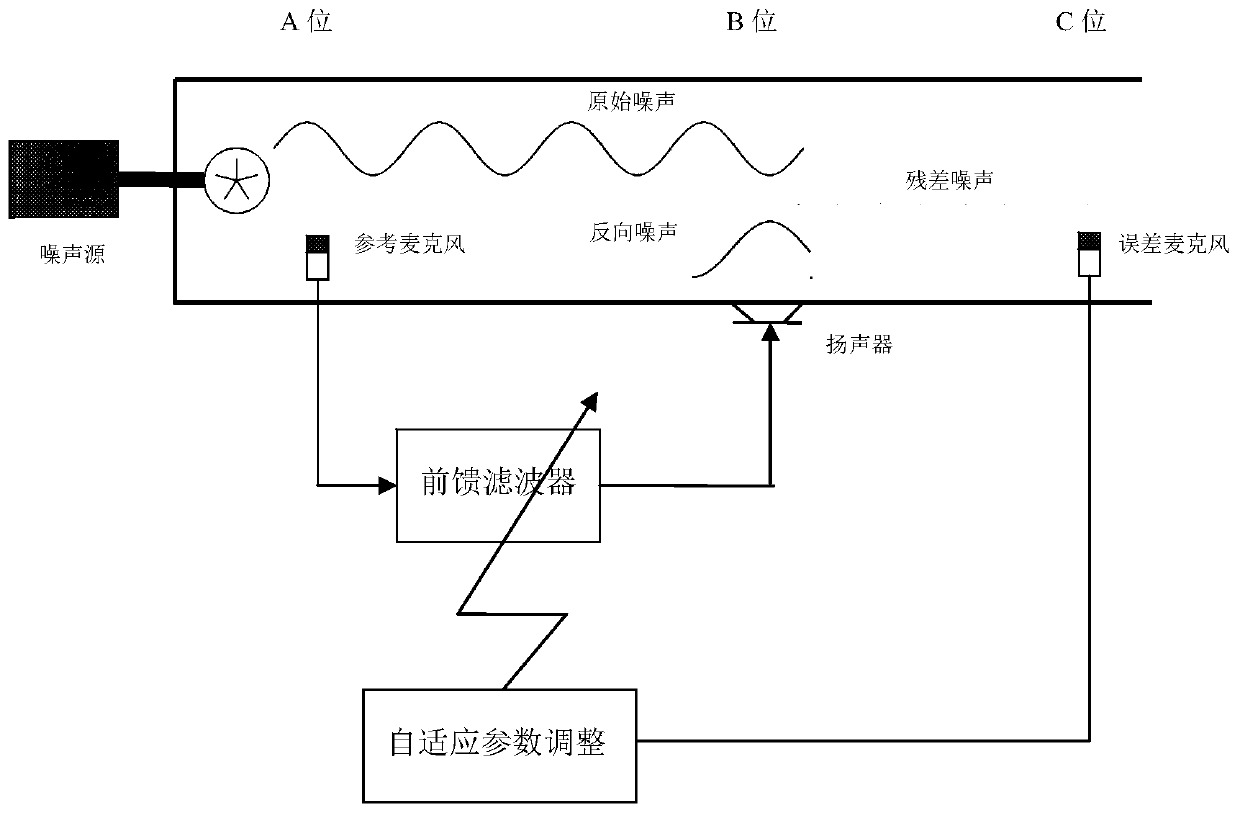
[0002] See figure 1 , the basic principle of the adaptive feedforward active noise reduction architecture in the earphone is as follows: at the A position, the reference microphone picks up the original noise signal in the environment, and the signal reversed to the original noise signal is generated through the feedforward filter (referred to as reverse noise signal), and then the reverse noise signal is output through the loudspeaker at the B position, so that the original noise signal and the reverse noise signal cancel each other at the B position to generate a residual noise signal. The above process is an adaptive feedforward active noise reduction.

[0003] On the basis of adaptive feed-forward active noise reducti...

Examples

Embodiment Construction

[0045] Exemplary embodiments of the present disclosure will be described in more detail below with reference to the accompanying drawings. Although exemplary embodiments of the present disclosure are shown in the drawings, it should be understood that the present disclosure may be embodied in various forms and should not be limited by the embodiments set forth herein. Rather, these embodiments are provided for more thorough understanding of the present disclosure and to fully convey the scope of the present disclosure to those skilled in the art.

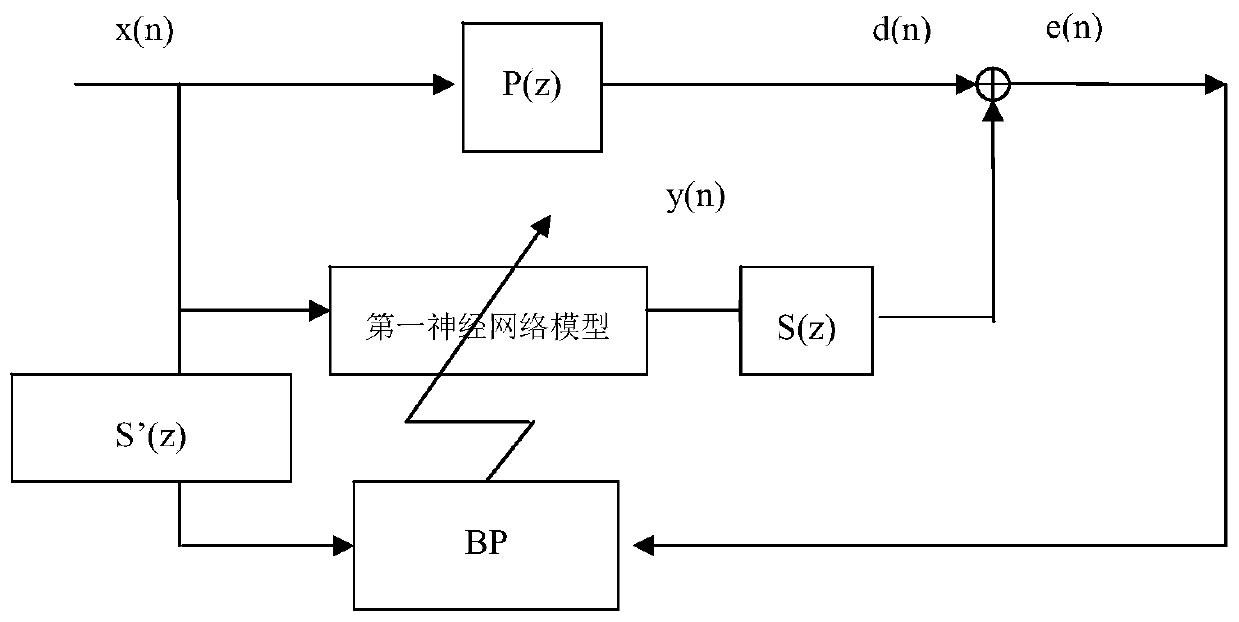
[0046] There is a nonlinear link in the propagation path from the A-position noise source to the B-position speaker. For example, if the original noise is too large, the reference microphone is nonlinear. If the feedforward filter can use a nonlinear filter, it can better deal with the noise. control, and the neural network is a nonlinear controller, based on this, the neural network can be used to realize the feed-forward filter to...