Unlock instant, AI-driven research and patent intelligence for your innovation.

Source-load collaborative distributed optimization regulation and control method based on consistency algorithm

A consistent and distributed technology, applied in the direction of reducing/preventing power oscillation, can solve problems such as the dynamic imbalance of supply and demand power, and the inability to achieve fully distributed algorithms, so as to achieve real-time optimal scheduling, fully distributed optimization, and real-time optimization. The effect of power flexibility dynamic balance

Inactive Publication Date: 2020-04-17
SHANGHAI UNIVERSITY OF ELECTRIC POWER
View PDF1 Cites 6 Cited by
  • Summary
  • Abstract
  • Description
  • Claims
  • Application Information

AI Technical Summary

Problems solved by technology

[0003] Many mainstream consensus algorithms cannot realize the complete distribution of the algorithm, nor can they deal with the dynamic unbalance problem of supply and demand power in the "source-load" coordination in the active distribution network.

Method used

the structure of the environmentally friendly knitted fabric provided by the present invention; figure 2 Flow chart of the yarn wrapping machine for environmentally friendly knitted fabrics and storage devices; image 3 Is the parameter map of the yarn covering machine
View more

Image

Smart Image Click on the blue labels to locate them in the text.
Viewing Examples
Smart Image
  • Source-load collaborative distributed optimization regulation and control method based on consistency algorithm
  • Source-load collaborative distributed optimization regulation and control method based on consistency algorithm
  • Source-load collaborative distributed optimization regulation and control method based on consistency algorithm

Examples

Experimental program
Comparison scheme
Effect test

Embodiment

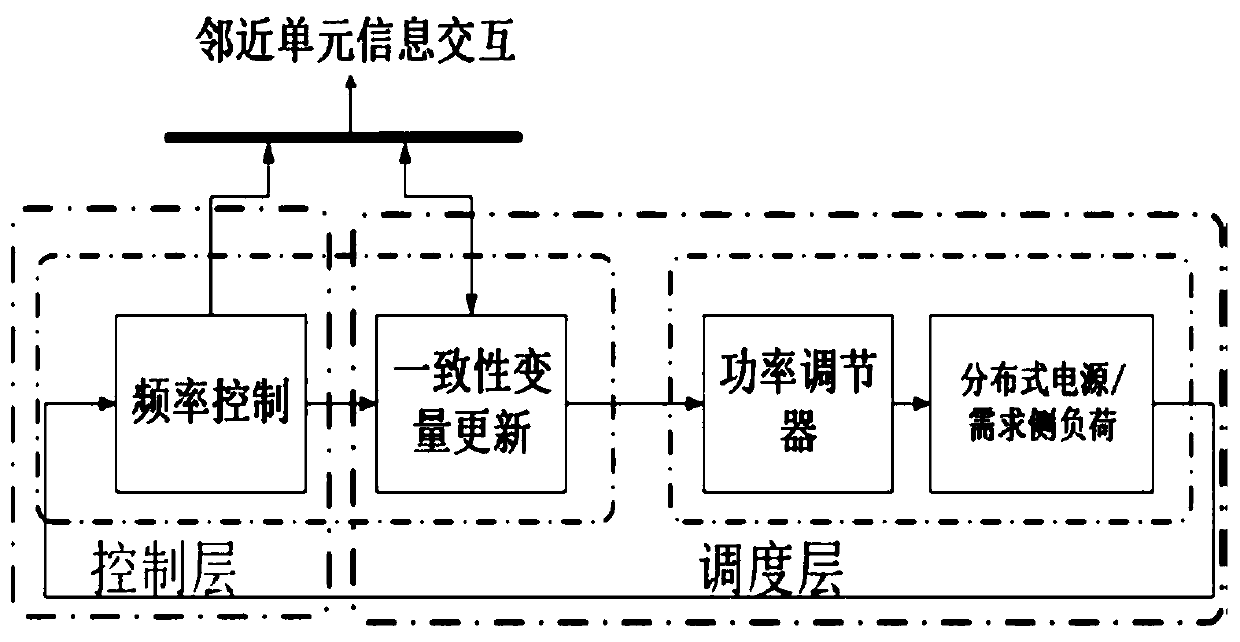
[0035] The present invention provides a source-load collaborative distributed optimization control method based on a consensus algorithm, comprising the following steps:

[0036] Step 1. Set the initial value. The distributed power source equipped with a phase-locked loop PLL obtains the initial frequency deviation, and at the same time calculates the initial value of the consistent incremental cost of each distributed unit. Calculate the Laplacian matrix and state transition matrix D according to the network communication topology;

[0037] Step 2. According to the state transition matrix D, update the consistent state variable of each distributed power source, that is, the incremental cost value, and update the output and frequency deviation of each distributed unit;

[0038] Step 3, judging whether the updated distributed unit power is within the constraint range. If it exceeds the constraint range, the distributed unit operates at the maximum or minimum constraint power,...

the structure of the environmentally friendly knitted fabric provided by the present invention; figure 2 Flow chart of the yarn wrapping machine for environmentally friendly knitted fabrics and storage devices; image 3 Is the parameter map of the yarn covering machine
Login to View More

PUM

No PUM Login to View More

Abstract

The invention relates to a source-load collaborative distributed optimization regulation and control method based on a consistency algorithm, and the method comprises the following steps: 1), taking the incremental cost of each distributed unit in an autonomous region of an active power distribution network as a consistency state variable [lambda], and obtaining a state transition matrix D according to a network communication topological structure; 2) updating the consistency state variable of each distributed unit and calculating the power and frequency deviation of each distributed unit in the current step; 3) when the power of the distributed unit exceeds a set constraint range, updating the consistency state variable, otherwise, carrying out the step 4); 4) when the frequency deviationof each distributed unit in the current step exceeds a set constraint range, taking the power of each distributed power supply at the moment as the optimum, otherwise, carrying out the step 5); and 5) returning to the step 1) after the consistency is updated and a correction factor is regulated and controlled. Compared with the prior art, the method has the advantages that the method adapts to asource-load bidirectional uncertainty scene, and the consistency regulation and control correction coefficient is self-adaptive.

Description

technical field [0001] The invention relates to the technical field of distributed optimal scheduling of active distribution networks, in particular to a source-load collaborative distributed optimal control method based on a consensus algorithm. Background technique [0002] With the continuous improvement of the penetration rate of renewable energy in the active distribution network, wind power and photovoltaics on the "source" side have intermittent and fluctuating characteristics, while the "load" side includes temperature-controlled loads, electric vehicles and other new loads. The emergence of active distribution network makes the active distribution network present the characteristics of "source-load" bidirectional uncertainty, which puts forward higher requirements for the real-time power balance of the active distribution network, and increases the difficulty of dispatching and control of the active distribution network. At present, there are mainly two types of sch...

Claims

the structure of the environmentally friendly knitted fabric provided by the present invention; figure 2 Flow chart of the yarn wrapping machine for environmentally friendly knitted fabrics and storage devices; image 3 Is the parameter map of the yarn covering machine
Login to View More

Application Information

Patent Timeline
no application Login to View More
Patent Type & Authority Applications(China)
IPC IPC(8): H02J3/24
CPCH02J3/24
Inventor 边晓燕孙明琦董璐吴振华赵健王小宇
Owner SHANGHAI UNIVERSITY OF ELECTRIC POWER