
Preparation method and application of thyroxine-releasing hormone
A thyroid-stimulating hormone and hormone-releasing technology, which is applied to peptide preparation methods, chemical instruments and methods, and bulk chemical production, can solve problems such as difficulty in realizing industrialized production and large safety hazards, and achieve short process cycles and no safety hazards. risk effect
- Summary
- Abstract
- Description
- Claims
- Application Information
AI Technical Summary
Problems solved by technology
Method used
Image



Examples
preparation example Construction
[0079] In the step of preparing Z-pGlu-His-OH provided by the present invention, a large amount of purified water is used in the later stage to fully remove Cl - And His impurities, so that the next step to form Z-pGlu-His-Pro-NH 2 The reaction rate is greatly improved, and the target peptide content is increased. The reaction solution obtained before concentration under reduced pressure was filtered to remove the main impurity DCU. After a small amount of acetonitrile is dissolved, the concentration and purity of the target peptide in the acetonitrile solution are relatively high, which meets the basic requirements of the crystallization process.
[0080] In some preferred embodiments, hydrogenolysis of Z-pGlu-His-Pro-NH 2 The steps include:
[0081] To Z-pGlu-His-Pro-NH 2 H in the solution 2 , was detected by TLC to complete the reaction, filtered, and concentrated to dryness under reduced pressure to obtain the thyrotropin-releasing hormone.
[0082] In order to furth...
Embodiment 1
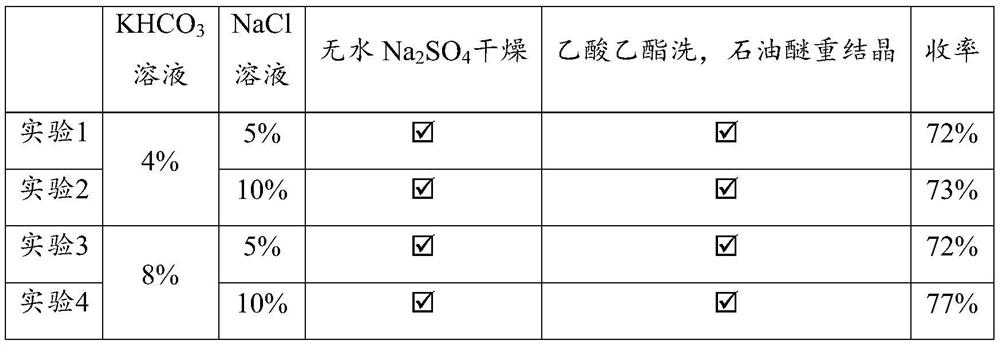
[0101] Example 1 Parameter optimization and screening for the preparation of Z-pGlu-ONB
[0102] An intermediate product was obtained which was dissolved in ethyl acetate.
[0103] Experiment 1: 4% KHCO 3 solution and 5% NaCl solution were washed three times each, Na 2 SO 4 Dry for 8 to 24 hours, filter, wash with ethyl acetate, and recrystallize petroleum ether.
[0104] Experiment 2: 4% KHCO 3 solution and 10% NaCl solution were washed three times each, Na 2 SO 4 Dry for 8 to 24 hours, filter, wash with ethyl acetate, and recrystallize petroleum ether.
[0105] Experiment 3: 8% KHCO 3 solution and 5% NaCl solution were washed three times each, Na 2 SO 4 Dry for 8 to 24 hours, filter, wash with ethyl acetate, and recrystallize petroleum ether.
[0106] Experiment 4: 8% KHCO 3 solution and 10% NaCl solution were washed three times each, Na 2 SO 4 Dry for 8 to 24 hours, filter, wash with ethyl acetate, and recrystallize petroleum ether.
[0107] Experiment 5: ...
Embodiment 2
[0114] Embodiment 2 docking dipeptide procedure carries out monitoring reaction
[0115]
[0116] Experiment 8: Weigh 19.43 grams of L-His, dissolve in 325ml of water, and add KHCO 3 14.54 g was stirred to dissolve.
[0117] Take 46 grams of the product Z-pGlu-ONB obtained in Experiment 7, dissolve it in 380ml of acetonitrile, add it to the above-mentioned L-His-OK aqueous solution, and stir at 30°C for 24 hours. After the Z-pGlu-ONB point disappears under TLC monitoring, at 40°C, Under the condition of -0.09MPa~-0.1MPa, concentrate under reduced pressure to a small volume, adjust the pH to about 6 with 2mol / L HCl under ice bath cooling, place at 2~10℃ for 8~24 hours, filter, and wash the product with ice-purified water to no Cl - and His, set P 2 o 5 After drying in a desiccator, 48.4 g of the product was obtained, with a yield of 73%.
[0118] Experiment 9: Weigh 10 grams of L-His, dissolve in 162ml of water, and add KHCO 3 7.2 g was stirred to dissolve.
[0119]...
PUM
 Login to View More
 Abstract
Description
Claims
Application Information
 Login to View More