Optical imaging lens
An optical imaging lens and lens technology, applied in optics, optical components, instruments, etc., can solve the problems of long overall length, hinder the miniaturization of smartphones, and limit the miniaturization of optical imaging lenses, so as to optimize optical parameters and miniaturize imaging. Quality, the effect of good imaging quality
- Summary
- Abstract
- Description
- Claims
- Application Information
AI Technical Summary
Problems solved by technology
Method used
Image



Examples
Embodiment 1
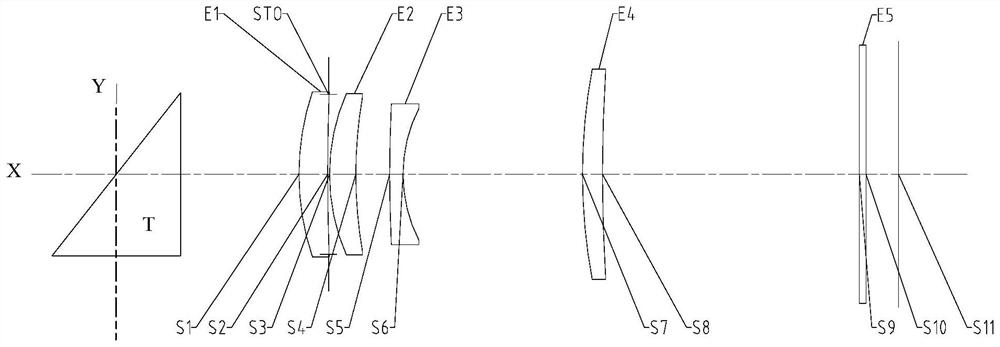
[0084] Refer to the following Figure 1 to Figure 2D The optical imaging lens according to Embodiment 1 of the present application is described. figure 1 A schematic structural diagram of the optical imaging lens according to Embodiment 1 of the present application is shown.
[0085] like figure 1 As shown, the optical imaging lens sequentially includes, from the object side to the image side: a prism T, a first lens E1, a diaphragm STO, a second lens E2, a third lens E3, a fourth lens E4, a filter E5 and an imaging surface S11.
[0086] The prism T has a light incident surface, a light reflection surface, and a light exit surface. The first lens E1 has positive refractive power, the object side S1 is convex, and the image side S2 is concave. The second lens E2 has positive refractive power, the object side S3 is convex, and the image side S4 is concave. The third lens E3 has negative refractive power, the object side S5 is convex, and the image side S6 is concave. The f...
Embodiment 2
[0098] Refer to the following Figures 3 to 4D The optical imaging lens according to Embodiment 2 of the present application is described. In this embodiment and the following embodiments, descriptions similar to those in Embodiment 1 will be omitted for the sake of brevity. image 3 A schematic structural diagram of the optical imaging lens according to Embodiment 2 of the present application is shown.
[0099] like image 3 As shown, the optical imaging lens sequentially includes, from the object side to the image side: a prism T, a first lens E1, a diaphragm STO, a second lens E2, a third lens E3, a fourth lens E4, a filter E5 and an imaging surface S11.
[0100] The prism T has a light incident surface, a light reflection surface, and a light exit surface. The first lens E1 has positive refractive power, the object side S1 is convex, and the image side S2 is convex. The second lens E2 has positive refractive power, the object side S3 is convex, and the image side S4 i...
Embodiment 3
[0109] Refer to the following Figures 5 to 6D The optical imaging lens according to Embodiment 3 of the present application is described. Figure 5 A schematic structural diagram of the optical imaging lens according to Embodiment 3 of the present application is shown.
[0110] like Figure 5 As shown, the optical imaging lens sequentially includes, from the object side to the image side: a prism T, a first lens E1, a diaphragm STO, a second lens E2, a third lens E3, a fourth lens E4, a filter E5 and an imaging surface S11.
[0111] The prism T has a light incident surface, a light reflection surface, and a light exit surface. The first lens E1 has positive refractive power, the object side S1 is convex, and the image side S2 is concave. The second lens E2 has positive refractive power, the object side S3 is convex, and the image side S4 is concave. The third lens E3 has negative refractive power, the object side S5 is convex, and the image side S6 is concave. The fourt...
PUM
 Login to View More
 Abstract
Description
Claims
Application Information
 Login to View More
 - R&D
- Intellectual Property
- Life Sciences
- Materials
- Tech Scout
- Unparalleled Data Quality
- Higher Quality Content
- 60% Fewer Hallucinations
Browse by: Latest US Patents, China's latest patents, Technical Efficacy Thesaurus, Application Domain, Technology Topic, Popular Technical Reports.
© 2025 PatSnap. All rights reserved.Legal|Privacy policy|Modern Slavery Act Transparency Statement|Sitemap|About US| Contact US: help@patsnap.com