
Cleaning nozzle
- Summary
- Abstract
- Description
- Claims
- Application Information
AI Technical Summary
Benefits of technology
Problems solved by technology
Method used
Image

Examples
Embodiment Construction
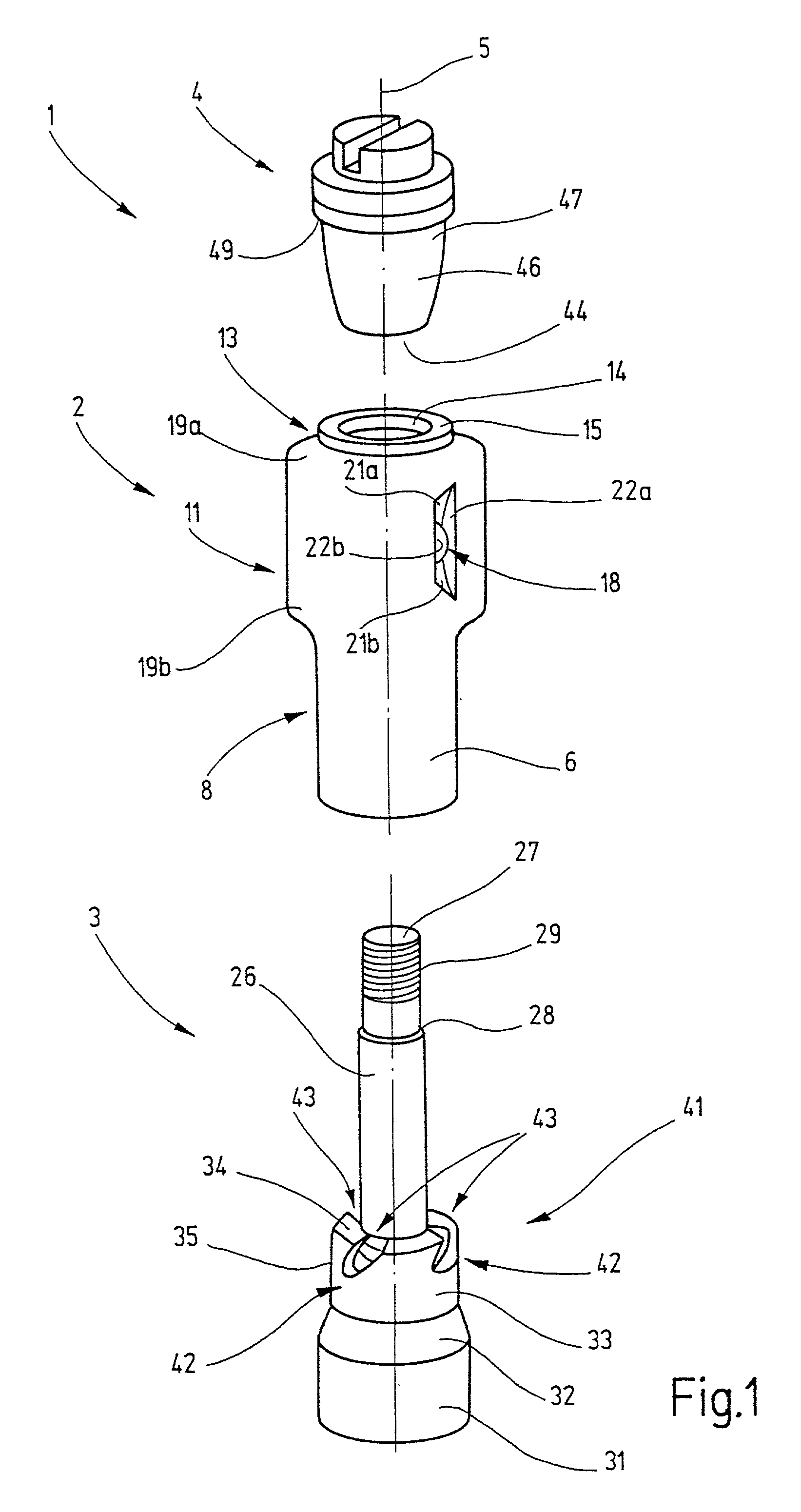
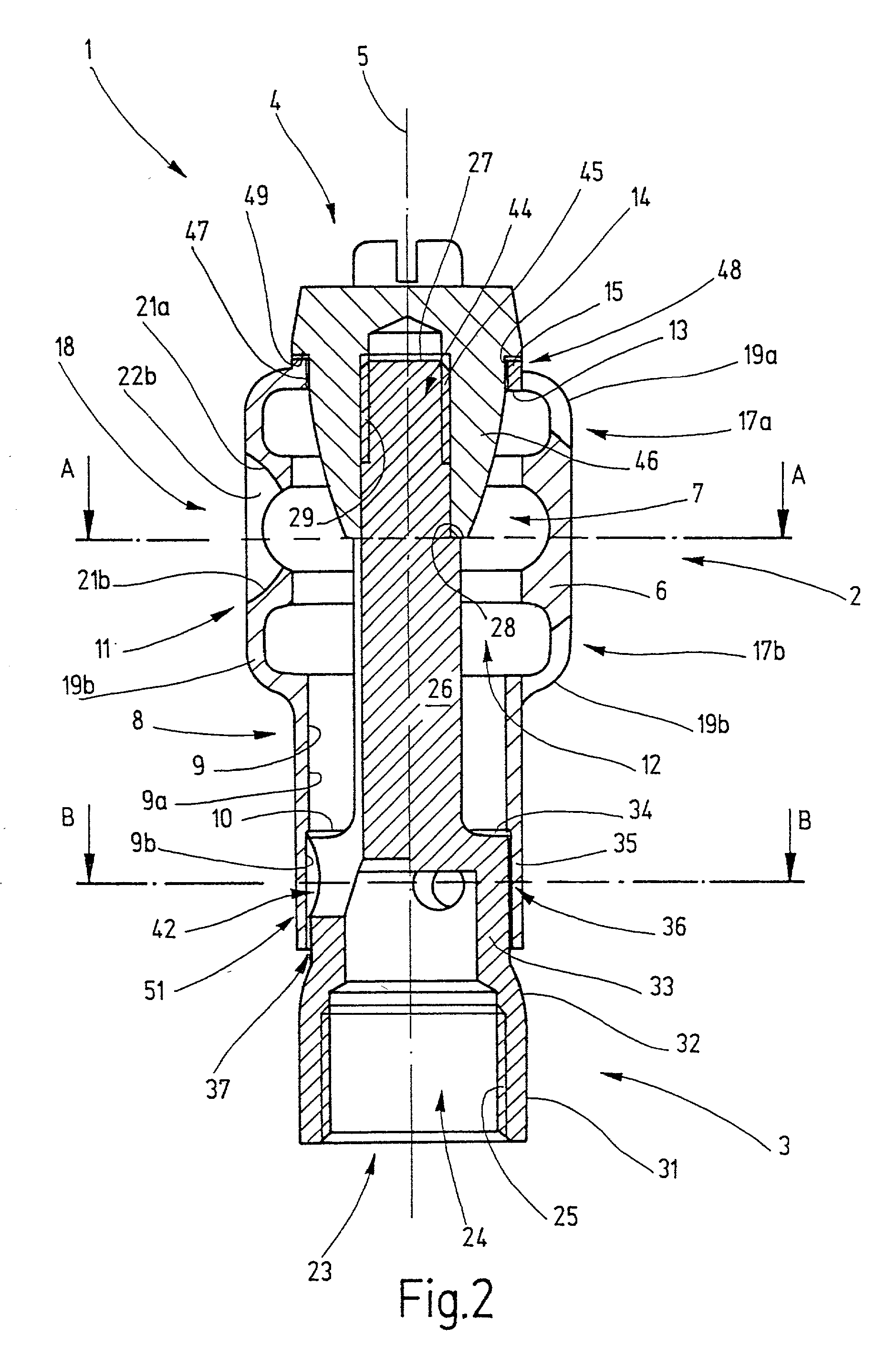
[0036] In FIGS. 1 and 2, a nozzle 1 according to the invention is shown, which serves for generating of a fan-shaped, radially outward-directed discharge jet. The nozzle 1 includes a nozzle body 2, which as shown in FIG. 2, is arranged between a bearing element 3 and a securing element 4 and on which the nozzle body is rotatably supported.
[0037] The nozzle body includes a cylindrical housing 6 that is substantially rotationally symmetrical with respect to the rotation axis 5 and includes a cylindrical interior space 7. On a first end facing away from the securing element 4, the housing 6 is constructed as a tubular neck 8 with a cylindrical inner circumferential surface 9. A radially inward-projecting shoulder 10 divides the cylindrical inner circumferential surface 9 into a first cylindrical section 9a and a second section 9b, which forms the free end of the neck 8 and has a somewhat larger inside diameter with respect to the section 9b.
[0038] The neck 8 transitions into a section ...
PUM
 Login to View More
 Abstract
Description
Claims
Application Information
 Login to View More