
Measuring probe for detecting agents and the measurement of their concentrations
a technology for measuring probes and detecting agents, applied in the direction of instruments, chemical methods analysis, material testing goods, etc., can solve the problems of reducing /hindrance or promotion of mobile charge carriers, etc., and achieves the reduction or increasing the number of mobile charge carriers. , the effect of high conductan
- Summary
- Abstract
- Description
- Claims
- Application Information
AI Technical Summary
Benefits of technology
Problems solved by technology
Method used
Image

Examples
Embodiment Construction
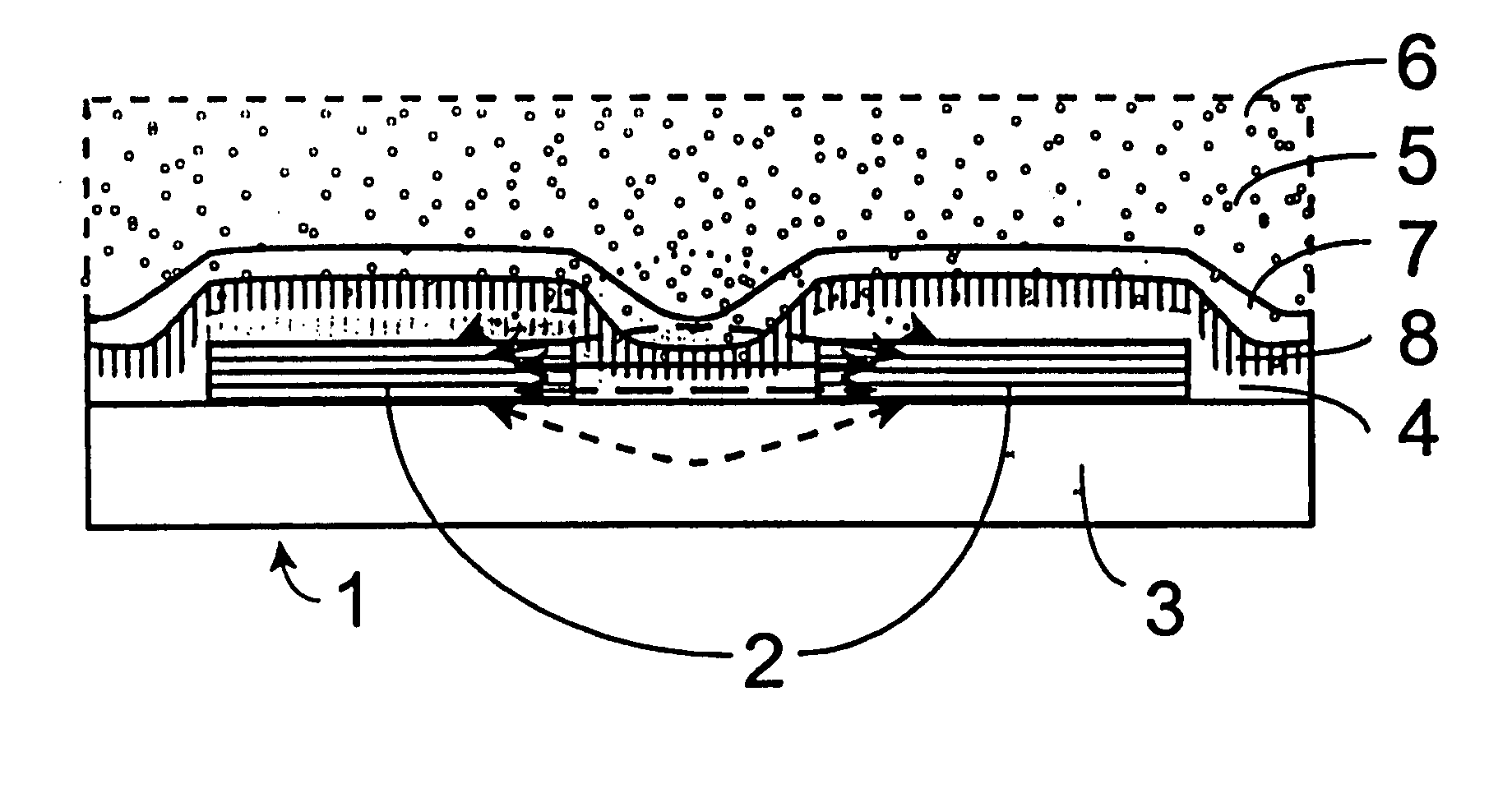
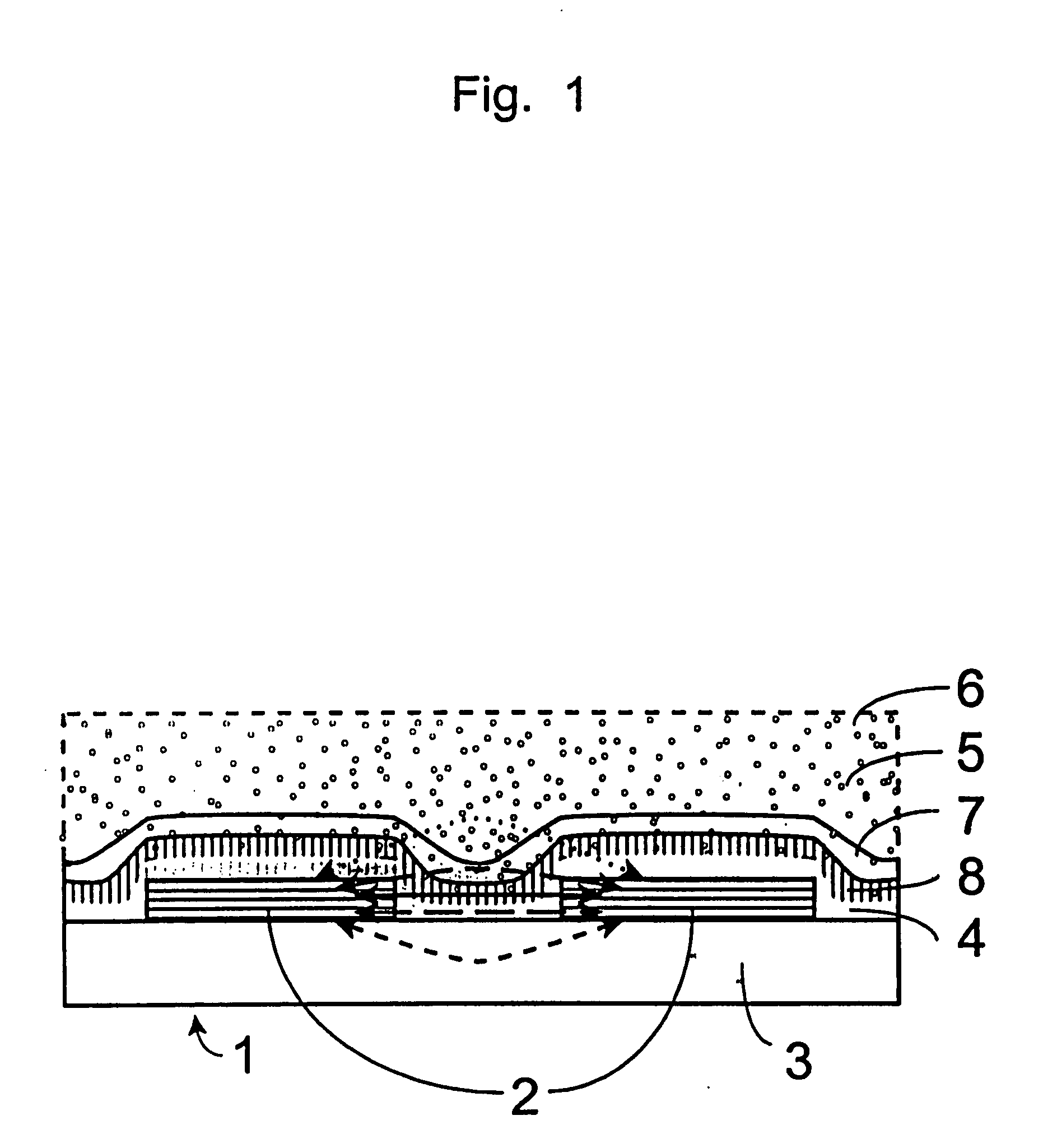
[0029] According to FIG. 1, a measuring probe 1 for agents in gases and / or liquids consists of a pair of electrodes 2, which are partially attached to a supporting material 3 and which are formed by raised sections or regions of the supporting material. A sensor-active solid layer 4 comprising a suitable solid substance is located above this surface structure. This solid layer 4 is not analyte-specific, does not absorb the agent molecules into it and does not react chemically with any of the agent molecules.
[0030] In particular this solid substance for the sensor-active solid layer 4 is an organic semiconductor in the form of a polymer, which reacts to the adsorption of certain agents 5 with a sufficient change in conductivity. The semiconductor polymer can be deposited as a polymer precursor fluid onto the surface structure, and can be tempered in-situ to yield the required polymeric species and chemical and physically functionality. A precursor, poly-2,5-furylene-hydroxy-ethylene...
PUM
| Property | Measurement | Unit |
|---|---|---|
| temperatures | aaaaa | aaaaa |
| resistances | aaaaa | aaaaa |
| concentrations | aaaaa | aaaaa |
Abstract
Description
Claims
Application Information
 Login to View More