

Electro-optical nucleic acid-based sensor array and method for detecting analytes
a sensor array and nucleic acid technology, applied in the field of electro-optical nucleic acid-based sensor array and method for detecting analytes, can solve the problems of inability to meet the needs of rapid analysis, inability to provide reliable, fast, easy and relatively cheap screening methods, and inability to collect sufficient material for preconcentration, etc., to achieve rapid response time, high throughput screening, and rapid sampling time
- Summary
- Abstract
- Description
- Claims
- Application Information
AI Technical Summary
Benefits of technology
Problems solved by technology
Method used
Image

Examples
example 1
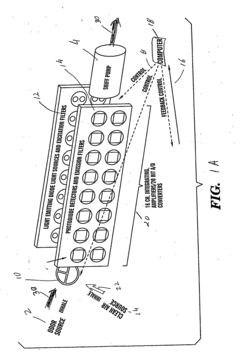
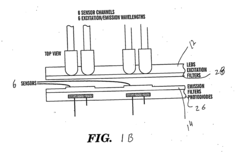
[0193] The portable EVID and a schematic overview of the EVID's sensing chamber, sensors, optical components, sniff mechanism, and computer control lines are shown in FIG. 1. The EVID uses an array of sensors that change their fluorescence intensity upon exposure to brief pulses of airborne analytes (e.g., “odorants”). The EVID in its present form contains 16 sensors that can be illuminated and observed at 16 different excitation and emission wavelengths. The'sensors are placed along a narrow chamber through which ambient air is drawn (see below). The optical elements for illuminating and monitoring the sensors are positioned along the sides of the chamber (FIG. 1B). Excitation light is produced by LEDs providing wavelengths appropriate for the sensors being used (e.g., 460 nm and 530 nm).
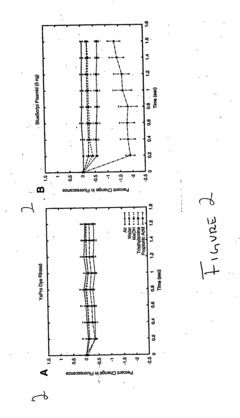
[0194] Dye-labeled DNA can act as an analyte sensor. As an initial test of whether DNA stained with a fluorescent dye responds to analytes, sensors were constructed from a standard 2.9 kb pBlueScr...
example2
[0201]
(SEQ ID NO: 1)LAPP1:5′ GAG TCT GTG GAG GAG GTA GTC 3′(SEQ ID NO: 2)LAPP2:5′ CTT CTG TCT TGA TGT TTG TCA ACC 3′(SEQ ID NO: 3)LAPPAS:5′ TTT GGC TTT CTG GAA ATG GGC 3′(SEQ ID NO: 4)LAJ001:5′ ACC AGG ACC TGA CTA AGC AGA T 3′
[0202] Oligomers LAPP1, LAPP2, LAPPAS, and LAJ001 were synthesized and labeled at the 5′ end with the fluorescent dye Cy3(tm) during synthesis (using Cy3(tm) phosphoramidite from Glen Research). The oligomers were stored in Tris-NaCl (10 mM Tris, 50 mM NaCl, pH 8) at 225 ng / ul, then diluted to a concentration of 50 ng / ul in distilled waterjust before use. Sensors were constructed by applying 20 ul of dilute oligomer solution to 10 mm×12 mm pieces of acid-washed 16xx silkscreen. Sensors were allowed to dry for at least 30 min at room temperature, then attached to supports for testing.
[0203] All sensors were mounted in the device and tested simultaneously. All were illuminated with excitation light at 540 nm (30nm bandwidth). Sensors made with LAPP1, LAPPAS, and...
example 3
[0205] The dye-labeled DNA-based sensors described above can be selected using the system described herein. The strategy for finding different DNA sequences that respond to different analytes takes advantage of modern high-throughput methods and equipment for examining large numbers of DNA interactions rapidly. An overview of the approach is shown in FIG. 5 and is detailed in the following sections.
[0206] Prior to a large-scale sensor screen, details of the steps shown in FIG. 5 are established through a series of pilot experiments. The appropriate sequence length is determined, the actual sensor template is designed, and the necessary amplification and labeling conditions are established for generating large numbers of random DNA sequences for use as sensors using the methods described elsewhere in the specification. The amount by which the full sequence library needs to be diluted for effective screening is also be determined by testing different dilutions.
[0207] Determine senso...
PUM
| Property | Measurement | Unit |
|---|---|---|
| concentration | aaaaa | aaaaa |
| concentration | aaaaa | aaaaa |
| concentration | aaaaa | aaaaa |
Abstract
Description
Claims
Application Information
 Login to View More