
Micro fluidic system for single molecule imaging
a fluidic system and single molecule technology, applied in the field of manipulating molecules, can solve the problems of difficult landmarking techniques, reducing the possibility of preserving the molecule for later additional or more complex analysis, and complicating the process
- Summary
- Abstract
- Description
- Claims
- Application Information
AI Technical Summary
Benefits of technology
Problems solved by technology
Method used
Image

Examples
Embodiment Construction
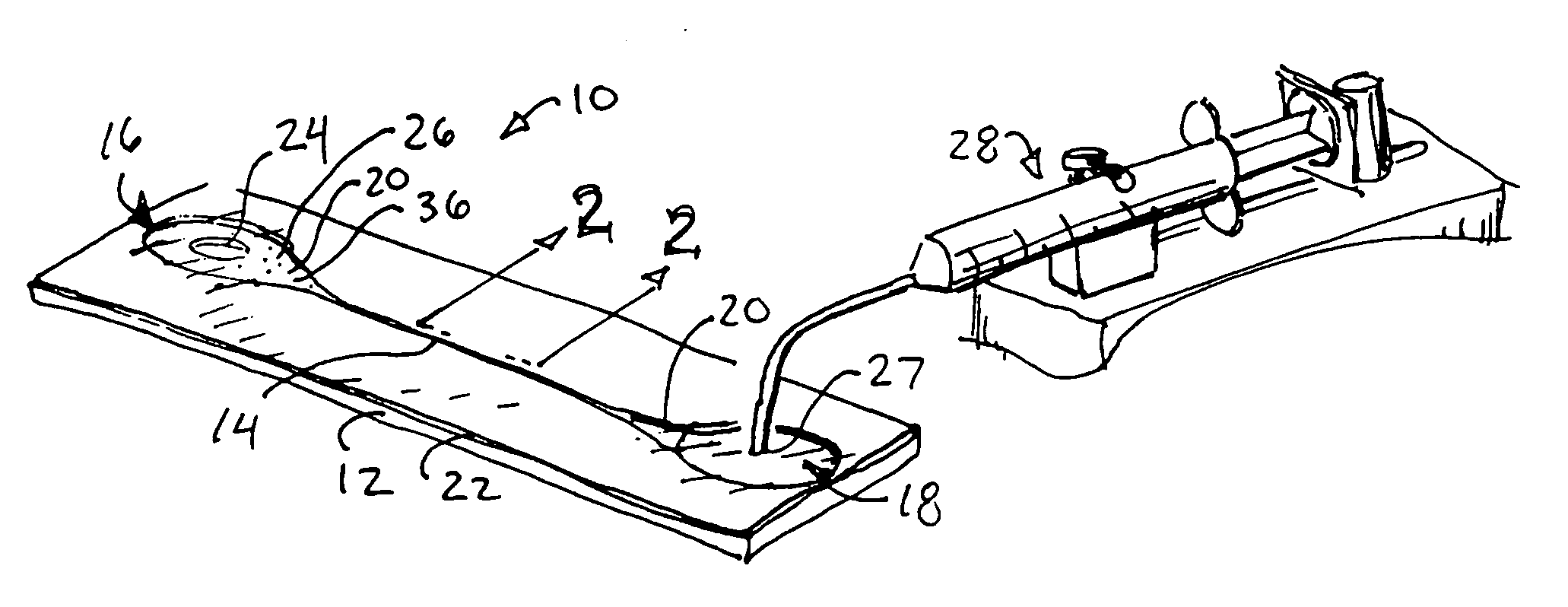
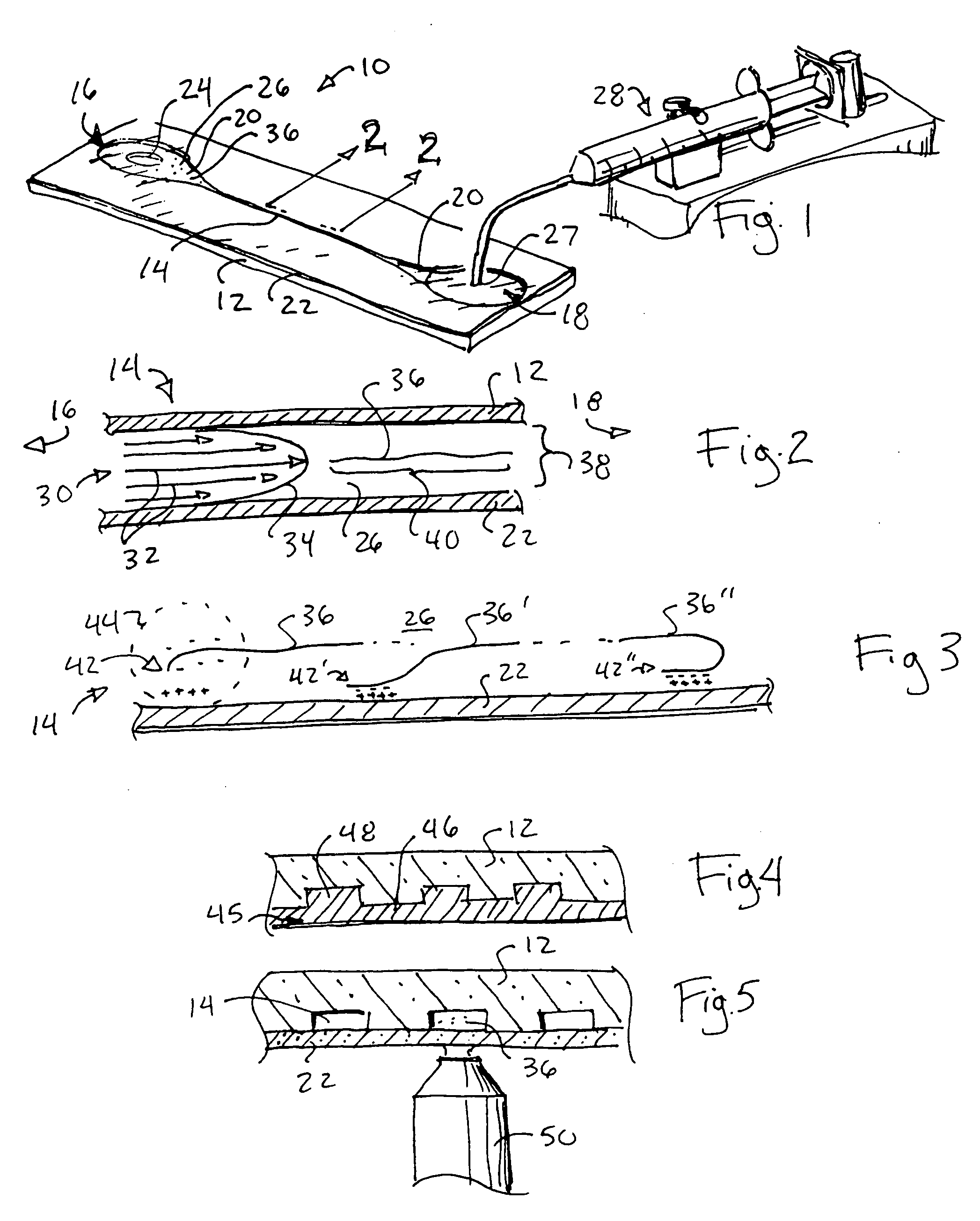
[0043] Referring now to FIG. 1, the apparatus 10 of the present invention provides a generally planar channel plate 12 into which a longitudinally extending micro-channel 14 is formed, flanked by a staging reservoir 16 and a collecting reservoir 18 positioned at longitudinal ends of the channel plate 12.
[0044] Junctions between the longitudinal ends of the micro-channel 14 and staging reservoir 16 and collecting reservoir 18 are tapered to create funnel sections with narrow ends attached to the micro-channel 14 and wide ends attached to one of the staging reservoir 16 or collecting reservoir 18. The funnel sections 20 provide a smooth transition of fluid from the staging reservoir 16 through the micro-channel 14 to the collecting reservoir 18 thereby promoting laminar flow within the micro-channel 14 and reducing breakage of polymeric molecules as will be described.
[0045] One common wall of the staging reservoir 16, the collecting reservoir 18, and the micro-channel 14 is provided...
PUM
| Property | Measurement | Unit |
|---|---|---|
| Time | aaaaa | aaaaa |
| Width | aaaaa | aaaaa |
| Length | aaaaa | aaaaa |
Abstract
Description
Claims
Application Information
 Login to View More