
Method and apparatus for patterned plasma-mediated laser trephination of the lens capsule and three dimensional phaco-segmentation
- Summary
- Abstract
- Description
- Claims
- Application Information
AI Technical Summary
Benefits of technology
Problems solved by technology
Method used
Image

Examples
Embodiment Construction
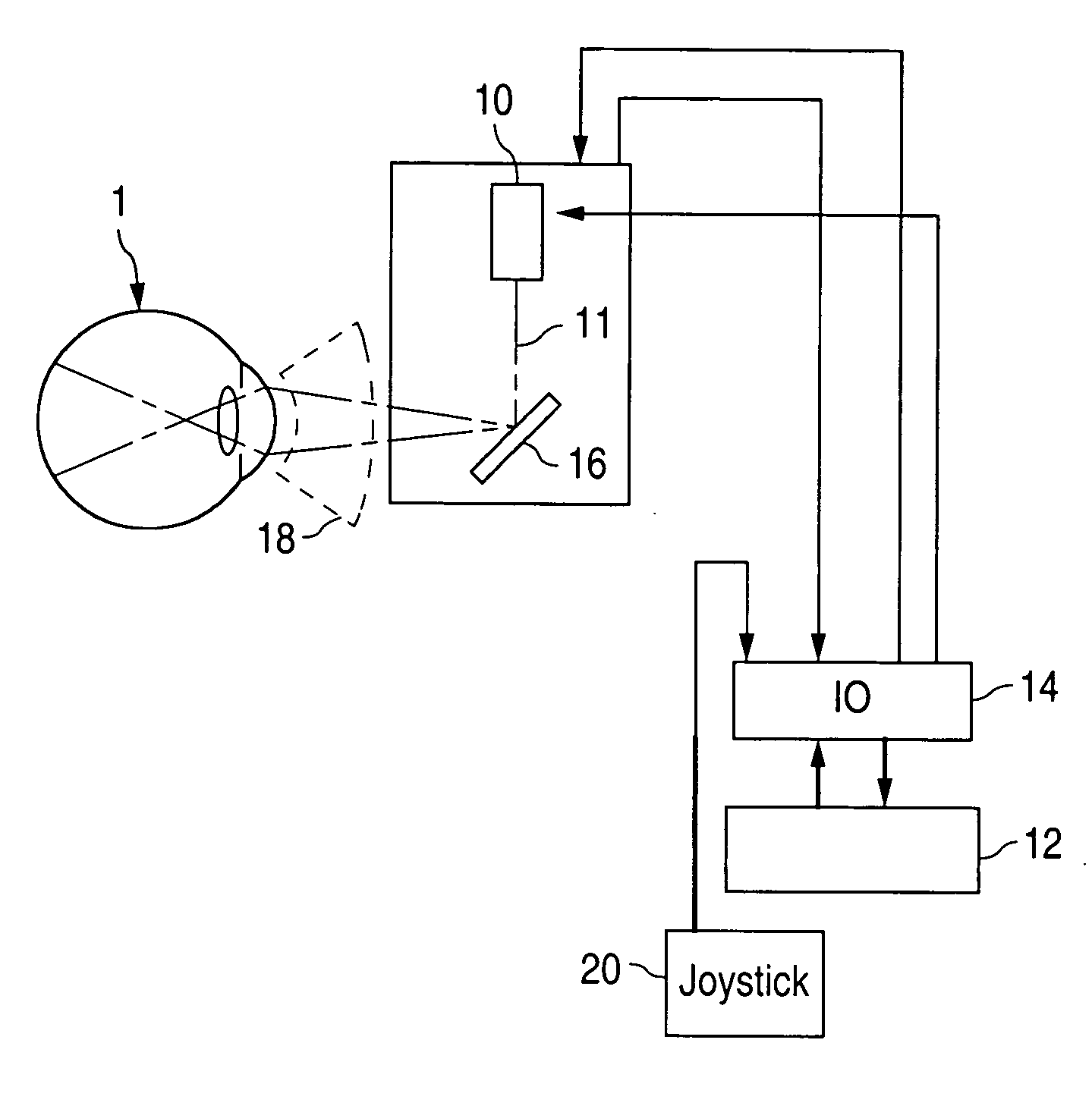
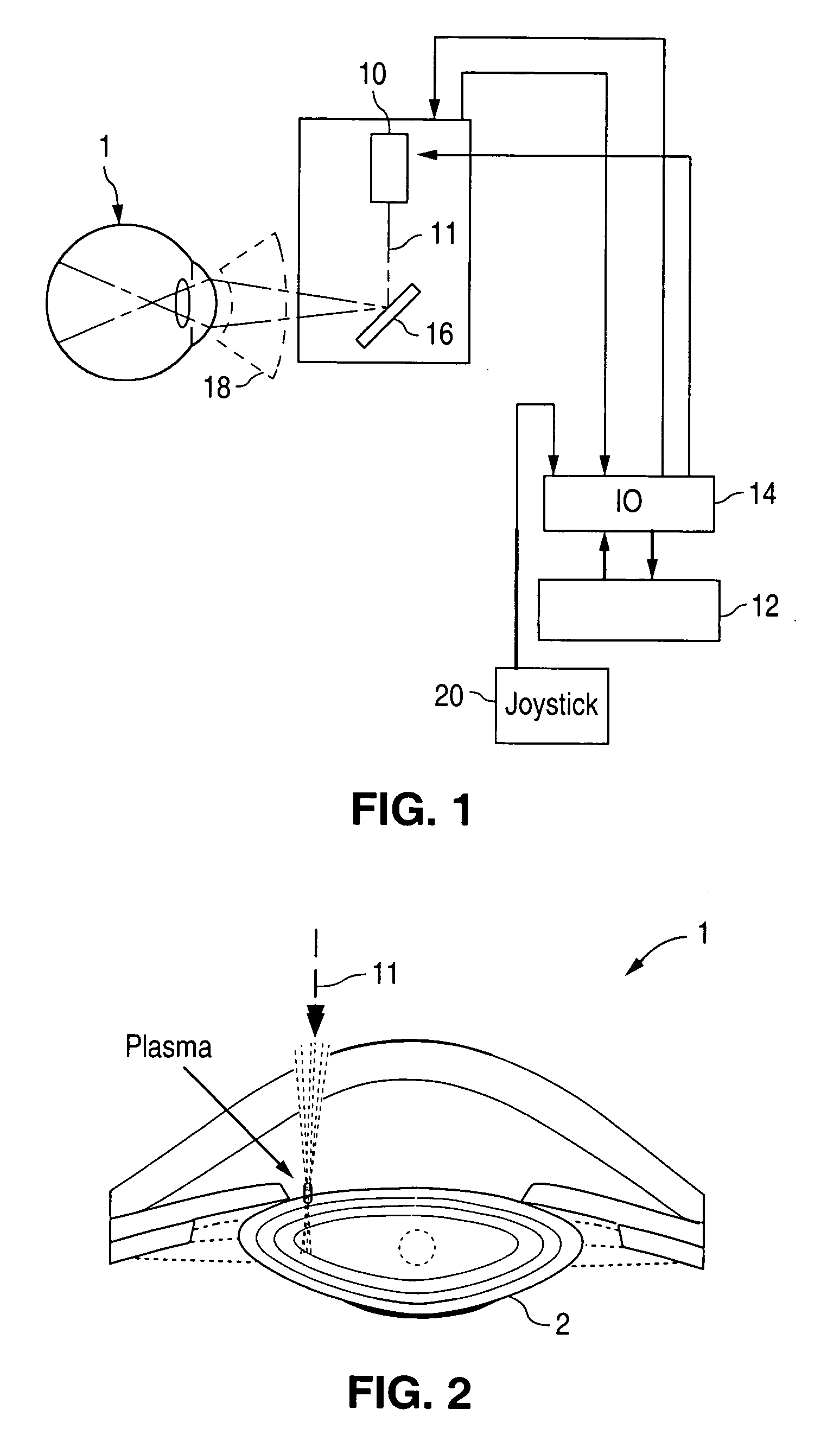
[0045] The present invention can be implemented by a system that projects or scans an optical beam into a patient's eye 1, such as the system shown in FIG. 1. The system includes a light source 10 (e.g. laser, laser diode, etc.), which may be controlled by control electronics 12, via an input and output device 14, to create optical beam 11 (either cw or pulsed). Control electronics 12 may be a computer, microcontroller, etc. Scanning may be achieved by using one or more moveable optical elements (e.g. lenses, gratings, or as shown in FIG. 1 a mirror(s) 16) which also may be controlled by control electronics 12, via input and output device 14. Mirror 16 may be tilted to deviate the optical beam 11 as shown in FIG. 1, and direct beam 11 towards the patient's eye 1. An optional ophthalmic lens 18 can be used to focus the optical beam 11 into the patient's eye 1. The positioning and character of optical beam 11 and / or the scan pattern it forms on the eye may be further controlled by use...
PUM
 Login to View More
 Abstract
Description
Claims
Application Information
 Login to View More