Hemodynamic stability assessment based on heart sounds

a technology of hemodynamic stability and heart sounds, applied in the field of implantable medical devices, can solve the problems of reducing lowering the likelihood of successfully converting the tachyarrhythmia to a normal sinus rhythm, and lowering the likelihood of successfully converting the rhythm. to a normal sinus rhythm, and achieving the effect of measuring the hemodynamic stability of the ventricular tachyarrhythmia

US20070239218A1Active Publication Date: 2007-10-11CARDIAC PACEMAKERS INC
99 Cites 79 Cited by

Patent Information

Authority / Receiving Office
US · United States
Patent Type
Applications(United States)
Current Assignee / Owner
Publication Date
2007-10-11

Smart Images

  • Figure 1
    Figure 1
  • Figure 2
    Figure 2
  • Figure 3
    Figure 3
Patent Text Reader

Abstract

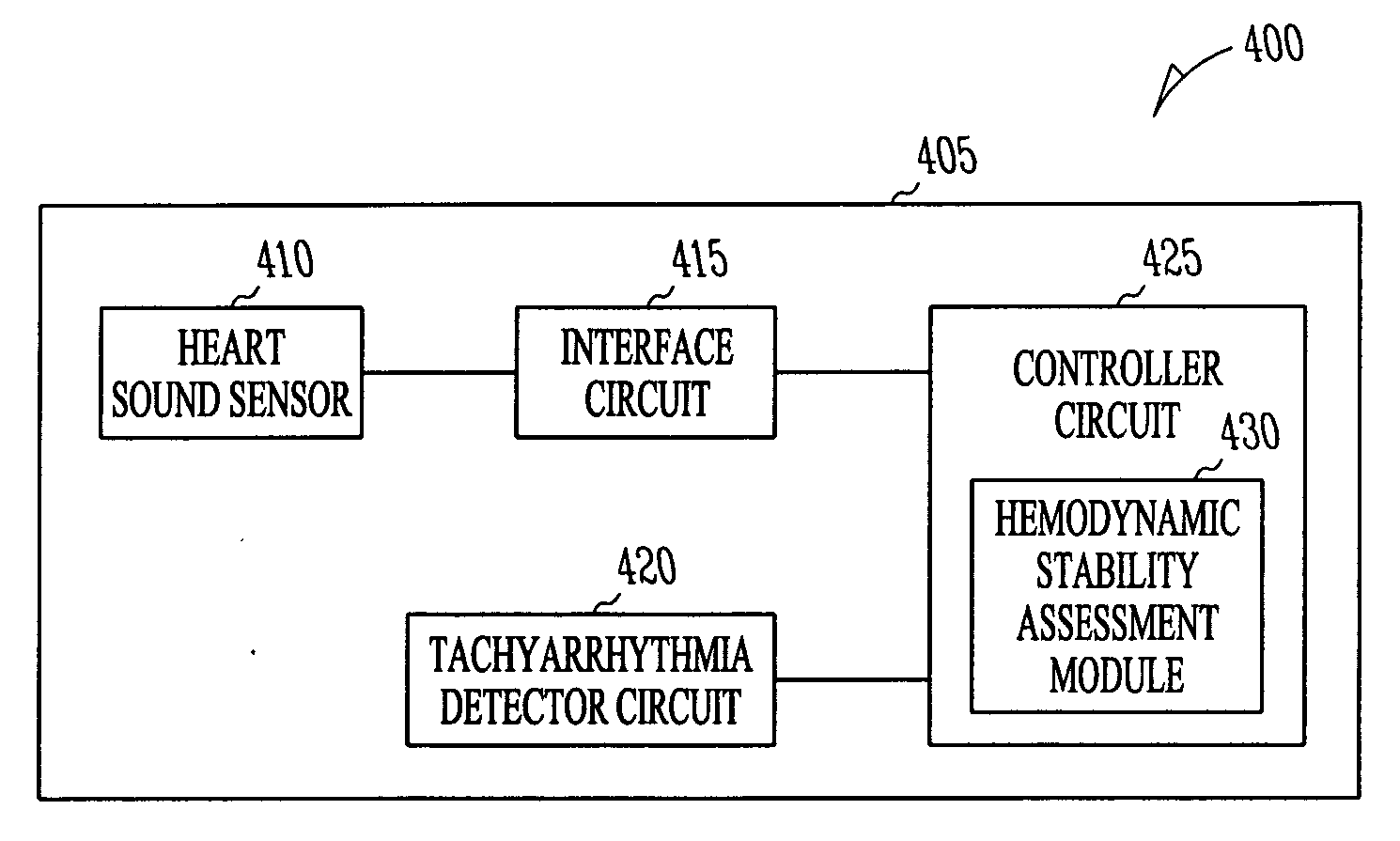
A system comprising an implantable medical device (IMD). The IMD includes an implantable sensor operable to produce an electrical signal representative of mechanical activity of a heart of a subject and a controller circuit coupled to the sensor. The IMD also includes a heart sound sensor interface circuit to produce a heart sound signal, a tachyarrhythmia detector, and a controller circuit. The controller circuit includes a hemodynamic stability assessment module configured to determine that at least one episode of ventricular tachyarrhythmia is detected in a subject and obtain a measurement of hemodynamic stability of the ventricular tachyarrhythmia from the heart sound signal.
Need to check novelty before this filing date? Find Prior Art

Description

CROSS-REFERENCE TO RELATED APPLICATIONS

[0001] This application is related to the following co-pending, commonly assigned U.S. patent applications Ser. No. 10 / 900,570 entitled “DETERMINING A PATIENT'S POSTURE FROM MECHANICAL VIBRATIONS OF THE HEART,” filed on Jul. 28, 2004, Ser. No. 10 / 703,175, entitled “A DUAL USE SENSOR FOR RATE RESPONSIVE PACING AND HEART SOUND MONITORING,” filed on Nov. 6, 2003, Ser. No. 10 / 334,694 entitled “METHOD AND APPARATUS FOR MONITORING OF DIASTOLIC HEMODYNAMICS,” filed on Dec. 30, 2002, Ser. No. 10 / 746,874 entitled “A THIRD HEART SOUND ACTIVITY INDEX FOR HEART FAILURE MONITORING,” filed on Dec. 24, 2003, Ser. No. 11 / 037,275, entitled “METHOD FOR CORRECTION OF POSTURE DEPENDENCE ON HEART SOUNDS,” filed on Jan. 18, 2005, Ser. No. 11 / 129,050, entitled “METHOD AND APPARATUS FOR CARDIAC PROTECTION PACING,” filed on May 16, 2005, and Ser. No. 11 / 148,107, entitled “ISCHEMIA DETECTION USING HEART SOUND SENSOR,” filed on Jun. 8, 2005, each of which is hereby inco...

Examples

Embodiment Construction

[0020] In the following detailed description, reference is made to the accompanying drawings which form a part hereof, and specific embodiments in which the invention may be practiced are shown by way of illustration. It is to be understood that other embodiments may be used and structural or logical changes may be made without departing from the scope of the present invention.

[0021] This document discusses systems and methods for improved detection of cardiac events. A rapid and unstable heart rate associated with tachyarrhythmia can prevent the heart chambers from filling properly; resulting in a drop in a patient's blood pressure. Sometimes, a heart rate becomes rapid but a patient's hemodynamic system remains stable, i.e. the heart rate is regular enough so that the heart chambers are able to fill adequately to maintain adequate blood pressure. A proper assessment of hemodynamic system stability is important in making a decision in whether to deliver or to delay treatment, or w...