
Lock-free concurrent object dictionary
a concurrent object and dictionary technology, applied in the field of computer data storage and retrieval, can solve the problems of requiring very large amounts (e.g., gigabytes) of costly ram, reducing the efficiency of search results, and reducing the number of objects to be searched, so as to reduce the memory requirements, memory savings, and significant memory savings
- Summary
- Abstract
- Description
- Claims
- Application Information
AI Technical Summary
Benefits of technology
Problems solved by technology
Method used
Image

Examples
Embodiment Construction
System Architecture
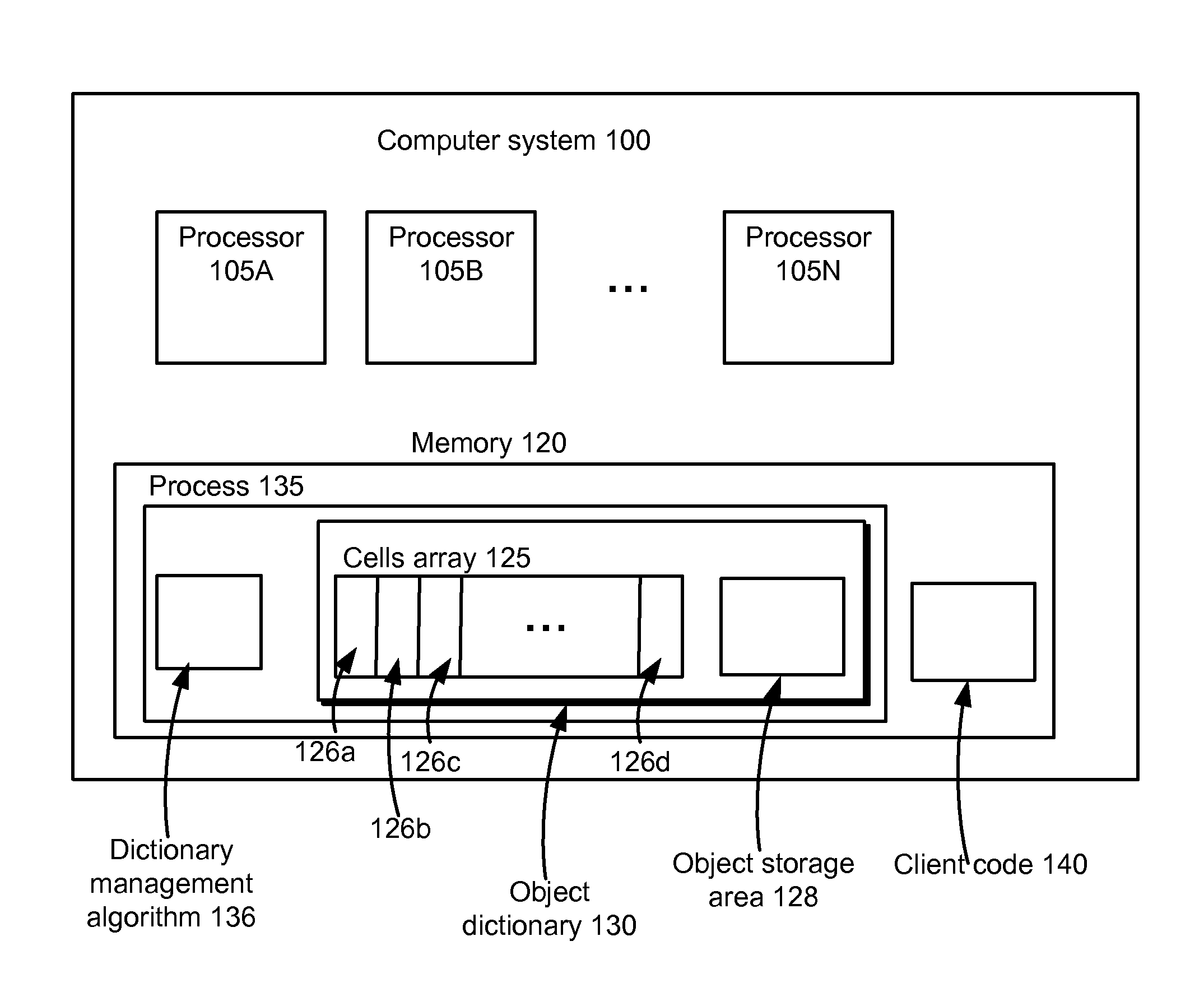
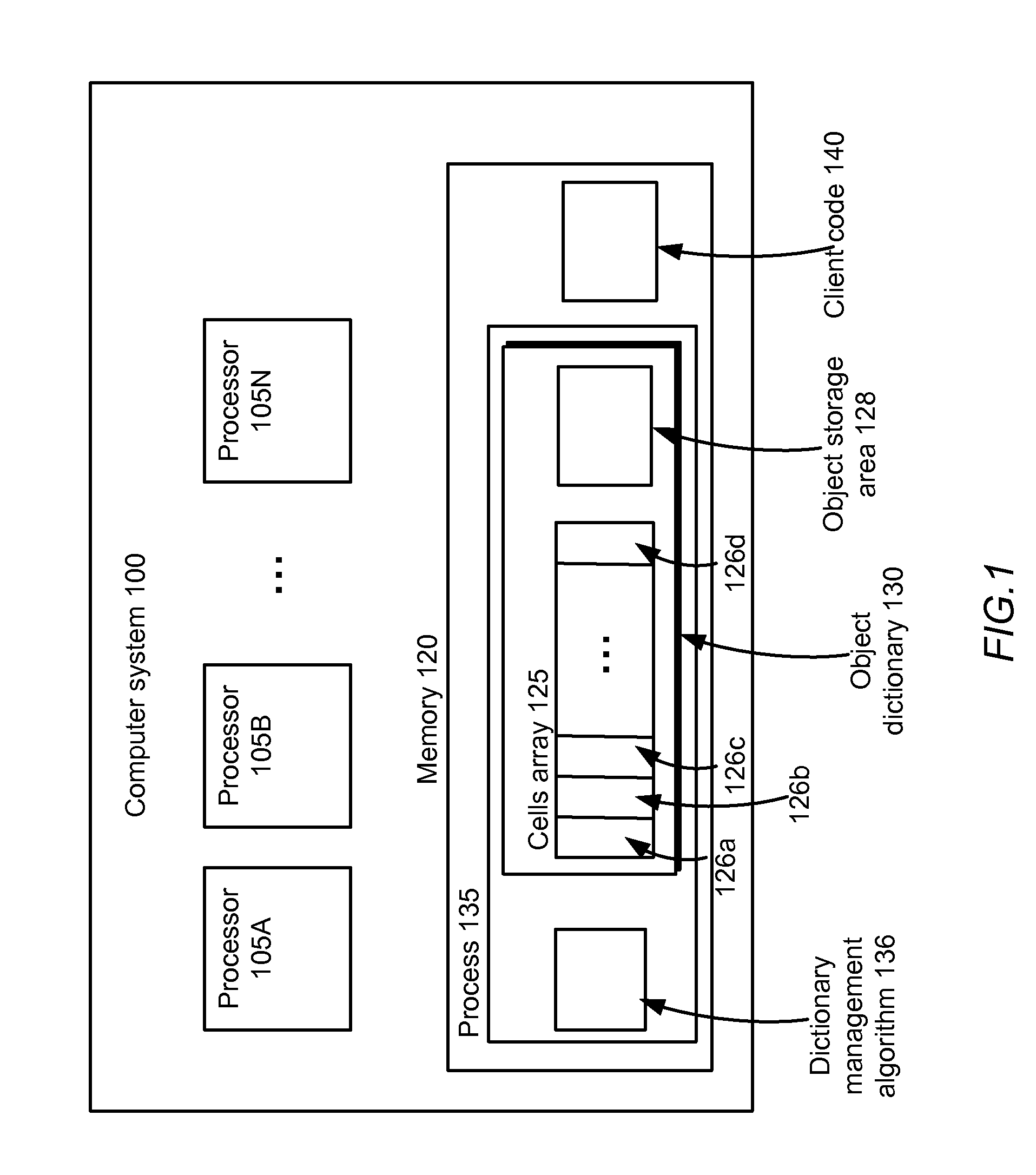
[0014]FIG. 1 is a block diagram of a computer system 100 within which an object dictionary is implemented, in accordance with one embodiment of the present invention. The computer system 100 as depicted in FIG. 1 has a set of processors 105 that may simultaneously access a memory 120. The term “processor” as used herein broadly refers to any of a multi-threaded uniprocessor (or a thread thereof), a single processor within a multiple processor system, a processing core in a multi-core processor, or the equivalent of any of these that may access the memory 120 concurrently with other processors.
[0015]The memory 120 is accessible by all processors 105. For example, the memory 120 can be a main, or primary, high speed memory that is accessed via a bus or equivalent high speed interface. Within the memory 120 is a process 135 that allocates a cells array 125 managed by a dictionary management algorithm 136 of the process. The process 135 also allocates an object storag...
PUM
 Login to View More
 Abstract
Description
Claims
Application Information
 Login to View More