
Switchable imaging device, switchable optical device, and display
a technology of optical devices and switchable parts, applied in the direction of instruments, color television details, electrical apparatus, etc., can solve the problems of reducing the transmission rate by 65%, affecting the efficiency of light usage, and affecting the transmission rate, so as to achieve high quality and attenuate the transmission of light. , the effect of high quality
- Summary
- Abstract
- Description
- Claims
- Application Information
AI Technical Summary
Benefits of technology
Problems solved by technology
Method used
Image

Examples
Embodiment Construction
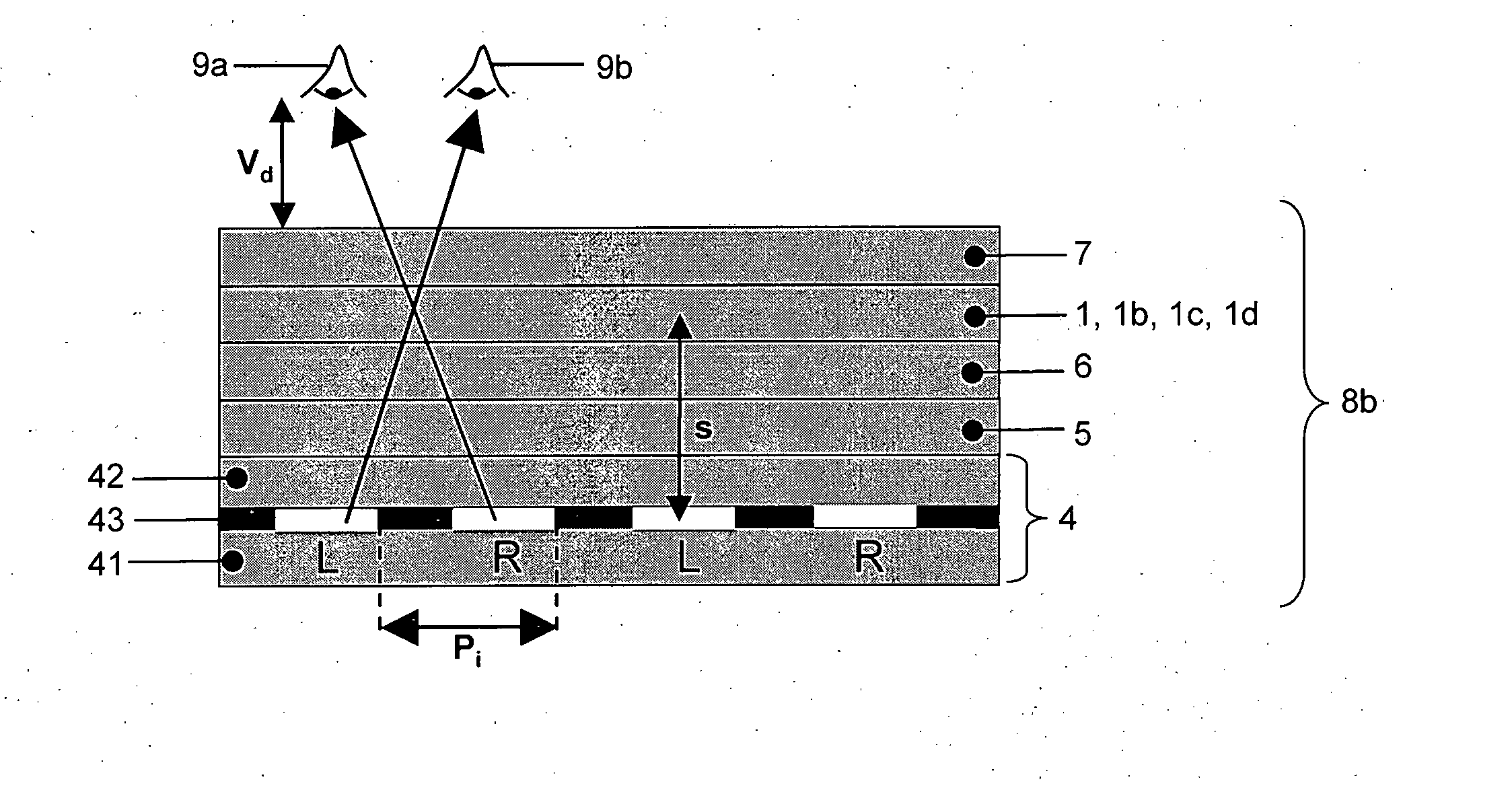
[0116]With reference to FIGS. 3a and 3b, FIGS. 4a and 4b and FIGS. 5a and 5b, a switchable imaging optical device 1 is fabricated that comprises a liquid crystal cell. With reference to FIG. 6 and FIG. 7 the switchable imaging optical device 1 is then combined with an image display 4 to yield a 2D-3D switchable display system.
[0117]With reference to FIGS. 3a and 3b, FIGS. 4a and 4b and FIGS. 5a and 5b, fabrication of the switchable imaging optical device 1 will now be described. The first substrate 111 (shown face up in FIG. 3a) and second substrate 121 (shown face up in FIG. 4a) are coated with transparent electrodes 112, 122 respectively, for example, indium tin oxide (ITO). The electrode layer 122 of the second substrate 121 is patterned in a pre-determined fashion, as illustrated by FIG. 4a. The dashed line 124 in FIG. 4a shows the approximate spatial extent of the pixelated area of the image display 4. For a 2-View 3D display system which has 1 pixel per image, the pitch 1222, ...
PUM
 Login to View More
 Abstract
Description
Claims
Application Information
 Login to View More