
Force detecting device, robot, electronic component conveying apparatus
- Summary
- Abstract
- Description
- Claims
- Application Information
AI Technical Summary
Benefits of technology
Problems solved by technology
Method used
Image

Examples
first embodiment
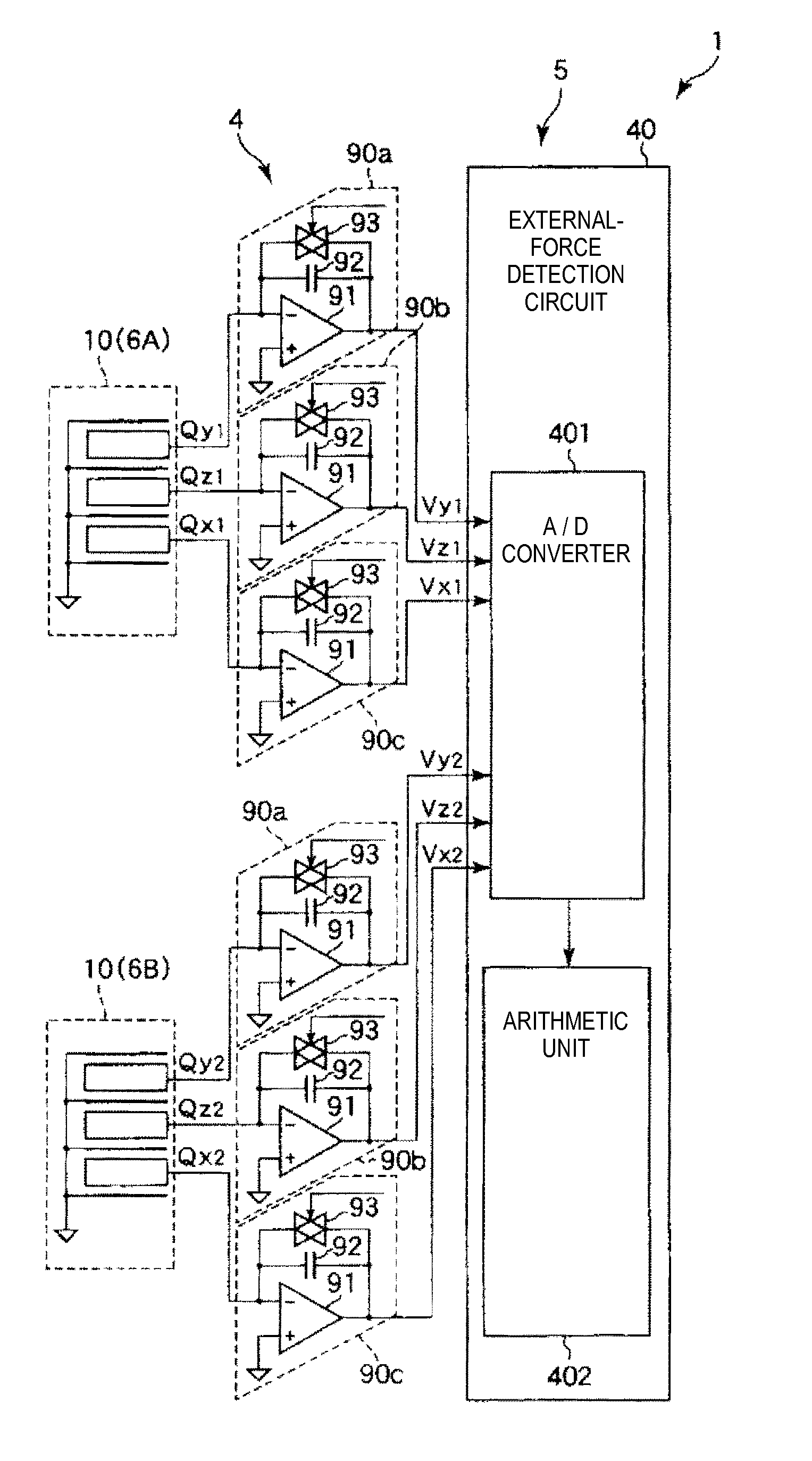
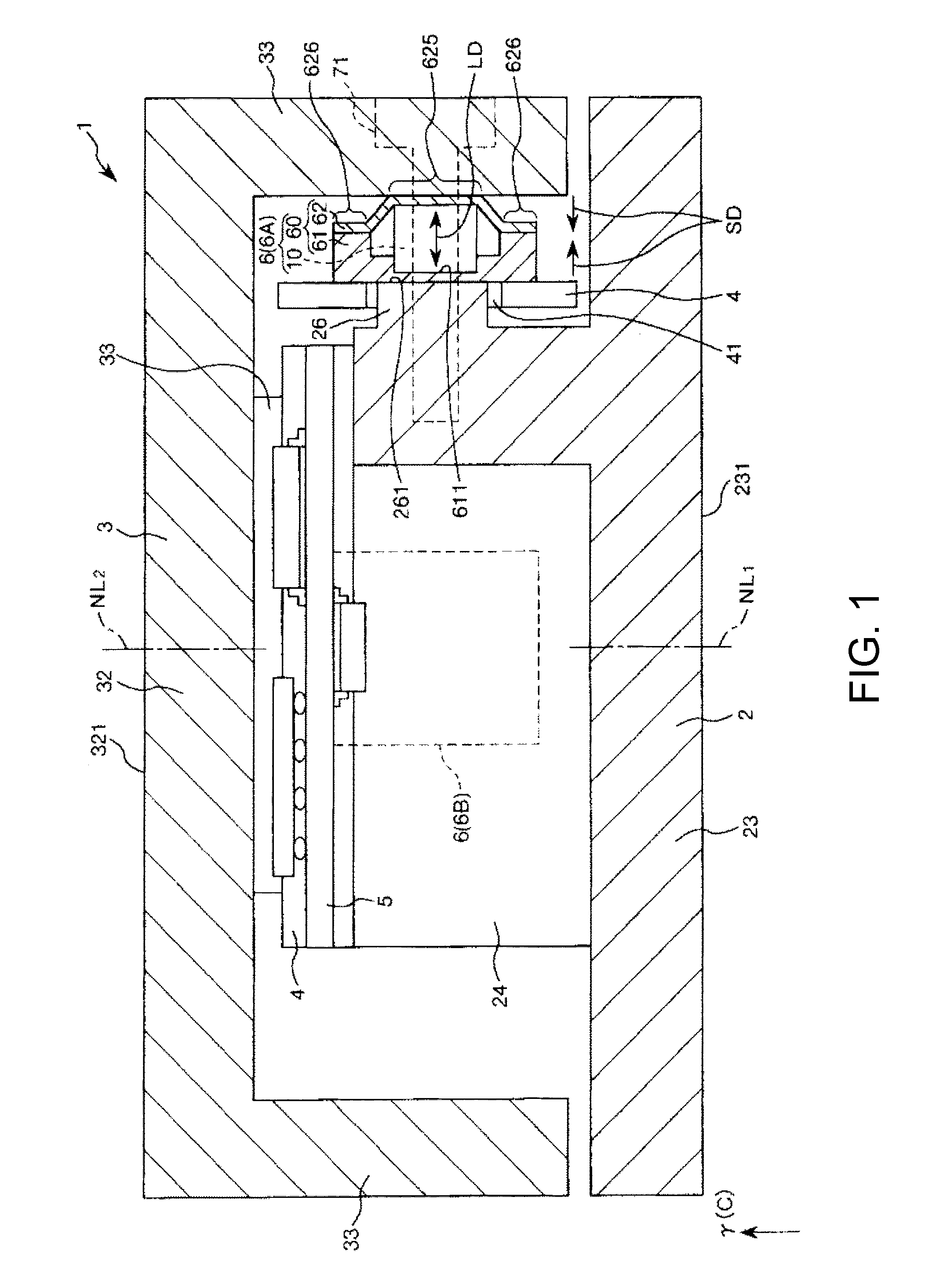
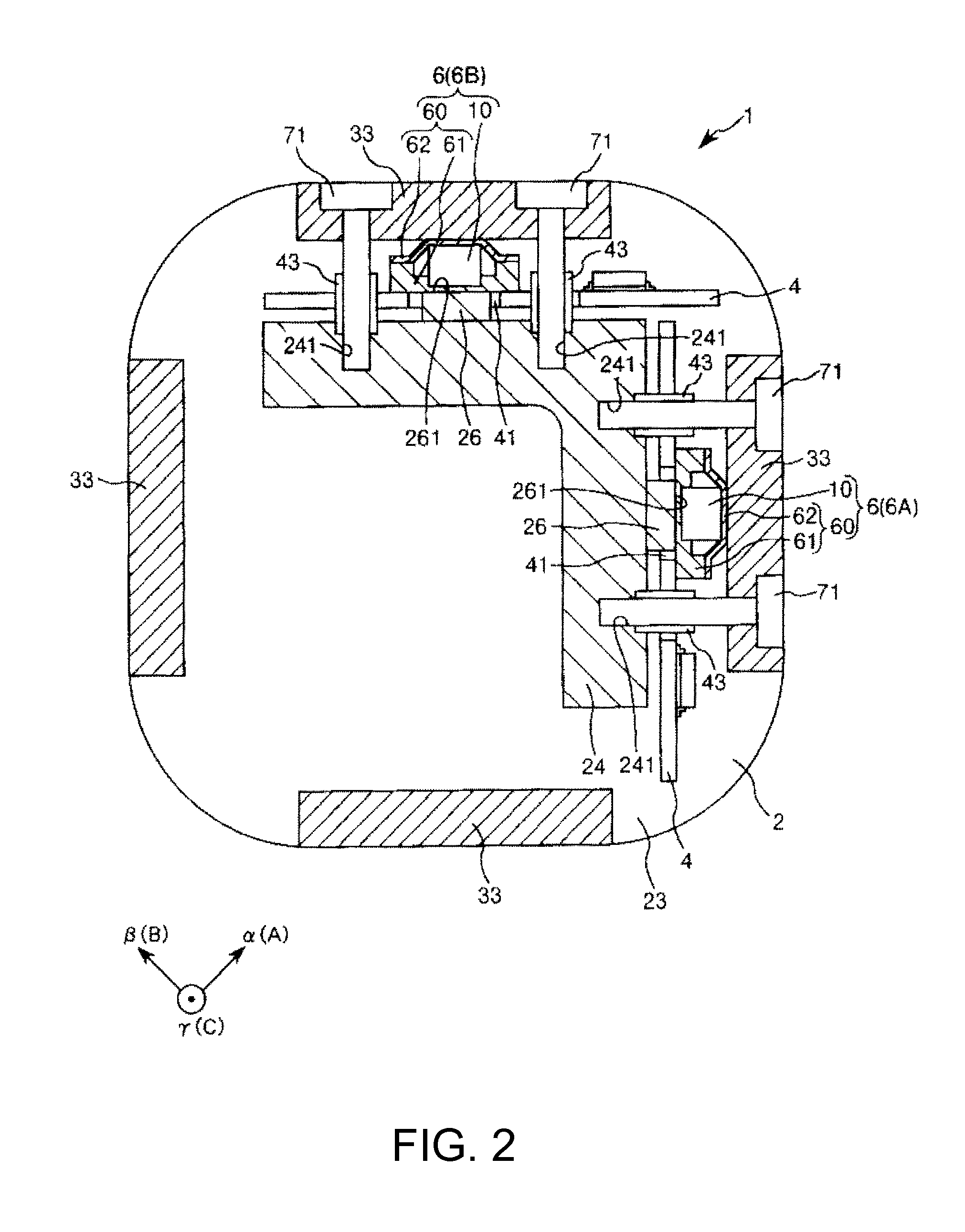
[0120]FIG. 1 is a sectional view showing a force detecting device according to a first embodiment of the invention. FIG. 2 is a plan view of the force detecting device shown in FIG. 1. FIG. 3 is a circuit diagram schematically showing the force detecting device shown in FIG. 1. FIG. 4 is a sectional view schematically showing a charge output element of the force detecting device shown in FIG. 1. FIG. 5 is a schematic diagram showing an action state of a force detected by a charge output element of the force detecting device shown in FIG. 1. FIG. 6 is a diagram of the charge output element viewed from an arrow A direction in FIG. 5.
[0121]Note that, in the following explanation, for convenience of explanation, the upper side in FIG. 1 is referred to as “up” or “upward” and the lower side in the figure is referred to as “down” or “downward”.
[0122]A force detecting device 1 shown in FIGS. 1 and 2 has a function of detecting an external force (including a moment), that is, a function of ...
second embodiment
[0204]FIG. 7 is a sectional view showing a force detecting device according to a second embodiment of the invention. FIG. 8 is a plan view of the force detecting device shown in FIG. 7. FIG. 9 is a circuit diagram schematically showing the force detecting device shown in FIG. 7.
[0205]A force detecting device, a robot, and an electronic component conveying apparatus according to the second embodiment of the invention are explained below with reference to the drawings. Differences from the first embodiment are mainly explained below. Explanation of similarities is omitted.
[0206]This embodiment is the same as the first embodiment except that the number of arranged sensor devices is different.
[0207]As shown in FIGS. 7 and 8, in this embodiment, four sensor devices 6 (charge output elements 10) are set. In the following explanation, the sensor devices 6 are referred to as “sensor device (first sensor element) 6A”, “sensor device (second sensor element) 6B”, “sensor device (third sensor e...
third embodiment
[0213]FIG. 10 is a sectional view showing a force detecting device according to a third embodiment of the invention. FIG. 11 is a circuit diagram schematically showing the force detecting device shown in FIG. 10. FIG. 12 is a sectional view schematically showing a charge output element of the force detecting device shown in FIG. 10. FIG. 13 is a schematic diagram showing an action state of a force detected by the charge output element of the force detecting device shown in FIG. 10. FIG. 14 is a diagram of the charge output element viewed from an arrow A direction in FIG. 13.
[0214]Note that, in the following explanation, for convenience of explanation, the upper side in FIG. 10 is referred to as “up” or “upward” and the lower side in the figure is referred to as “down” or “downward”.
[0215]A force detecting device 1001 shown in FIG. 10 has a function of detecting an external force (including a moment), that is, a function of detecting external forces applied along three axes (an α (A)...
PUM
 Login to View More
 Abstract
Description
Claims
Application Information
 Login to View More