Unlock instant, AI-driven research and patent intelligence for your innovation.

Method and device for improving countermass-based recoil control in projectile launchers

a technology of countermass-based recoil control and projectile launcher, which is applied in the direction of missile propulsion, weapons, weapon components, etc., can solve the problems of affecting affecting and affecting the accuracy of the target, so as to improve the performance of the countermass-based recoil control mechanism and the effect of improving the overall amount or direction

Active Publication Date: 2016-08-04
GRANT KEVIN PAUL
View PDF0 Cites 1 Cited by
  • Summary
  • Abstract
  • Description
  • Claims
  • Application Information

AI Technical Summary

Benefits of technology

The present invention provides a method and device for controlling recoil (the reactive force generated when a firearm is fired) with a simpler, cheaper, lighter, more robust, durable, and easier to maintain mechanism. This is achieved by using a countermass that is accelerated in the direction of the recoil, which counteracts the effect of the primary recoil on the body of the firearm. The countermass impacts against the surfaces of the recoil controller, transferring momentum from the countermass to the recoil controller and to the body of the firearm. The effect of the recoil controller on the distribution of recoil experienced by the body of the firearm can change over time.

Problems solved by technology

There is no way to alter the total amount or direction of primary recoil without affecting the velocity or direction of the projectile, usually an undesirable outcome.
Uncompensated recoil causes both excessive wear and tear on the supporting mechanism (possibly a person) as well as a tendency to knock the projectile launcher out of alignment with the target.
These undesirable effects are due more to the way in which the recoil is distributed over time than to the total amount or direction of the recoil.
Unfortunately this approach has the disadvantage of making the projectile launcher substantially heavier.
This approach has the disadvantage of creating an area of intense danger directly behind the projectile launcher, through which the ejected countermass travels.b) Do not allow the countermass to leave the projectile launcher.
Friction between the cup and the inside surface of the barrel slows the cup as it travels rearward.
There are several practical problems with this approach which render it unusable as a recoil reduction device.
Because of this each use would change the amount of friction between the barrel and successive cups, significantly altering the performance of the gun.
Second, differences in the amount of expansion that different metals undergo at different temperatures would change the fit between the cup and the barrel.
A gun manufactured in a temperate environment might not function properly in a desert or arctic setting.
Even the heat generated by friction as the cup travels along the barrel might be enough to cause misfires or worse.
This is particularly troublesome given that the successful operation of the mechanism is strongly dependent on having an exact fit between the cup and the barrel.
Third, the mechanism is so dependent on having an exact fit between cup and barrel that the presence of small amounts of dust or dirt in the barrel could jam the cup long before it reached the end of the barrel, with unpredictable results.
As with all of the piston-based approaches most of the problems are those related to the use of an unnecessarily complex mechanism.
One problem is the unnecessarily high cost of construction, including the cost of the various machined components and their assembly into the final device.
Other problems include the costs and efforts associated with cleaning, maintaining, durability, repair, and the necessity for the stockpiling of replacement parts.
The fact that successful functioning requires that several parts move smoothly against each other in a controlled fashion makes the mechanism vulnerable to dirt, dust and sand.
The fact that the same force that propels the bullet forwards also propels the reciprocating barrel backwards, and that some of the propellant gasses are bled from inside of the barrel before the bullet exits the barrel, robs the bullet of power.
Finally, the mechanism is unnecessarily heavy, adding to the weight of the gun.
The friction generated heat creates the same risk of differential expansion of different parts of the mechanism, and the potential negative consequences thereof, which were present in the device disclosed in British patent number GB126336.
This approach is problematic in two regards.
First, it doesn't decrease peak recoil; it only delays peak recoil until the moving portion of the barrel hits the stop.
Second, some of the power used to propel the bullet is diverted into moving the moving portion of the barrel, robbing the bullet of power.
The primary problem with the mechanism described in this patent is that it requires manual replacement of the deformed mass after use, as well as manual resetting of the positions of the various components of the weapon, including the barrel.

Method used

the structure of the environmentally friendly knitted fabric provided by the present invention; figure 2 Flow chart of the yarn wrapping machine for environmentally friendly knitted fabrics and storage devices; image 3 Is the parameter map of the yarn covering machine
View more

Image

Smart Image Click on the blue labels to locate them in the text.
Viewing Examples
Smart Image
  • Method and device for improving countermass-based recoil control in projectile launchers
  • Method and device for improving countermass-based recoil control in projectile launchers
  • Method and device for improving countermass-based recoil control in projectile launchers

Examples

Experimental program
Comparison scheme
Effect test

Embodiment Construction

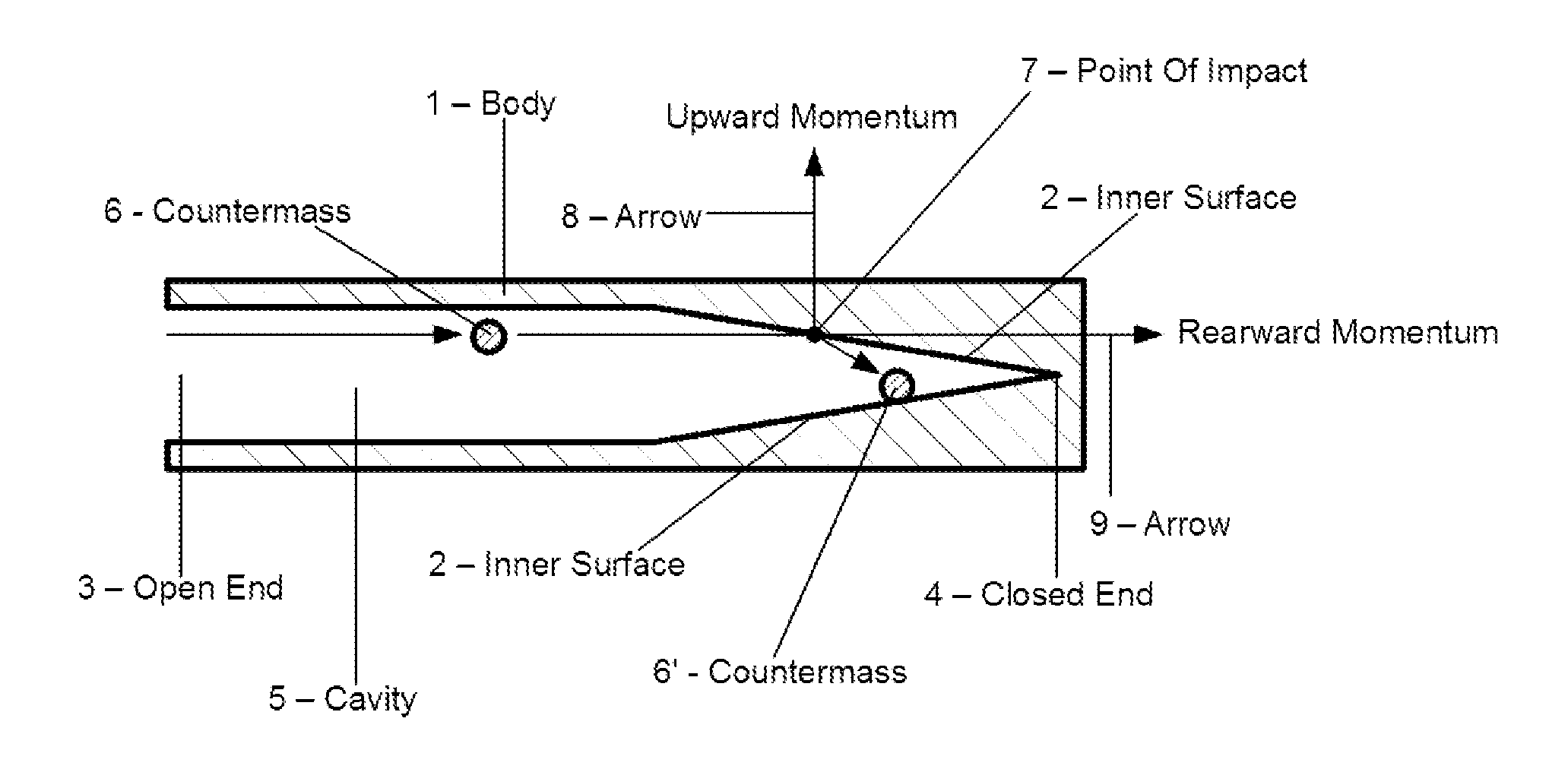
[0053]FIG. 1 shows the preferred embodiment of the apparatus of the present invention. In FIG. 1, the recoil controller is shown just after the countermass 6 has entered the body 1. The countermass 6 enters the body 1 at the open end 3 and continues to move through the cavity 5 towards the closed end 4. Eventually the countermass 6 will impact against the inner surfaces 2 of the body 1 at the point of impact 7 imparting some or all of its momentum to the body 1. The amount and direction of the momentum imparted by the mechanism described in this and other embodiments will depend on one or more members of a set of factors, a subset of which consists of the following:[0054]1. the composition of the inner surfaces 2 of the body 1;[0055]2. the geometry of the inner surfaces 2 of the body 1;[0056]3. the composition of the body 1 in whole or in part;[0057]4. the geometry of the body 1 in whole or in part;[0058]5. variations in the mass, charge, temperature, magnetic field strength and / or ...

the structure of the environmentally friendly knitted fabric provided by the present invention; figure 2 Flow chart of the yarn wrapping machine for environmentally friendly knitted fabrics and storage devices; image 3 Is the parameter map of the yarn covering machine
Login to View More

PUM

No PUM Login to View More

Abstract

A recoil controller is disclosed whose body 1 incorporates a strategically designed inner surface or surfaces 2. A moving countermass 6 impacts one or more times against one or more inner surfaces 2. During this process momentum is transferred from the countermass 6, to the inner surfaces 2, and then to the body 1 of the recoil controller, and then to anything to which it is attached or against which it is braced. The distributions, over time, of the momenta resulting from this transfer of momentum will depend on various factors including the composition, geometry and placement of the inner surfaces 2. A given recoil controller is designed such that the distributions, over time, of the momenta resulting from its use, are preferable to the distributions, over time, of the original momenta. The countermass 6′ shown in FIG. 1 is the countermass 6 shown after one impact.

Description

CROSS-REFERENCE TO RELATED APPLICATIONS[0001]Not applicable.STATEMENT REGARDING FEDERALLY SPONSORED RESEARCH OR DEVELOPMENT[0002]Not applicableREFERENCE TO A “MICROFICHE APPENDIX”[0003]Not applicableBACKGROUND OF THE INVENTION[0004]1. Field of the Invention[0005]The present invention relates to improving the performance of countermass-based mechanisms for recoil control in projectile launchers.[0006]2. General Background of the Invention[0007]In any projectile-firing device, Newton's third law requires that the recoil caused by the firing of the projectile exactly balances the momentum carried by the projectile and the exhaust gasses. Recoil resulting from the momentum of the exhaust gases is called “secondary recoil”. Secondary recoil can be reduced to acceptable levels via the use of ports. Ports are holes in the forward end of the barrel of a projectile launcher that release the exhaust gasses radially just before the projectile exits the barrel. Since the gasses are released rad...

Claims

the structure of the environmentally friendly knitted fabric provided by the present invention; figure 2 Flow chart of the yarn wrapping machine for environmentally friendly knitted fabrics and storage devices; image 3 Is the parameter map of the yarn covering machine
Login to View More

Application Information

Patent Timeline
no application Login to View More
IPC IPC(8): F41A1/10
CPCF41A25/16F41A1/10
Inventor GRANT, KEVIN PAUL
Owner GRANT KEVIN PAUL
Features
  • R&D
  • Intellectual Property
  • Life Sciences
  • Materials
  • Tech Scout
Why Patsnap Eureka
  • Unparalleled Data Quality
  • Higher Quality Content
  • 60% Fewer Hallucinations
Social media
Patsnap Eureka Blog
Learn More