

Nanoporous Carbon as Host Material for Sodium
a sodiumion battery and sodiumion supercapacitor technology, applied in the field of electrochemical energy storage systems, can solve the problems of large irreversible capacity loss of alloys, short circuits, low coulombic efficiency, etc., and achieve the effects of minimizing capacity fade, optimizing performance, and great affecting charge storage capacity
- Summary
- Abstract
- Description
- Claims
- Application Information
AI Technical Summary
Benefits of technology
Problems solved by technology
Method used
Image

Examples
Embodiment Construction
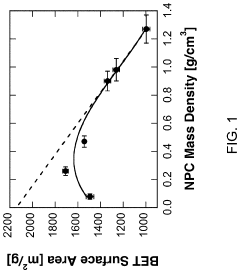
[0019]NPC is a unique and attractive carbon material for sodium-ion storage. NPC materials can be grown with controlled mass density and total surface area. The total surface area for a given mass of material defines the fraction of material that is available for sodium ion adsorption. The Brunauer-Emmett-Teller (BET) method can be used to measure surface areas. See S. Brunauer et al., J. Am. Chem. Soc. 60, 309 (1938). FIG. 1 shows how surface area varies with NPC mass density. The solid line is merely a guide-for-the-eye. Surface area increases with decreasing mass density for all but the lowest mass density materials studied, ranging from 997±32 m2 / g to 1,709±24 m2 / g for samples with mass densities ranging from 1.27-0.26 g / cm3, respectively. Overall, such values are mostly higher than those reported for other carbon materials. For example, while the surface area of a single graphene sheet is 2,630 m2 / g, chemically-modified graphene agglomerates used for graphene-based supercapacit...
PUM
| Property | Measurement | Unit |
|---|---|---|
| interplanar spacing | aaaaa | aaaaa |
| density | aaaaa | aaaaa |
| density | aaaaa | aaaaa |
Abstract
Description
Claims
Application Information
 Login to View More