System and method for assessing urinary function

a system and urinary function technology, applied in the field of system and a method for assessing urinary function, can solve the problems of inability to maintain the seal of the urethra, the urethra cannot function properly, and the urethra cannot be properly supported in the correct position by weakened muscles and pelvis, so as to prevent the fluid flow therebetween

US6896650B2Inactive Publication Date: 2005-05-24ETHICON INC
84 Cites 23 Cited by

Patent Information

Authority / Receiving Office
US · United States
Patent Type
Patents(United States)
Current Assignee / Owner
Publication Date
2005-05-24
Estimated Expiration
Not applicable · inactive patent

Smart Images

  • Figure 1
    Figure 1
  • Figure 2
    Figure 2
  • Figure 3
    Figure 3
Patent Text Reader

Abstract

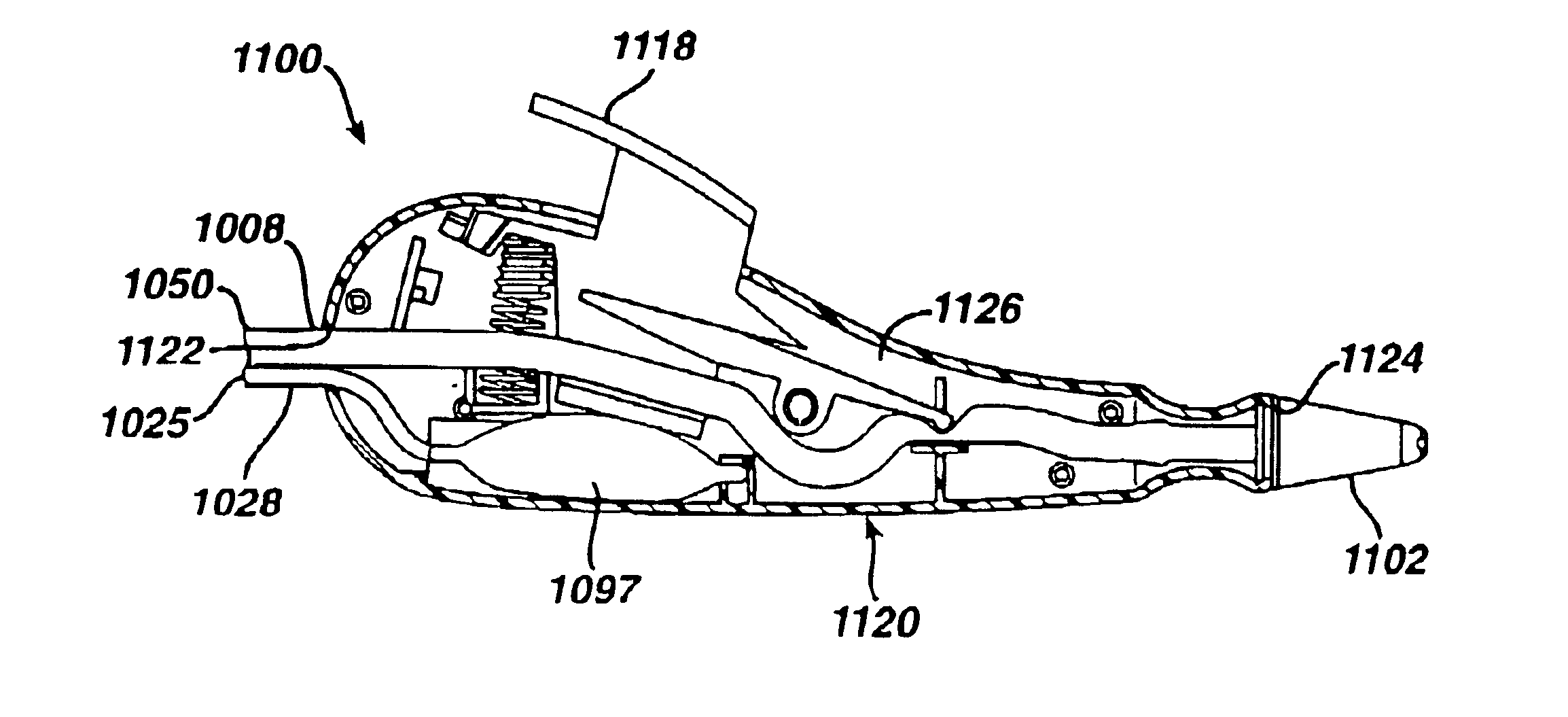
An insertion device is provided for use in assessing urinary function. The insert device includes an insert member for at least partial insertion into a patient's urethral canal having a length such that it is positioned distal of the urethral sphincter, and having an outer surface at least a portion of which is configured to engage the inner wall of the urethra to substantially prevent fluid flow therebetween. The insert member has a channel therethrough through which fluid from a fluid source can be introduced into the urethral canal. Also provided is a device for introducing fluid into a patient's urethral canal including a hand-sized casing having a fluid conduit therein between a fluid inlet and a fluid source assembly. The device further includes an activation device movable between a first position wherein it does not obstruct the fluid conduit and a second position wherein it does obstruct the fluid conduit. An insert member is coupled to a distal end of the hand-sized casing and has a channel therethrough between a fluid inlet and a fluid outlet, and is dimensioned for at least partial insertion into the patient's urethral canal distal of the urethral sphincter. The insert member channel is in fluid communication with the fluid conduit.
Need to check novelty before this filing date? Find Prior Art

Description

CROSS REFERENCE TO RELATED APPLICATIONS

[0001] The present invention claims the benefit of earlier filed U.S. provisional patent applications, Ser. No. 60 / 302,069, filed on Jun. 29, 2001 and 60 / 372,579, filed on Apr. 12, 2002, which are both incorporated by reference in their entirety herein.FIELD OF THE INVENTION

[0002] The present invention relates generally to a system and a method for assessing urinary function. More particularly, the system and method is used for testing the integrity of the urinary system for diagnostic purposes and for use with therapies to correct urinary incontinence.BACKGROUND OF THE INVENTION

[0003] Women account for more than 11 million of incontinence cases. Moreover, a majority of women with incontinence suffer from stress urinary incontinence (SUI). Women with SUI involuntarily lose urine during normal daily activities and movements, such as laughing, coughing, sneezing and regular exercise.

[0004] SUI may be caused by a functional defect of the tissue or lig...

Examples

Embodiment Construction

[0055]FIGS. 1 through 26 illustrate generally various systems and methods for assessing urinary function and / or components of such systems and methods. Although the systems and methods disclosed herein are described in detail in relation to the female urinary system, it is to be understood that the present invention can readily be adapted for use in assessing male urinary function as well. Further, those skilled in the art will recognize that inventive principles, apparatus and methods disclosed herein may also have application to assessing function in other areas, such as coronary function or pulmonary function. The present invention is to be limited only by the claims set forth herein.

[0056]Referring now to FIGS. 1 and 2, one embodiment of a portable medical system 100 is illustrated having particular application for assessing urinary function. The system 100 includes a control device 102 that controls operation of the system, at least one module 104 that can be removably coupled ...