Manufacturing conduits for use in placing a target vessel in fluid communication with a source of blood

a technology for a target vessel and a fluid communication, which is applied in the direction of manufacturing tools, buttons, food shaping, etc., can solve the problems that heart disease remains the leading cause of death, and achieve the effect of sufficient rigidity and sufficient resilien

a technology for a target vessel and a fluid communication, which is applied in the direction of manufacturing tools, buttons, food shaping, etc., can solve the problems that heart disease remains the leading cause of death, and achieve the effect of sufficient rigidity and sufficient resilien

US7285235B2Inactive Publication Date: 2007-10-23MEDTRONIC INC

Image

Smart Image Click on the blue labels to locate them in the text.
Viewing Examples
Smart Image
  • Manufacturing conduits for use in placing a target vessel in fluid communication with a source of blood
  • Manufacturing conduits for use in placing a target vessel in fluid communication with a source of blood
  • Manufacturing conduits for use in placing a target vessel in fluid communication with a source of blood

Examples

Experimental program
Comparison scheme
Effect test

example 1

[0110]A first mold including two mold halves was machined from aluminum and had a configuration substantially the same as that shown in FIG. 6. The mold halves were connected via dowel pins and grooves were milled into the faces of the mold halves. The grooves defined a cavity with first and second portions disposed transverse to each other to form a conduit having the same configuration. The first and second cavity portions were sized to receive a steel mandrel, and the cavities and the mandrel substantially corresponded to those shown in FIG. 6

[0111]A light coating of spray-on mold release was applied to the mandrel, and the mandrel was placed in the mold halves which were then assembled. Silicone was used as the moldable material. Air was removed from the silicone by vacuum and ultrasonic agitation prior to injecting the silicone into the mold cavity. Next, approximately one cc of NuSil Med-4950 silicone was poured into the inlet of the mold to form the conduit preform (as this c...

example 2

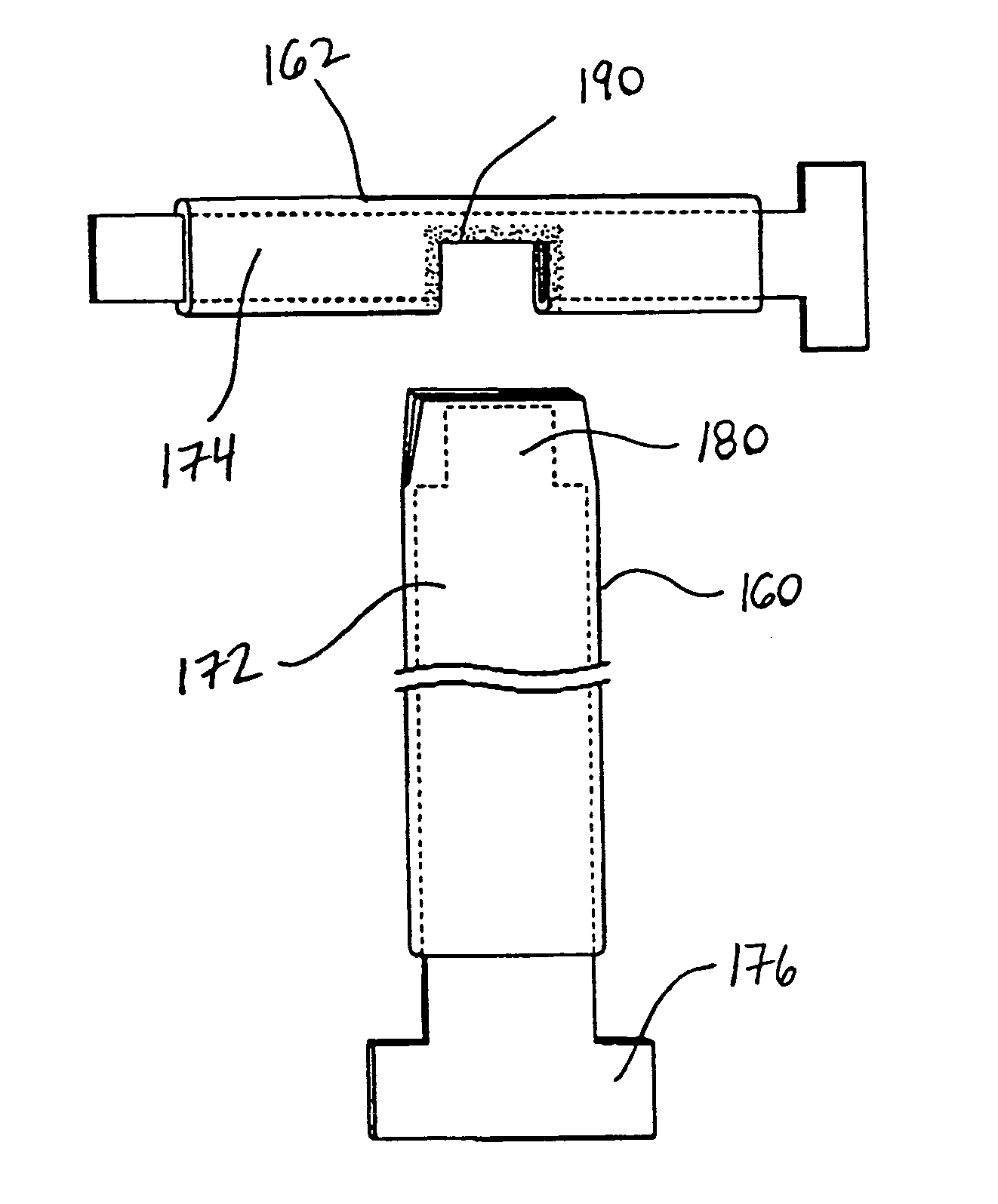
[0115]Two tubular lengths of expanded PTFE (ePTFE) having a wall thickness of 0.008 inch and an internodal distance of 30 microns were formed substantially as the two conduit portions shown in FIG. 18. Mandrels were coated with a release agent and were used to support the two pieces of ePTFE while they were joined. Silicone was placed between the two portions at the junction and the silicone was cured in an oven at 150° for 2 hours to bond the two portions; the silicone, NuSil Med-6640 wicked between the nodes of the ePTFE and when cured bonded the pieces together to produce a conduit preform having two portions with lumens in fluid communication.

[0116]A reinforcing component was applied by wrapping a nitinol wire around the first and second conduit portions. The exterior surface of the conduit preform was coated with NuSil Med-4850 (LSR) silicone and the reinforcing wire was wrapped around the preform, embedding itself in the silicone. The silicone was then cured again in an oven a...

the structure of the environmentally friendly knitted fabric provided by the present invention; figure 2 Flow chart of the yarn wrapping machine for environmentally friendly knitted fabrics and storage devices; image 3 Is the parameter map of the yarn covering machine
Login to View More

PUM

PropertyMeasurementUnit
angleaaaaaaaaaa
wall thicknessaaaaaaaaaa
Login to View More

Abstract

Methods and devices for manufacturing a conduit for placing a target vessel in fluid communication with a source of blood, such as a heart chamber containing blood. The conduit includes first and second portion adapted to be placed in fluid communication with a heart chamber and a target vessel. The conduit lies on the exterior of the myocardium between the blood source and the target vessel and delivers blood in multiple directions within the lumen of the target vessel. The conduit, which may be formed of any suitable synthetic vascular graft material, is generally T-shaped with the leg having two free ends disposed in the target vessel, preferably being secured thereto via a suture-free attachment. The conduit comprises vascular graft material and may be manufactured various ways, such as molding a conduit from any suitable biocompatible material or fabricating a conduit from one or more pieces of vascular graft material.

Description

CROSS REFERENCE TO RELATED APPLICATION:[0001]This application is a divisional of U.S. patent application Ser. No. 09 / 314,119, filed May 19, 1999 now U.S. Pat. No. 7,075,937.BACKGROUND OF THE INVENTION[0002]1. Field of the Invention[0003]The invention relates to methods and devices for manufacturing a conduit for placing a target vessel in fluid communication with a source of blood, and more particularly placing a coronary vessel in fluid communication with a heart chamber containing blood.[0004]2. Description of Related Art[0005]Despite the considerable advances that have been realized in cardiology and cardiovascular surgery, heart disease remains the leading cause of death throughout much of the world. Coronary artery disease, or arteriosclerosis, is the single leading cause of death in the United States today. As a result, those in the cardiovascular field continue to search for new and improved treatments.[0006]Coronary artery disease is currently treated by interventional proce...

Claims

the structure of the environmentally friendly knitted fabric provided by the present invention; figure 2 Flow chart of the yarn wrapping machine for environmentally friendly knitted fabrics and storage devices; image 3 Is the parameter map of the yarn covering machine
Login to View More

Application Information

Patent Timeline
23 Oct 2007
Publication
US7285235B2
IPC
B29C65/52; B29C41/14; B29C45/00; B29C45/14
CPC
B29C41/14; B29C45/0001; Y10T156/1062; B29K2083/005; B29K2995/0056; B29C45/14
Inventors
RAPACKI, ALAN R.; CARSON, DEAN F.