
Acrylate adhesives containing silica nanoparticles crosslinked with polyfunctional aziridines
- Summary
- Abstract
- Description
- Claims
- Application Information
AI Technical Summary
Benefits of technology
Problems solved by technology
Method used
Image

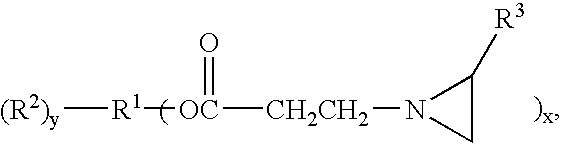
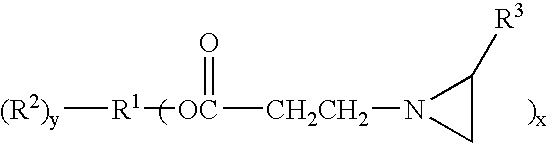
Examples
synthesis example 1
Preparation of PSA-3
[0111]To a 1-liter stainless steel Waring blender container was added 360 grams of deionized water, 8 grams of RHODACAL DS-10, 1.0 gram of lithium hydroxide, 1.2 grams of triethanolamine, 344 grams of 2-Octyl acrylate (2-OA), 15 grams of acrylic acid (AA), and 15 grams of methyl methacrylate (MMA). The content was homogenized with the blender at low speed setting for 2 minutes then poured into a 2-liter resin flask equipped with a thermometer, mechanical agitation with Teflon impeller, condenser and nitrogen inlet tube. 0.8 grams of potassium persulfate was then added. The reaction mixture was stirred at 250 rpm under nitrogen blanket and heated to 62° C. The stirring, and nitrogen blanket was maintained throughout the reaction period. After exotherm peaked at about 90° C., 82 grams of deionized water was added. The batch was maintained at 75° C. for 4 hours, cooled and filtered through cheesecloth to give a latex adhesive of 47.3% solids, Brookfield viscosity of...
PUM
| Property | Measurement | Unit |
|---|---|---|
| Fraction | aaaaa | aaaaa |
| Fraction | aaaaa | aaaaa |
| Fraction | aaaaa | aaaaa |
Abstract
Description
Claims
Application Information
 Login to View More