Olopatadine formulations for topical nasal administration
Inactive Publication Date: 2011-07-12
NOVARTIS AG
View PDF33 Cites 43 Cited by
Summary
Abstract
Description
Claims
Application Information
AI Technical Summary
This helps you quickly interpret patents by identifying the three key elements:
Problems solved by technology
Method used
Benefits of technology
Problems solved by technology
Despite their relatively high concentration of olopatadine, they do not contain any polymeric ingredient as a physical stability enhancing ingredient.
Method used
the structure of the environmentally friendly knitted fabric provided by the present invention; figure 2 Flow chart of the yarn wrapping machine for environmentally friendly knitted fabrics and storage devices; image 3 Is the parameter map of the yarn covering machine
View more
Image
Smart Image Click on the blue labels to locate them in the text.
Viewing Examples
Smart Image
Click on the blue label to locate the original text in one second.
Reading with bidirectional positioning of images and text.
Smart Image
Examples
Experimental program
Comparison scheme
Effect test
example 1
Topically Administrable Nasal Solution
[0033]
TABLE 1IngredientAmount (%, w / v)Olopatadine Hydrochloride0.665aBenzalkonium Chloride0.01Edetate Disodium, Dihydrate0.01Sodium Chloride0.41Dibasic Sodium Phosphate, Anhydrous0.5Hydrochloric AcidAdjust to pH 3.7 ± 0.1and / orSodium HydroxidePurified Waterqs to 100a0.665% w / v olopatadine hydrochloride (665 mcg / 100 microliter spray) is equivalent to 0.6% w / v olopatadine as base (600 mcg / 100 microliter spray).
An exemplary compounding procedure for the nasal composition shown in Table 1 is described as below.[0034]1. Tare a suitable compounding vessel with magnetic stir bar. Add approximately 80% of the batch weight of purified water.[0035]2. While stirring, add dibasic sodium phosphate (anhydrous), sodium chloride, edetate disodium, benzalkonium chloride and olopatadine HCl.[0036]3. Add equivalent to approximately 0.55 g, 6N hydrochloric acid per 100 ml batch.[0037]4. Allow adequate time between each addition for dissolution of each ingredient[00...
example 2
Effect of NaCl and Phosphate Buffer on Dissolution of Olopatadine Hydrochloride
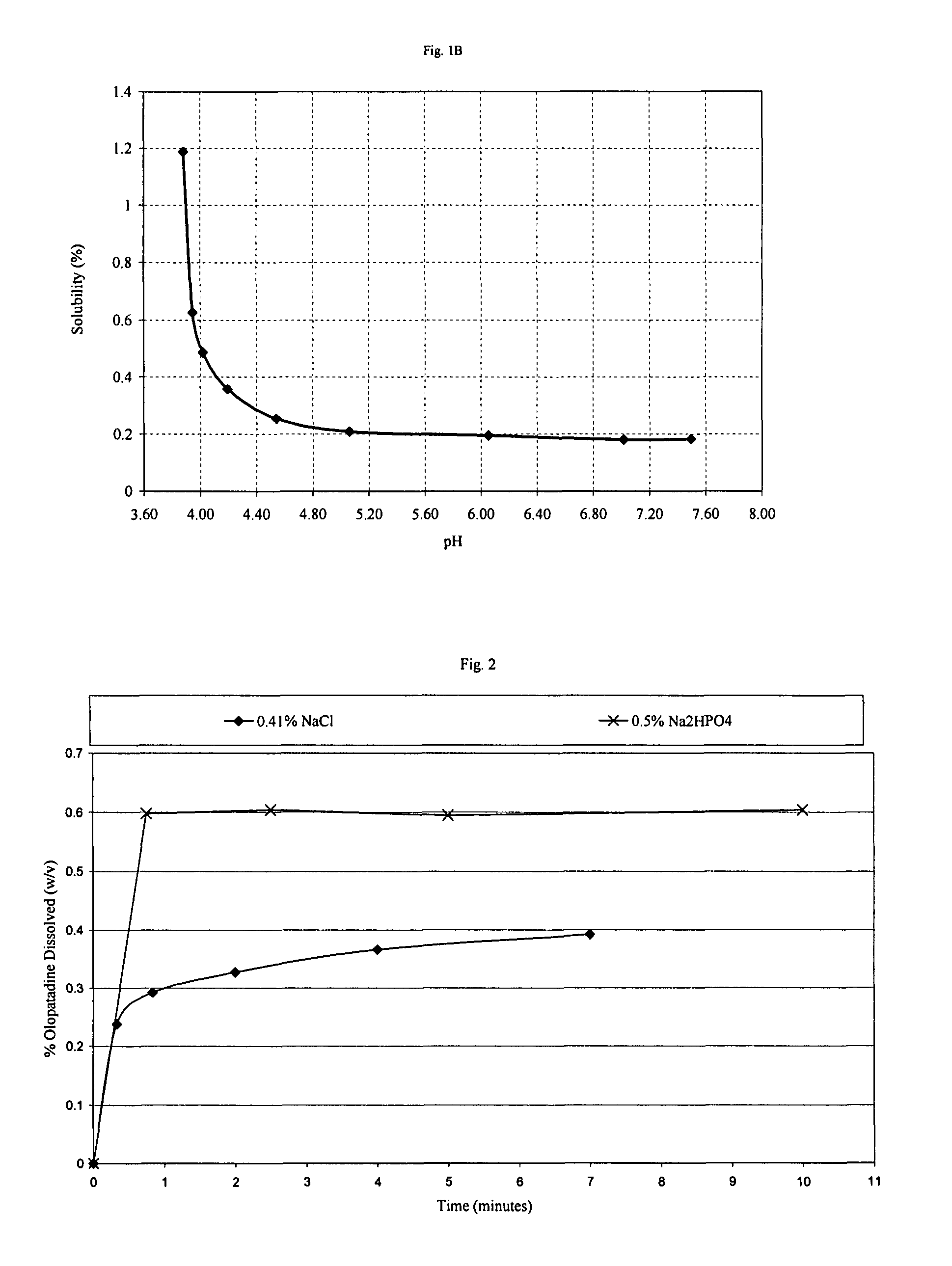
[0043]The effect of NaCl on the dissolution rate of olopatadine hydrochloride in water was determined. NaCl caused a significant reduction in the rate of dissolution of olopatadine. With addition of Na2HPO4, however, the dissolution of olopatadine was dramatically improved. The complete dissolution of 0.6% olopatadine solution without Na2HPO4 would take at least several hours assuming that the entire amount of olopatadine would eventually dissolve, but with Na2HPO4 it takes less than one minute. The results are shown in FIG. 2.
example 3
Effect of NaCl and Na2HPO4 on the Dissolution Olopatadine Hydrochloride in a Nasal Vehicle
[0044]The effect of NaCl, Na2HPO4, and mannitol on the dissolution rate of olopatadine hydrochloride in a nasal formulation containing 0.01% EDTA and 0.01% BAC was determined. The results are shown in FIG. 3. The effect of phosphate salt in this vehicle is the same as that shown in water in Example 2.
the structure of the environmentally friendly knitted fabric provided by the present invention; figure 2 Flow chart of the yarn wrapping machine for environmentally friendly knitted fabrics and storage devices; image 3 Is the parameter map of the yarn covering machine
Login to View More
PUM
Property
Measurement
Unit
osmolality
aaaaa
aaaaa
osmolality
aaaaa
aaaaa
pH
aaaaa
aaaaa
Login to View More
Abstract
Topical formulations of olopatadine for treatment of allergic or inflammatory disorders of the nose are disclosed. The aqueous formulations contain approximately 0.6% (w / v) of olopatadine.
Description
[0001]This application is a continuation-in-part of Ser. No. 11 / 079,996, filed Mar. 15, 2005, now U.S. Pat. No. 7,402,609 which is a continuation of Ser. No. 10 / 175,106, filed Jun. 19, 2002, now U.S. Pat. No. 6,995,186 which claims priority to U.S. Provisional Application Ser. No. 60 / 301,315, filed Jun. 27, 2001, all of which are incorporated herein by reference.BACKGROUND OF THE INVENTION[0002]1. Field of the Invention[0003]The present invention relates to topical formulations used for treating allergic and inflammatory diseases. More particularly, the present invention relates to formulations of olopatadine and their use for treating and / or preventing allergic or inflammatory disorders of the nose.[0004]2. Description of the Related Art[0005]As taught in U.S. Pat. Nos. 4,871,865 and 4,923,892, both assigned to Burroughs Wellcome Co. (“the Burroughs Wellcome Patents”), certain carboxylic acid derivatives of doxepin, including olopatadine (chemical name: Z-11-(3-dimethylaminopropyli...
Claims
the structure of the environmentally friendly knitted fabric provided by the present invention; figure 2 Flow chart of the yarn wrapping machine for environmentally friendly knitted fabrics and storage devices; image 3 Is the parameter map of the yarn covering machine
Login to View More
Application Information
Patent Timeline
Application Date:The date an application was filed.
Publication Date:The date a patent or application was officially published.
First Publication Date:The earliest publication date of a patent with the same application number.
Issue Date:Publication date of the patent grant document.
PCT Entry Date:The Entry date of PCT National Phase.
Estimated Expiry Date:The statutory expiry date of a patent right according to the Patent Law, and it is the longest term of protection that the patent right can achieve without the termination of the patent right due to other reasons(Term extension factor has been taken into account ).
Invalid Date:Actual expiry date is based on effective date or publication date of legal transaction data of invalid patent.


 Login to View More