Check patentability & draft patents in minutes with Patsnap Eureka AI!

Long life lead acid battery having titanium core grids and method of their production

a lead acid battery, titanium core technology, applied in the direction of cell components, electrochemical generators, cell groupings, etc., can solve the problems of grid corrosion, battery paste flaking and non-adhesion, etc., and achieve the effect of positive grid li

Inactive Publication Date: 2011-11-01
GERBER ELIOT SAMUEL
View PDF31 Cites 3 Cited by
  • Summary
  • Abstract
  • Description
  • Claims
  • Application Information

AI Technical Summary

Benefits of technology

The solution extends the lifespan of lead acid batteries to 10 years by reducing thermal expansion and corrosion, allowing for more charging / discharging cycles while maintaining mechanical integrity and conductivity.

Problems solved by technology

The contraction and expansion of lead battery grids may cause flaking and non-adherence of the battery paste and corrosion of the grids.

Method used

the structure of the environmentally friendly knitted fabric provided by the present invention; figure 2 Flow chart of the yarn wrapping machine for environmentally friendly knitted fabrics and storage devices; image 3 Is the parameter map of the yarn covering machine
View more

Image

Smart Image Click on the blue labels to locate them in the text.
Viewing Examples
Smart Image
  • Long life lead acid battery having titanium core grids and method of their production
  • Long life lead acid battery having titanium core grids and method of their production
  • Long life lead acid battery having titanium core grids and method of their production

Examples

Experimental program
Comparison scheme
Effect test

Embodiment Construction

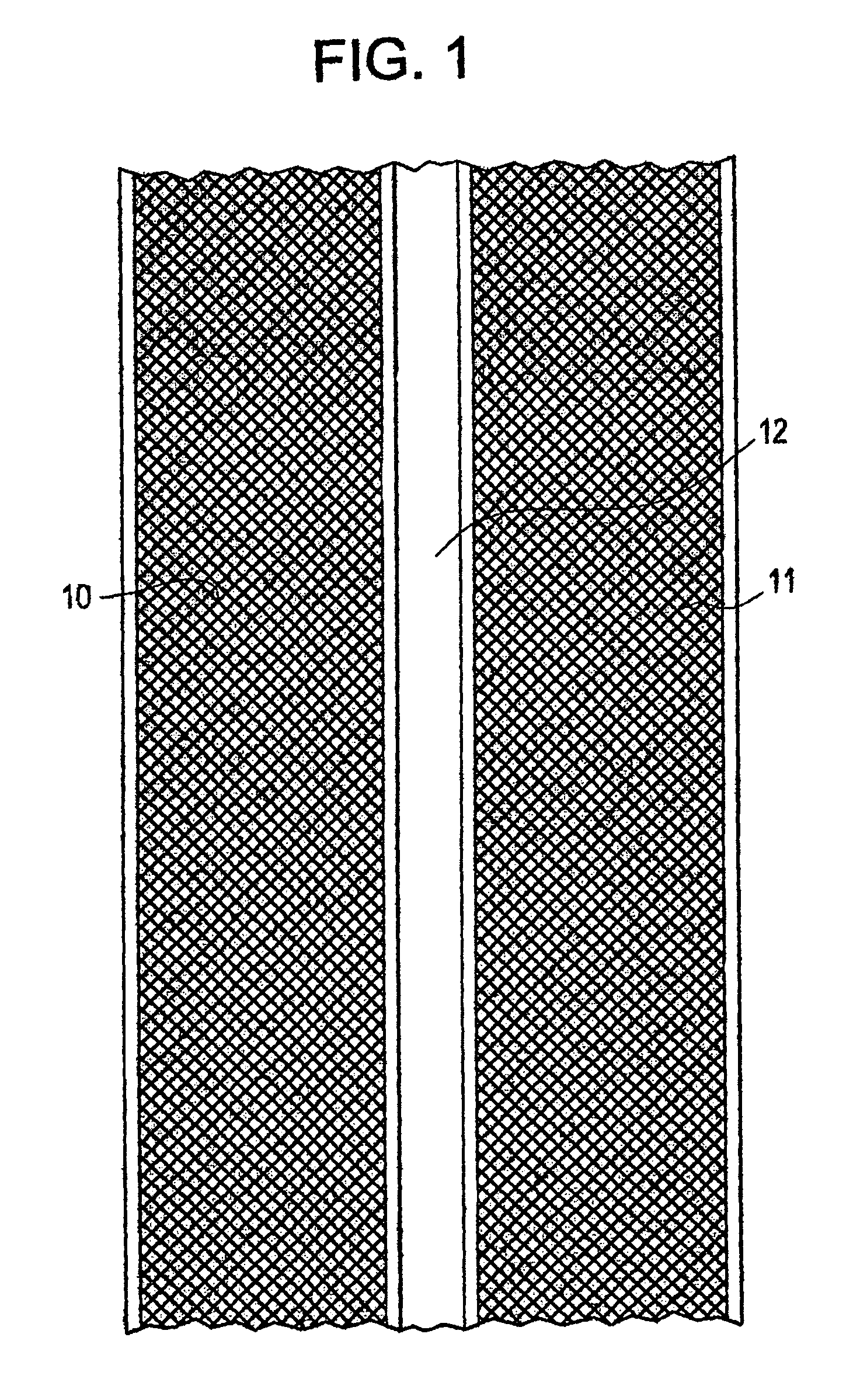
[0023]The grid 9 of FIGS. 1-5 is formed from a titanium thin sheet (thin coil). Its thickness, for starter batteries or auto batteries for electric and hybrid cars, is in the preferred range of 01 mm to 0.7 mm and most preferably 0.2 mm to 0.4 mm and in any event, less than 0.7 mm. Most preferably the thickness of the core is about 0.3-04 mm for those batteries.

[0024]However, for deep discharge batteries, thicker grids are preferably used, although not as thick as the lead grids used for deep discharge batteries. For deep discharge batteries the thickness of the titanium or copper cores are preferably 0.4 mm to 2.0 mm and more preferably 0.5 mm to 0.8 mm.

[0025]Titanium has good electrical conductivity compared to lead; it is stronger than lead; it is lighter than lead; however it may not be completely corrosion resistant to the dilute sulfuric acid (“battery acid”) used in lead acid batteries. “Expanded” means perforated and expanded metal.

[0026]In the preferred grid core 9, the fra...

the structure of the environmentally friendly knitted fabric provided by the present invention; figure 2 Flow chart of the yarn wrapping machine for environmentally friendly knitted fabrics and storage devices; image 3 Is the parameter map of the yarn covering machine
Login to View More

PUM

PropertyMeasurementUnit
thicknessaaaaaaaaaa
thicknessaaaaaaaaaa
thicknessaaaaaaaaaa
Login to View More

Abstract

A lead acid electric storage battery uses conventional lead-acid secondary battery chemistry. The battery may be a sealed battery, an unsealed battery or a conventional multi-cellbattery. It has 12 to 25 cells in a single case. The case is less than 12 inches long and may be less than 6 inches long. The battery has a set of positive battery grids (plates) which are constructed with a core of thin titanium expanded metal having a thickness preferably, for start batteries etc. in the range 0.1 mm to 0.7 mm and most preferably 0.2 mm to 0.4 mm. The grid cores are of a titanium alloy containing a platinum group metal. The cores are coated with hot melt dip lead and are not lead electroplated. The grid cores expand and contract, with temperature changes, much less than conventional lead grids.

Description

RELATED UNITED STATES PATENT APPLICATIONS[0001]The present patent application is a continuation-in-part application partly based upon the applicant's prior United States patent applications as follows: application Ser. No. 12 / 313,090 (20100092630) filed Nov. 17, 2008 now U.S. Pat. No. 7,732,098 and entitled “Lead acid battery having ultra-thin titanium grids” and application Ser. No. 12 / 218,154 filed Jul. 11, 2008 (now abandoned)FIELD OF THE INVENTION[0002]The present invention relates to lead acid storage batteries, and more especially to the cells for such batteries.BACKGROUND OF THE INVENTION[0003]The need for improvements in lead-acid storage batteries is widely recognized.[0004]Hundreds of articles, patents and research projects have been directed toward improving such batteries. Some of the important characteristics that still need improvement are mechanical ruggedness, long life and multiple cycles (charge-discharge).[0005]It is generally believed that automobile batteries ha...

Claims

the structure of the environmentally friendly knitted fabric provided by the present invention; figure 2 Flow chart of the yarn wrapping machine for environmentally friendly knitted fabrics and storage devices; image 3 Is the parameter map of the yarn covering machine
Login to View More

Application Information

Patent Timeline
no application Login to View More
Patent Type & Authority Patents(United States)
IPC IPC(8): H01M4/68H01M4/74H01M4/82
CPCH01M4/73H01M10/06Y10T29/49115Y02T10/7016Y10T29/10Y02E60/126Y02E60/10Y02T10/70
Inventor GERBER, ELIOT SAMUEL
Owner GERBER ELIOT SAMUEL
Features
  • R&D
  • Intellectual Property
  • Life Sciences
  • Materials
  • Tech Scout
Why Patsnap Eureka
  • Unparalleled Data Quality
  • Higher Quality Content
  • 60% Fewer Hallucinations
Social media
Patsnap Eureka Blog
Learn More