Method of making a cyclic guanidine from dicyandiamide and coating compositions containing same
a technology of dicyandiamide and guanidine, which is applied in the field of producing a cyclic guanidine, can solve the problems of complicated published methods for synthesizing bicyclic guanidines, prohibitively expensive materials, and use of hazardous materials
- Summary
- Abstract
- Description
- Claims
- Application Information
AI Technical Summary
Benefits of technology
Problems solved by technology
Method used
Image

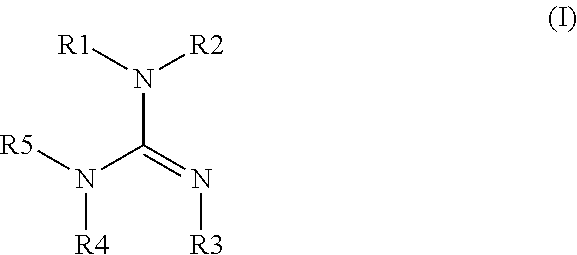
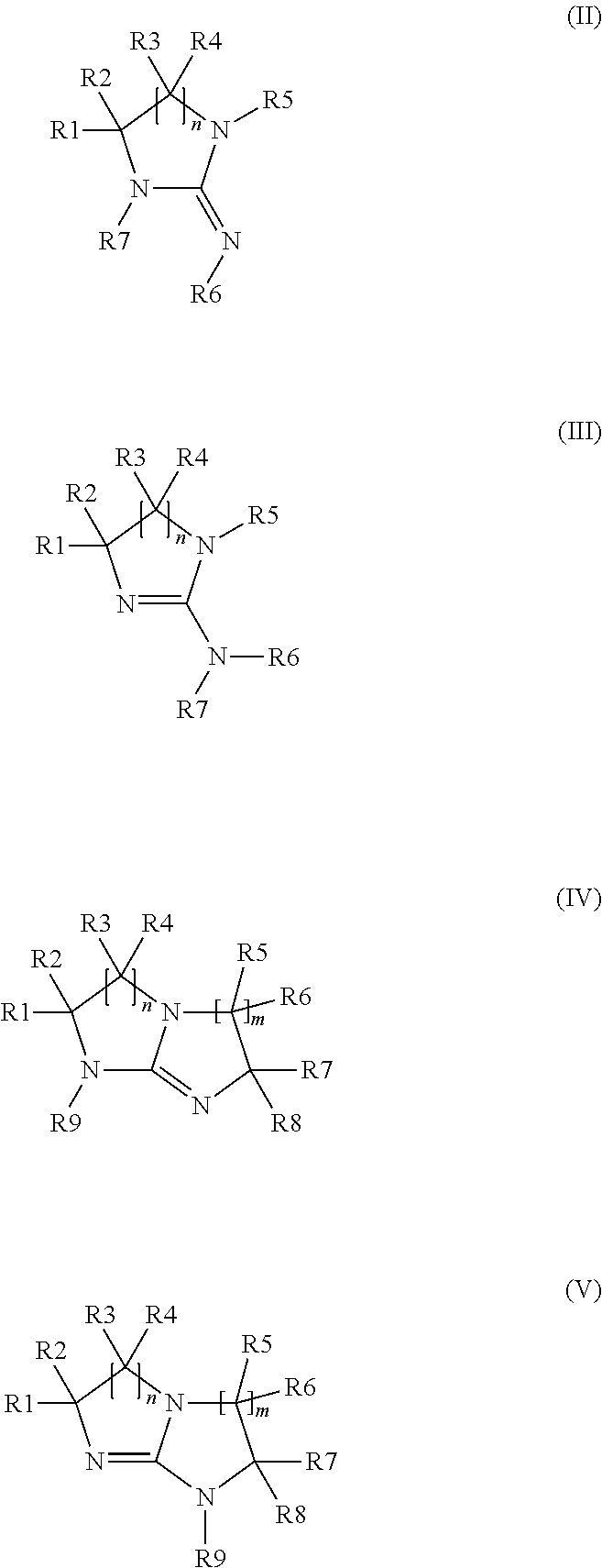
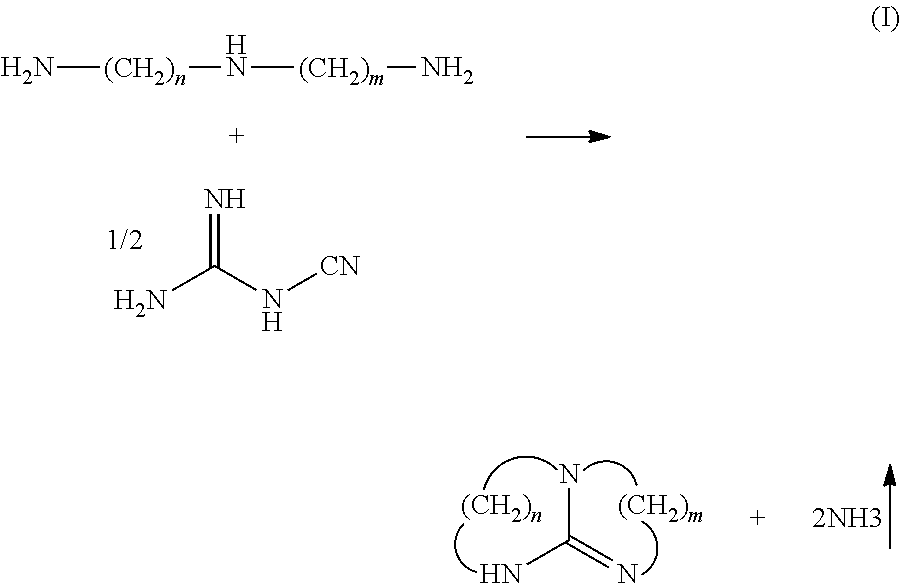
Examples
example 1
Preparation of Cyclic Guanidine, No Weak Acid
[0079]
#MaterialParts by Weight (g)1dicyandiamide42.02Butyl cellosolve125.43Dipropylene triamine131.2
[0080]Materials 1 and 2 were added to a round bottom flask equipped with a mechanical stirrer, reflux condenser, temperature probe and inert gas inlet. The mixture was then warmed to 60° C., at which time material 3 was added and the mixture held at 60° C. for 1 hour (h). The mixture was then warmed to 170° C. and sampled hourly. After one hour at temperature all the dicyandiamide had been consumed. A 13C NMR analysis of the cooled product indicates that the dicyandiamide had been converted in 34% yield to 1,5,7-triazabicyclo[4.4.0]dec-5-ene and 47% yield 2,4,6-triamino-s-triazine or melamine as a side product.
example 2
Preparation of Cyclic Guanidine Under CO2
[0081]
#MaterialParts by Weight (g)1dicyandiamide42.02Butyl cellosolve125.43Dipropylene triamine131.2
[0082]Materials 1 and 2 were added to a round bottom flask equipped with a mechanical stirrer, reflux condenser, temperature probe and a gas inlet. The mixture was placed under an atmosphere of carbon dioxide and then warmed to 60° C. , at which time material 3 was added dropwise over 60 minutes. The mixture was then warmed to 130° C., held there and sampled hourly. After 5 hours essentially all the dicyandiamide had been consumed. A 13C NMR analysis of the cooled product indicated that the dicyandiamide had been converted in 57% yield to 1,5,7-triazabicyclo[4.4.0]dec-5-ene. No 2,4,6-triamino-s-triazine or melamine side product was observed.
example 3
Cyclic Guanidine-BPA Salt
[0083]
#MaterialParts by Weight (g)1dicyandiamide100.92Butyl cellosolve470.03Bisphenol A456.64Dipropylene triamine262.4
[0084]Materials 1 and 2 were added to a round bottom flask equipped with a mechanical stirrer, reflux condenser, temperature probe and inert gas inlet. The mixture was then warmed to 60° C. , at which time material 3 was added. Material 4 was then added over 30 min, and a mild exotherm of less than 5° C. was observed. The mixture was then warmed to 171° C., and ammonia evolution was monitored using pre-moistened pH paper. After ammonia evolution slowed (approximately 1.5 h at 171° C.), the reaction was cooled. 13C NMR analysis of the cooled product indicates that the reaction mixture consists of 17.6 wt % 1,5,7-triazabicyclo[4.4.0]dec-5-ene, 38 wt % bisphenol A, 3.1 wt % dipropylene triamine, 40.3 wt % butyl cellosolve, and 1.1wt % melamine. HPLC analysis under acidic aqueous conditions indicated that the final reaction mixture contained 18.4...
PUM
| Property | Measurement | Unit |
|---|---|---|
| temperature | aaaaa | aaaaa |
| temperature | aaaaa | aaaaa |
| temperature | aaaaa | aaaaa |
Abstract
Description
Claims
Application Information
 Login to View More
 - R&D
- Intellectual Property
- Life Sciences
- Materials
- Tech Scout
- Unparalleled Data Quality
- Higher Quality Content
- 60% Fewer Hallucinations
Browse by: Latest US Patents, China's latest patents, Technical Efficacy Thesaurus, Application Domain, Technology Topic, Popular Technical Reports.
© 2025 PatSnap. All rights reserved.Legal|Privacy policy|Modern Slavery Act Transparency Statement|Sitemap|About US| Contact US: help@patsnap.com