
Method for treating rhinitis and sinusitis by rhamnolipids
a technology of rhamnolipids and rhinitis, which is applied in the direction of biocide, drug composition, immunological disorders, etc., can solve the problems of nasal mucus, nasal mucus, nasal mucus that is normally thin, clear liquid, and can become thick or colored,
- Summary
- Abstract
- Description
- Claims
- Application Information
AI Technical Summary
Benefits of technology
Problems solved by technology
Method used
Image

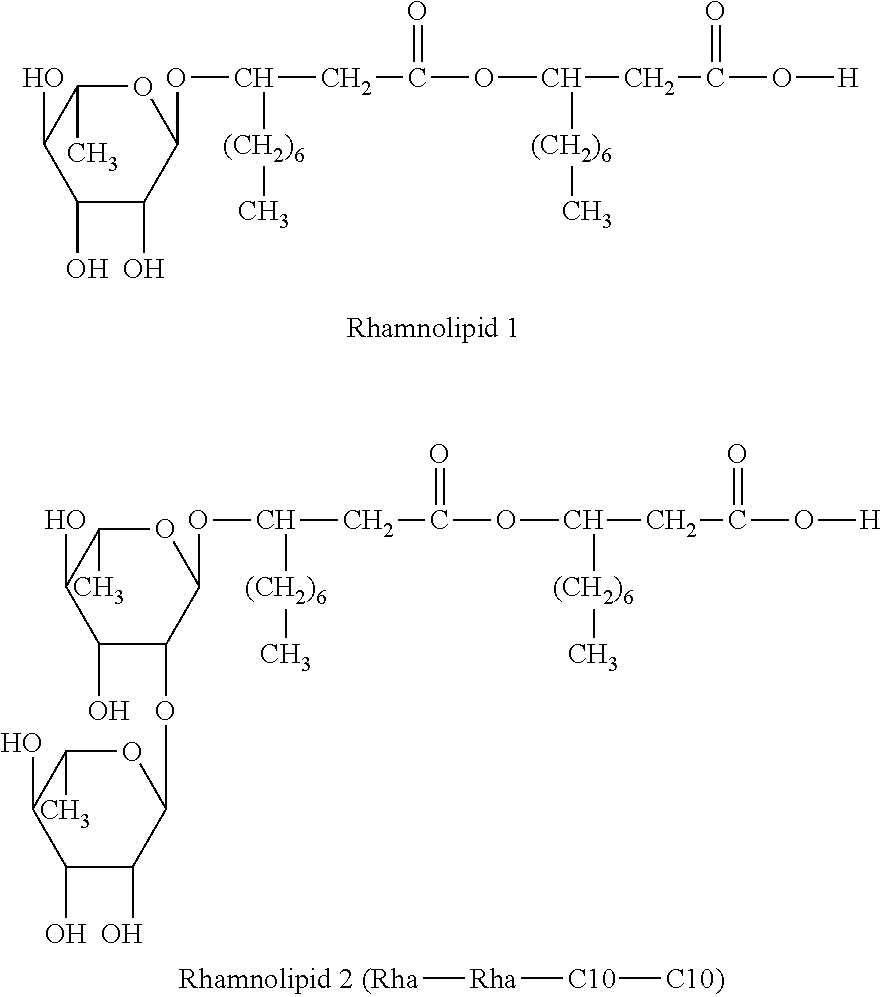
Examples
example 1
[0086]A deionized water solution of rhamnolipids (JBR 515, a mixture of R1 and R2) at 15% concentration was obtained from Jeneil Biosurfactant Co., LLC (Saukville, Wis.). The rhamnolipid solution was diluted in water to 0.5% (w / w) and applied to a subject that suffered from perennial rhinitis. The same 0.5% (w / w) rhamnolipid formulation was also used in Examples 3-8.
[0087]The 0.5% rhamnolipid formulation was applied to the subject. A standard Q-Tip was dipped into the 0.5% rhamnolipid formulation and then the Q-Tip was applied gently onto the intranasal areas of the subject; the subject's intranasal area had eschars due to excessive mechanical rubbing of the assessable intranasal areas with paper handkerchiefs for excessive itching and nasal discharge associated with his perennial rhinitis.
[0088]The symptoms of his allergic rhinitis (nasal congestion, nasal hypersecretion, and sneezing) disappeared almost immediately for approximately 4 hours.
[0089]After 4 hours on the day of the fi...
example 2
Objective
[0091]The objective of this study was to evaluate the efficacy of rhamnolipid in treating rhinitis in an animal model.
Material
Animal:
[0092]Female BALB-c mice each weighing 20-30 grams were used in this study.
[0093]The followings were used to sensitize the mice:[0094]1. 0.5 ml saline (0.9% sodium chloride), containing 25 μg of OVA (grade V, Sigma Chemical Co., St. Louis, Mo., USA) and 2 mg of aluminum hydroxide (alum) (pH 5.5, 308 mOsmol L−1) were used as intraperitoneal injection;[0095]2. 5 μl of 5% ovalbumin solution in saline was instilled in each nostril. Isoflurane (an anesthetic agent) was given prior to the intranasal administrations.
Rhamnolipids:[0096]5 μl of 0.5% rhamnolipids (ABI-100, a mixture of rhamnolipid 1 and rhamnolipid 2) in saline was administered for each nostril.
Method
[0097]Mice were sensitized by 5 weekly intraperitoneal injection of ovalbumin (at Day 1, 8, 15, 22, and 29). After the 5 weekly intraperitoneal injections, from Day 32-50), mi...
example 3
[0104]The 0.5% (w / w) rhamnolipid formulation (same as that described in Example 1) was applied to a healthy male, 66 years old, who had a history of mild nasal congestion. The rhamnolipid formulation was applied to the subject as 2 intranasal administrations, separated by 5 minutes, using Q-Tips soaked in the rhamnolipid formulation (a new Q-tip for every application). Each Q-Tip was dipped into the 0.5% rhamnolipid formulation and then applied by the subject gently onto the intranasal surfaces of the subject. The subject reported within minutes of dosing that his nasal passages were clearer, and this feeling lasted for 4 hours.
PUM
| Property | Measurement | Unit |
|---|---|---|
| time | aaaaa | aaaaa |
| w/w | aaaaa | aaaaa |
| thick | aaaaa | aaaaa |
Abstract
Description
Claims
Application Information
 Login to View More