
Method for extracting Staphylococcus aureus antigen, reagent for extracting Staphylococcus aureus antigen, and method for assessing Staphylococcus aureus
a staphylococcus aureus and staphylococcus aureus technology, applied in the field of reagent for extracting staphylococcus aureus antigen, and method for assessing staphylococcus aureus, can solve the problems of long culturing time, undesirable to employ methods of treating mrsa-infected patients, and difficult to treat infection, etc., to achieve efficient extraction of pbp2
- Summary
- Abstract
- Description
- Claims
- Application Information
AI Technical Summary
Benefits of technology
Problems solved by technology
Method used
Image

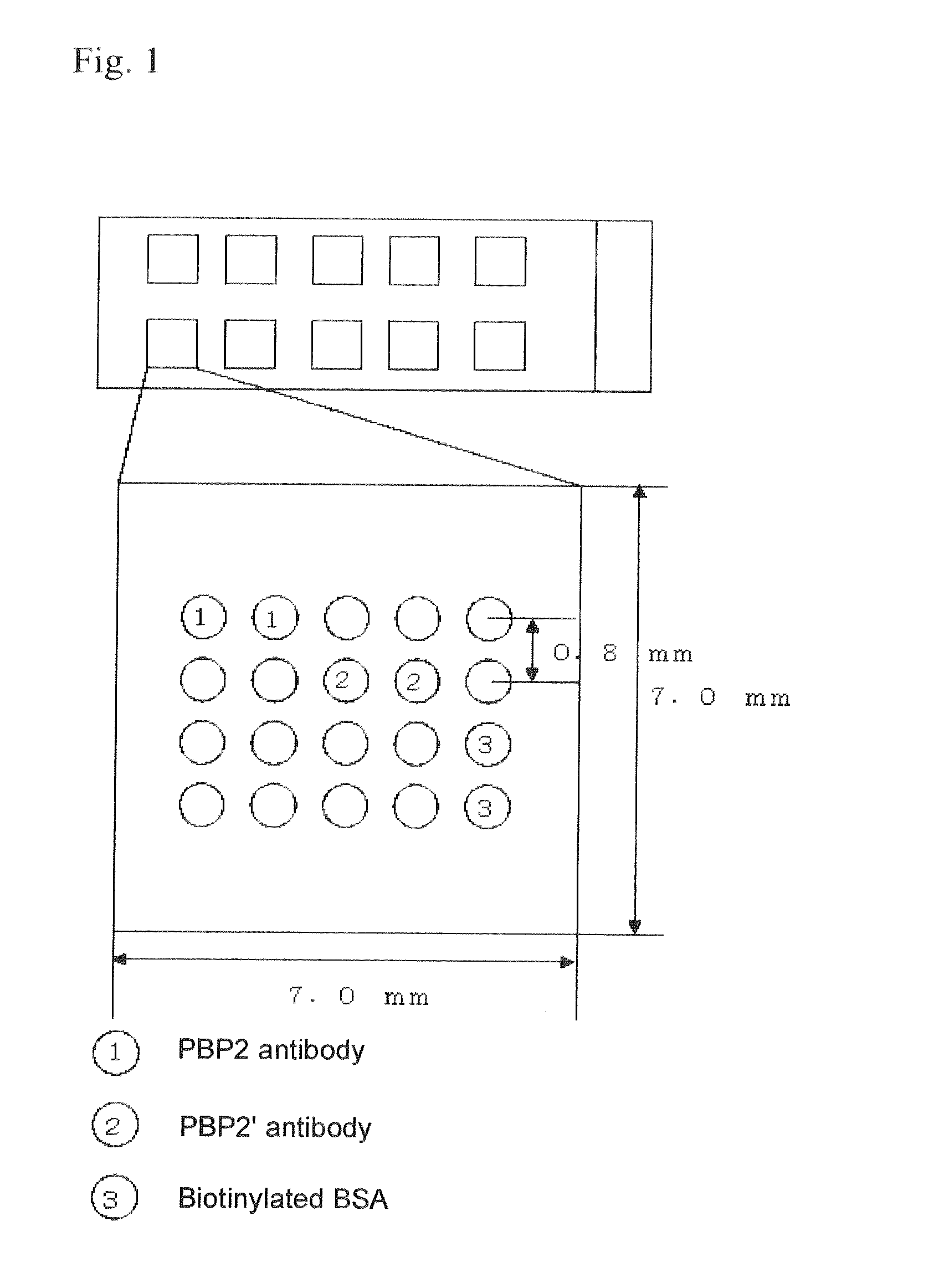
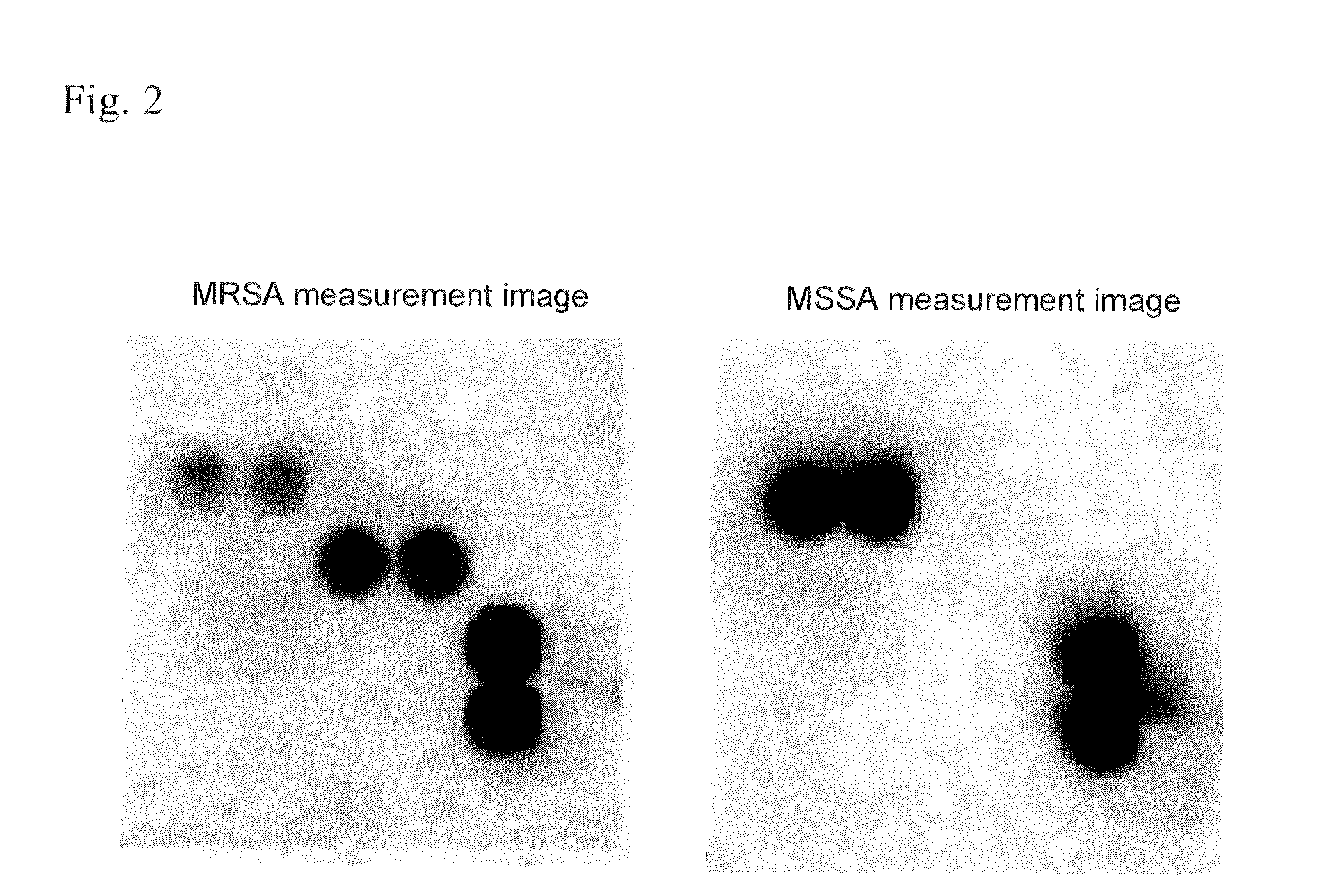
Examples
example 1
Preparation of Staphylococcus Antigen Extraction Reagent and Extraction of Staphylococcus aureus Antigen from MRSA
[0091]1. Preparation of MRSA Specimen
[0092]After dissolving 17 g of Brain Heart Broth (Catalog No.: 110493, Merck) in 100 ml of water, the mixture was subjected to autoclave sterilization at 121° C. for 20 minutes to prepare a culture medium. A clinically isolated MRSA strain was seeded in the medium and cultured at 37° C. for 48 hours. Upon completion of the culturing, the cells were collected by centrifugal separation and lysed in 10 ml of 20 mM phosphate buffer (pH 7.2). Next, the lysed MRSA cell solution (50 μl) was dispensed into a microtube and the supernatant was removed by centrifugal separation.[0093]2. Antigen Extraction from MRSA using Staphylococcus aureus Antigen Extraction Reagent
[0094]A Staphylococcus antigen extraction reagent comprising 0.1 M HCl and a Staphylococcus antigen extraction reagent comprising 0.1 M HCl and different 2.0% (w / w) surfactants (bo...
example 2
Detection of MRSA by Western Blotting
[0106]Following the method described in Example 1, antigen was extracted from a clinically isolated strain of MRSA, and was electrophoresed according to the method of Shagger et al. Purified antigen was simultaneously electrophoresed as a standard sample. Following the electrophoresis, the electrophoresed extracted antigen was immobilized on a PVDF membrane according to the method of Towbin et al. (Towbin et al, Proc. Natl, Acad, Sci. USA, vol. 76, p. 4350-4354(1979)). Next, the portion without the protein being immobilized on the PVDF membrane was blocked with TBS buffering solution containing 2% BSA.
[0107]On the blocked PVDF membrane there was dropped polyclonal antibody for PBP2′ or PBP2, diluted 1,000-fold with 1% BSA TBS-Tween 0.1%, and the membrane was allowed to stand at room temperature for 1 hour. The PVDF membrane was then rinsed with TBS-T (Tween20 concentration: 0.1%) to remove the unreacted polyclonal antibody. Next, peroxidase-label...
example 3
Discrimination of MRSA and MSSA Using Method for Assessing Staphylococcus aureus According to the Invention
[0111]In order to confirm that MRSA and MSSA can be discriminated by the method for assessing Staphylococcus aureus according to the invention, 3 strains each that were clinically isolated strains previously confirmed as MRSA or MSSA were used in a discrimination test for MRSA and MSSA. Each strain was cultured by the same method as in Example 1, and the collected cells were suspended in 200 μl of a 0.1 M HCl±2.0% Tween20 solution (pH≦5.0), as the extraction reagent. The cell suspension was boiled for 2 minutes in boiling water and cooled on ice, and then 0.1 M NaOH (200 μl) and 100 mM phosphate buffer (pH 8.0, 20 μl) were added to the cell suspension for neutralization to pH 6.0-8.0. This was followed by centrifugation at 1,500×g for 5 minutes, and the supernatant was used as specimen and supplied for the immunoassay method described in 4. of Example 1.
(Results and Discussion)...
PUM
| Property | Measurement | Unit |
|---|---|---|
| temperature | aaaaa | aaaaa |
| extraction efficiency | aaaaa | aaaaa |
| extraction efficiency | aaaaa | aaaaa |
Abstract
Description
Claims
Application Information
 Login to View More