
Soybean blossoming regulator gene GmCIB5, encoding protein and application thereof
A technology for regulating genes and soybeans, applied in the field of genetic engineering, can solve the problems of difficult soybean flowering habit and no fundamental changes in soybeans.
Patent Information
- Authority / Receiving Office
- CN · China
- Patent Type
- Applications(China)
- Current Assignee / Owner
- Publication Date
- 2010-12-22
- Estimated Expiration
- Not applicable · inactive patent
Smart Images
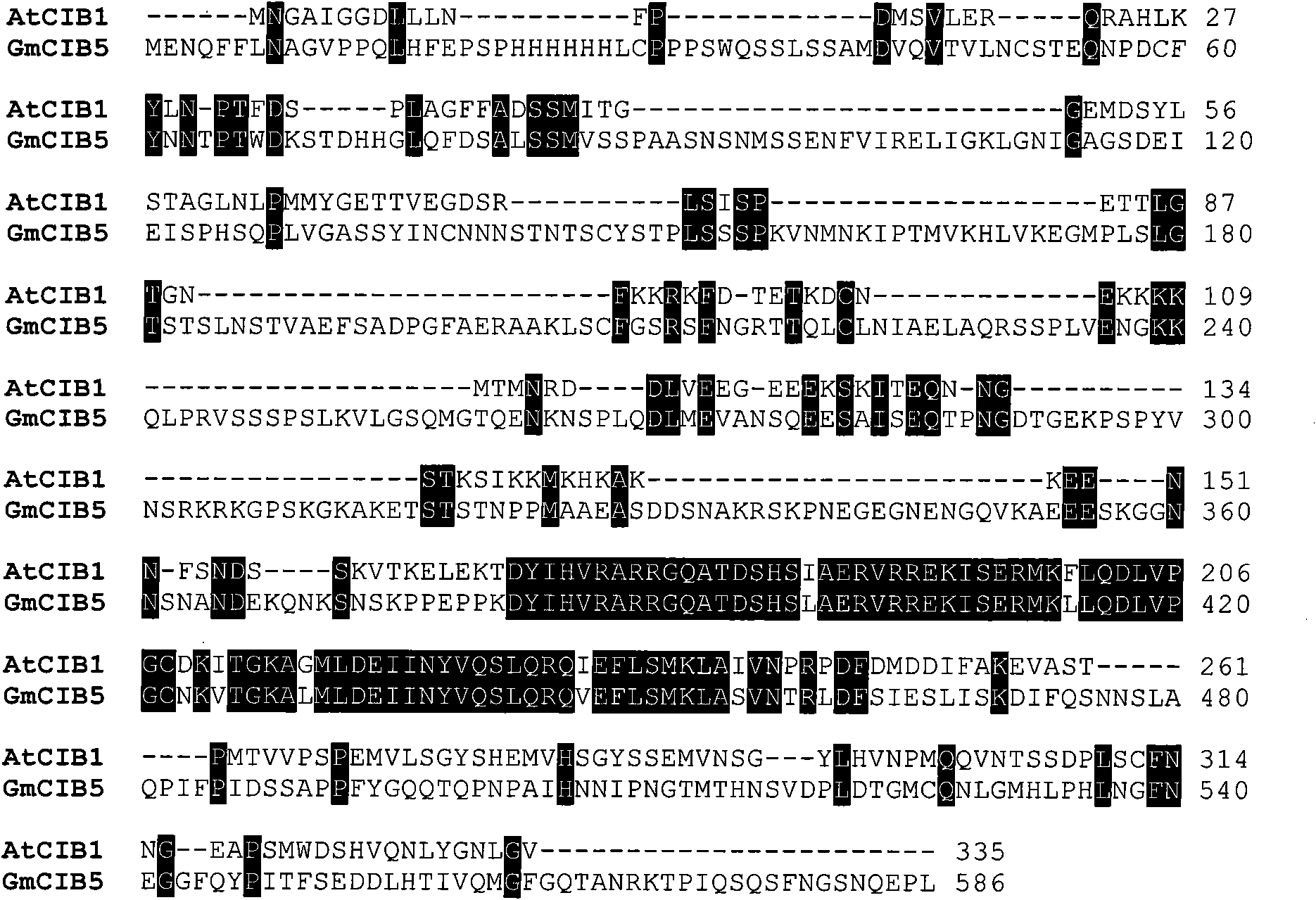
Figure 1 
Figure 2 
Figure 3
Abstract
Description
technical field
[0001] The invention relates to the field of genetic engineering, in particular to soybean flowering regulator gene GmCIB5, its encoded protein and its application in plant photoperiod and flowering time regulation. Background technique
[0002] Soybean is one of the important crops, and it is an important source of plant protein, edible oil, biodiesel, and secondary metabolites such as isoflavones and lecithin. Because soybean is a short-day plant, flowering is strictly controlled by photoperiod, so excellent varieties in different regions cannot be introduced to each other, and the growth period is also restricted by environmental photoperiod. If the sensitivity of soybean to photoperiod can be reduced, and the limitation of soybean flowering to photoperiod can be broken, the problem of soybean introduction can be solved, so as to realize the mutual exchange of high-quality varieties in various regions, enrich excellent germplasm resources in various region...
Examples
Embodiment 1
[0023] Example 1 Isolation and Cloning of GmCIB5 Gene
[0024] According to the CDS (code sequence) sequence of the Arabidopsis CIB1 gene, a homology comparison was performed on the http: / / www.phytozome.net website, and a batch of soybean homologous sequences were found, among which the CDS sequence of GmCIB5 was on the soybean genome The position is Glyma08g46040.1, PCR amplification primers were designed, forward primer F1: 5′-ATGGAAAACCAATTCTTTCTCAATG-3′ and reverse primer R1: 5′-TCATAGGGGTTCTTGATTTGAGC-3′. Using the total soybean cDNA as a template, PCR was performed to obtain the complete sequence of GmCIB5, the nucleotide sequence of which is shown in SEQ ID NO.1.
[0025] The total PCR reaction system is 25 μL, including soybean cDNA (50ng) 1 μL; dNTP (2.5mM) 2.5 μL; primer F1 (10 μM) 1 μL; primer R1 (10 μM) 1 μL; LATaq enzyme (5U / μL) 0.3 μL; 10× buffer Solution 2.5μL; ddH 2 O 16.7 μL, a total of 25 μL. The PCR reaction program was: 94°C pre-denaturation for 5 minute...
Embodiment 2
[0026] Example 2 Analysis and identification of GmCIB5 gene
[0027] The full-length CDS sequence of GmCIB5 is 1761bp, encoding a 586AA protein, which has 36.4% homology with Arabidopsis CIB1 protein. Protein structure analysis shows that its C-terminus contains a basic helix-loop-helix structure, which is a conserved domain of bHLH family transcriptional regulators, which regulates gene transcription by binding to the E-box in DNA; protein N The end also contains an NLS, which is associated with nuclear import.
[0028] According to the sequence query results on NCBI (www.ncbi.nlm.nih.gov), so far, there is no sequence information similar to CIB1 in soybean; and there are no published papers related to its function research. Therefore, it is considered that GmCIB5 is a new gene in soybean.
Embodiment 3
[0029] Example 3 Obtaining of transgenic Arabidopsis thaliana
[0030] According to the sequence information of GmCIB5, PCR amplification primers were designed at both ends of its CDS, forward primer F1: 5′-ATGGAAAACCAATTCTTTCTCAATG-3′ and reverse primer R1: 5′-TCATAGGGGTTCTTGATTTGAGC-3′. The complete sequence of GmCIB5 was obtained by PCR using the total soybean cDNA as a template.
[0031] The total PCR reaction system is 25 μL, including soybean cDNA (50ng) 1 μL; dNTP (2.5mM) 2.5 μL; primer F1 (10 μM) 1 μL; primer R1 (10 μM) 1 μL; LATaq enzyme (5U / μL) 0.3 μL; 10× buffer Solution 2.5μL; ddH 2 O 16.7 μL, a total of 25 μL. The PCR reaction program was: 95°C pre-denaturation for 5 minutes, 30 cycles at 94°C for 30s, 53.5°C for 30s, 72°C for 2 minutes, and finally 72°C for 10 minutes. The above PCR procedure was repeated three times, and the three PCR products were combined for agarose gel electrophoresis, and then the purified PCR product was recovered by cutting the gel.
...