
Process for producing dimethyl carbonate from industrial synthetic gas
A technology of dimethyl carbonate and synthesis gas, which is used in the preparation of carbonate/haloformate, the reaction preparation of carbon monoxide or formate, and the chemical industry, which can solve the problems of ineffective recovery of heat energy and energy loss.
Patent Information
- Authority / Receiving Office
- CN · China
- Current Assignee / Owner
- Publication Date
- 2013-11-27
Smart Images
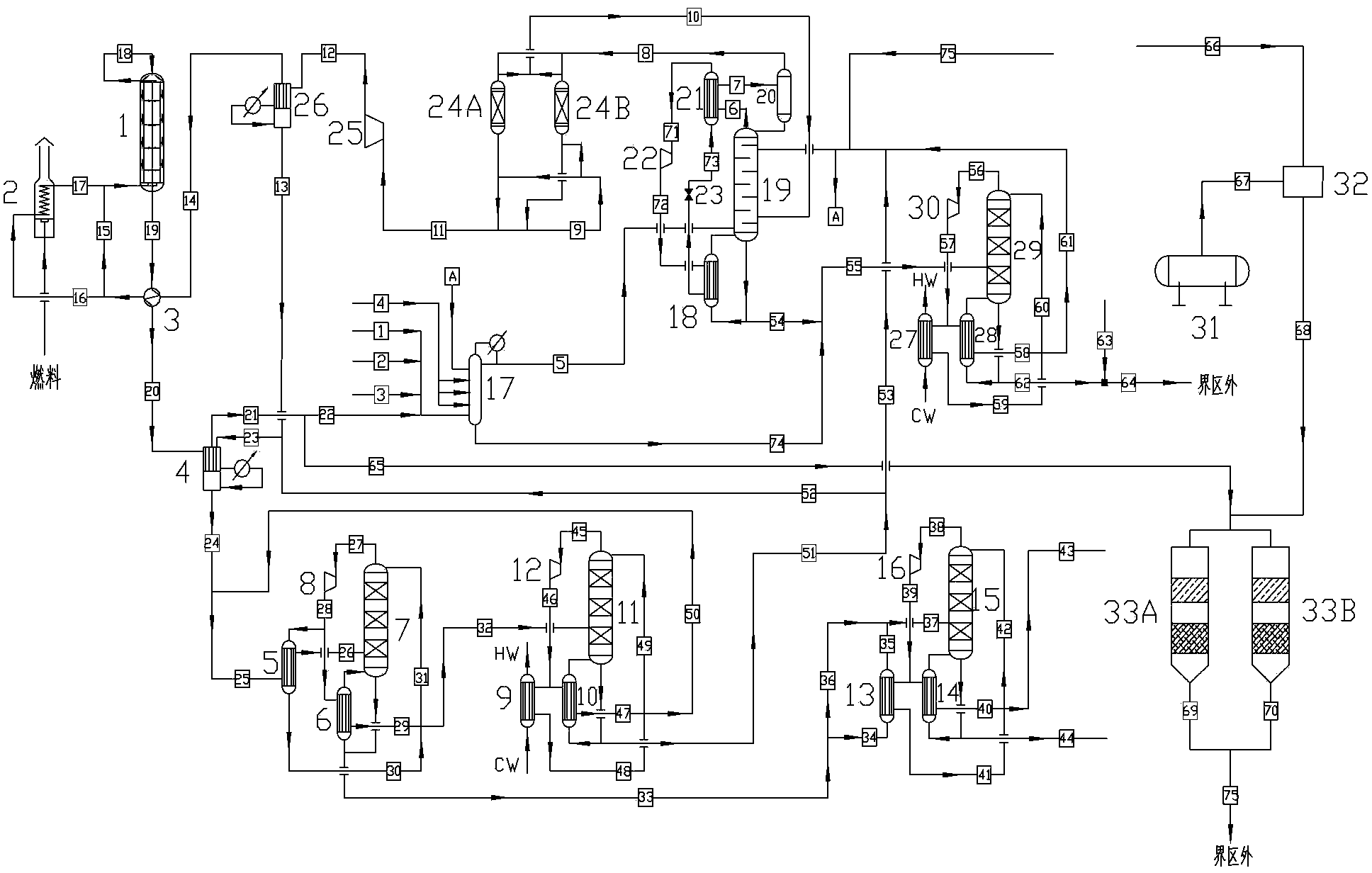
Figure 1
Abstract
Description
technical field
[0001] The invention relates to a process for producing dimethyl carbonate from industrial synthesis gas, in particular to a process for energy-saving and environment-friendly large-scale industrial synthesis of dimethyl carbonate. Background technique
[0002] Dimethyl carbonate (English name Dimethyl carbonate), is a colorless transparent liquid at room temperature, can be mixed with organic solvents such as alcohols, ketones, and esters in any proportion, slightly soluble in water, with a melting point of 4°C, a boiling point of 90.3°C, and a flash point of 18°C , density 1.069. DMC is a green organic compound with less toxic esters and is biodegradable. It can replace highly toxic phosgene and dimethyl sulfate as carbonylating and methylating agents, and is used in the production of pesticides, pharmaceuticals, polycarbonates and polyurethanes. At the same time, it is widely used in organic synthesis, reagents, solvents, oxygenates, dyes, electronic che...
Examples
Embodiment 1
[0141] In this example, refer to the attached figure 1 The apparatus and procedures shown set up the various reaction components.
[0142] Industrial-grade CO (98V%), which is the reaction raw material of carbonylation reactor 1, and nitrogen, which is an inert gas source, are used together as a pre-esterification tower 17 (inner diameter 160mm, height 1500mm, theoretical plate number 20, and the plate structure is sieve plate type plate reaction distillation tower) reaction hot dilution gas and cycle gas (composition: CO: 10.7v%, CO 2 :2.4v%, MN: 9.6v%, N 2 : 63.9v%, Methanol: 2.6v%, DMC: 0.8v%, NO: 10v%) and NO from outside the boundary area are mixed and then enter the pre-esterification tower 17 (the 16th tray is fed and fed), and the separated Oxygen entering the pre-esterification tower 17 from the three routes (feeding at the 2nd, 6th and 10th trays) and the methanol raw material fed into the first tray at the top of the tower are countercurrently contacted on the tra...