
Supported metallocene catalyst, its preparation method and application
A metallocene catalyst and supported technology, applied in the field of supported metallocene catalysts, can solve the problems of affecting the polymer shape, easily broken catalyst particles, low strength of magnesium chloride support, etc., and achieve high olefin polymerization activity, controllable composition and content , the effect of catalyst cost and polymerization cost reduction
Patent Information
- Authority / Receiving Office
- CN · China
- Current Assignee / Owner
- Publication Date
- 2014-02-05
- Estimated Expiration
- Not applicable · inactive patent
Smart Images
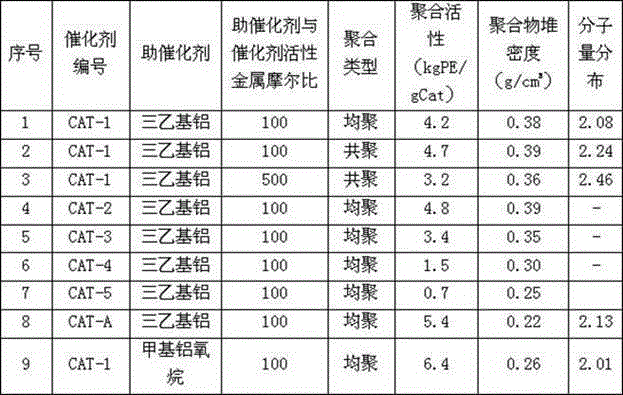
Figure 1
Abstract
Description
Technical field
[0001] The invention involves a load -load metal catalyst.Specifically, the present invention involves a load -loaded metal catalyst, its preparation method, and its application in an olefin.
[0002] Background technique
[0003] Metal luminous cooperation is used to catalyze the advantages of high activity and controllable polymer structures, but there is also a serious adhesive phenomenon during the polymerization process. At the same timehigh.The loading technology of Mao Metal is a carrier that fixes metal limats through physical or chemical means. In addition to the characteristics of the Mao metal catalyst, the load catalyst also has many advantages: (1) the active center is fixed on the carrier on the carrier, Reducing the probability of biomolecules and β-hydrogen disappearance, which increases the stability of catalysts, thereby reducing the amount of methane of methyl aluminum, and also increases the molecular weight of the polymer; (2) the characterist...
Examples
preparation example Construction
[0015] According to the present invention, it relates to a supported metallocene catalyst and a preparation method thereof, comprising the following steps: dissolving a magnesium compound in a solvent in the presence of alcohol to obtain a magnesium compound solution; making the porous a step of mixing the carrier with the magnesium compound solution to obtain a carrier slurry; drying the carrier slurry to obtain a composite carrier; treating the composite carrier with an alkylaluminum to obtain an active carrier; and treating with a metallocene compound The active carrier is the step of obtaining a supported catalyst.
[0016] The steps for obtaining the magnesium compound solution are specifically described below.
[0017] According to this step, the magnesium compound solution is obtained by dissolving a magnesium compound in an appropriate solvent (ie, a solvent for dissolving the magnesium compound) in the presence of alcohol.
[0018] As the solvent, for example, C 6-1...
Embodiment 1
[0095] The porous carrier adopts silicon dioxide, that is, silica gel, and the model is ES757 of Ineos Company. Firstly, the silica gel was continuously fired at 600° C. under nitrogen atmosphere for 4 hours to thermally activate it. Magnesium chloride is used as the magnesium compound, butanol is used as the alcohol, tetrahydrofuran is used as the solvent for dissolving the magnesium compound, titanocene dichloride is used as the metallocene compound, and triethylaluminum is used as the alkyl aluminum reagent.
[0096] Weigh 2.5g of anhydrous magnesium chloride, add a certain amount of butanol and tetrahydrofuran, heat to 60°C to dissolve, add silica gel to form a carrier slurry, stir for 2 hours, heat evenly to 90°C and directly vacuum-dry to obtain a composite carrier.
[0097] Measure 25ml of hexane solvent, add it to the composite carrier, add triethylaluminum dropwise for 15 minutes under stirring condition, react at 60°C for 4 hours, filter, wash with hexane three times...
Embodiment 2
[0103] Basically the same as Example 1, but with the following changes:
[0104] The magnesium compound was changed to magnesium ethoxide, the alcohol was changed to ethanol, the metallocene compound was zirconocene dichloride, and the magnesium oxide mixed oxide was continuously calcined at 600° C. under an argon atmosphere for 4 hours. The carrier slurry was vacuum dried at 80°C.
[0105] The ratio is: the molar ratio of magnesium compound to alcohol is 1:1; the ratio of magnesium compound to solvent for dissolving magnesium compound is 1mol:240ml; the molar ratio of magnesium compound to metallocene compound is 1:0.006; the ratio of magnesium compound to porous carrier The mass ratio is 1:1; the molar ratio of magnesium compound to alkylaluminum reagent is 1:1.
[0106] This catalyst is designated CAT-2.
[0107]