
Biological scaffold and preparation method and application thereof
A bio-scaffold and bio-matrix technology applied in the field of biomedicine to achieve the effects of shortening gelation time, improving cell viability, and maintaining stability
Patent Information
- Authority / Receiving Office
- CN · China
- Patent Type
- Applications(China)
- Current Assignee / Owner
- Publication Date
- 2019-08-30
Smart Images
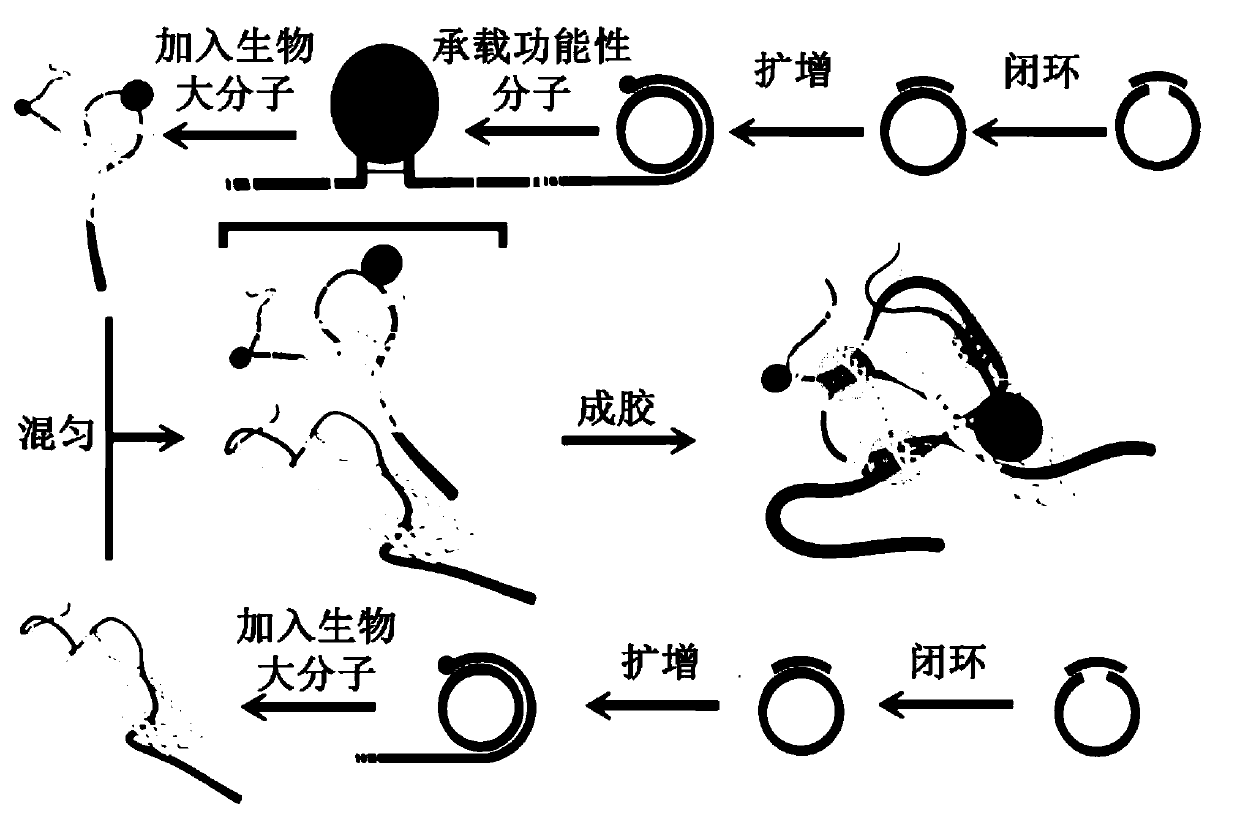
Figure 1 
Figure 2 
Figure 3
Abstract
Description
technical field
[0001] The invention belongs to the technical field of biomedicine, and relates to a biological scaffold and its preparation method and application. Background technique
[0002] In recent years, cell transplantation therapy has achieved great development and has been widely used in the treatment of trauma, endometrial injury, heart failure, liver failure, spinal cord injury and type I diabetes. Bioscaffolds that support cell growth in regenerative medicine play a vital role in mimicking the growth and development of human organs. Under the dual regulation of physical factors (such as viscoelasticity, porosity, surface topography) and biological factors (such as biocompatibility, biodegradability, antigenicity / immunogenicity), novel scaffold materials can be remodeled by cells , promote morphogenesis, bind cell surface receptors and release growth factors.
[0003] At present, the clinically common biological matrix gel is mostly hyaluronic acid (HA), which...
Examples
Embodiment 1
[0078] Example 1 DNA rolling circle amplification and purification
[0079] Design a nucleic acid aptamer targeting VEGF and perform rolling circle amplification to obtain long-chain DNA with a length of more than 10,000 nt. The specific steps are as follows:
[0080] (1) Annealing: the reaction system is H 2O 150.8 μL, 5.2 μL of 10×T4 ligase buffer, 12 μL of 5 μM complementary strand template, 12 μL of 10 μM nucleic acid aptamer template, after mixing, incubate at 90 ° C for 10 min at 300 rpm, and slowly cool to room temperature;
[0081] (2) Ligation: The reaction system is 180 μL of annealed product, 14.8 μL of 10×T4 ligase buffer, 5.2 μL of 10U / μL T4 ligase, after mixing, incubate at 16°C at 300r for 16h, then at 65°C at 300r Incubate at rotating speed for 10 minutes, and slowly cool to room temperature;
[0082] (3) Rolling circle amplification (RCA): the reaction system is H 2 O 300μL, 10×phi29 polymerase buffer 50μL, 100mMdNTP 10μL / type (four bases), ligation product...
Embodiment 2
[0084] Embodiment 2 The preparation of the bioscaffold containing VEGF
[0085] The schematic diagram of the preparation of the bioscaffold is as follows: figure 1 As shown, after the long-chain DNA of the rolling circle amplification product containing the functional site is bound to the functional molecule, it is entangled in the biological matrix, and acts as a mechanical lock to lock the biological matrix fiber, partially hybridizes with the complementary strand, and forms in the biological matrix With a mechanical interlocking structure, the sol containing a large number of monodisperse droplets quickly gels under the action of shear force to form a bioscaffold.
[0086] The preparation method steps of the biological support containing VEGF are as follows:
[0087] (1) Mix 5 μL of 0.01 mg / mL VEGF165 with 10 μL of 2 mg / mL RCA product SEQ ID NO: 1, and incubate at 30°C for 30 min at 300 rpm;
[0088] (2) Take 100 μL of type I collagen (containing 1×PBS buffer) at a concen...
Embodiment 3
[0092] Embodiment 3 The preparation of the bioscaffold containing VEGF
[0093] (1) Mix 5 μL of 0.01 mg / mL VEGF165 with 10 μL of 2 mg / mL RCA product SEQ ID NO: 1, and incubate at 30°C for 30 min at 300 rpm;
[0094] (2) Take 500 μL of type I collagen (containing 1×PBS buffer) at a concentration of 2 mg / mL, and mix with 10 μL of 2 mg / mL RCA product SEQ ID NO: 1 and 20 μL of RCA under the condition of pH 6.5 The complementary strand (c-RCA) of SEQ ID NO: 2 was mixed and placed in a metal bath shaker at 0°C for 24 hours at a speed of 1000r;
[0095] (3) After adjusting the pH of the system to 8.0 with 1.0M NaOH, put it in a metal bath shaker at 0°C and incubate at a speed of 1000r for 60min to obtain RCA-collagen complex (RCA-Col) and RCA complementary strand-collagen complex ( c-RCA-Col);
[0096] (4) Shake and mix RCA-Col and c-RCA-Col at 0°C for about 1.5 hours to obtain a DNA-collagen complex (DNA-Col), which is stored at 4°C until use.