
Difunctional electrocatalyst with heterostructure nickel cobalt nitride nanosheet array and preparation and application of difunctional electrocatalyst
A nanosheet array, heterostructure technology, applied in nanotechnology, electrodes, electrolysis process, etc., to achieve the effect of improving catalytic activity, promoting charge transfer, and fast charge transfer
Patent Information
- Authority / Receiving Office
- CN · China
- Current Assignee / Owner
- Publication Date
- 2022-04-15
Smart Images
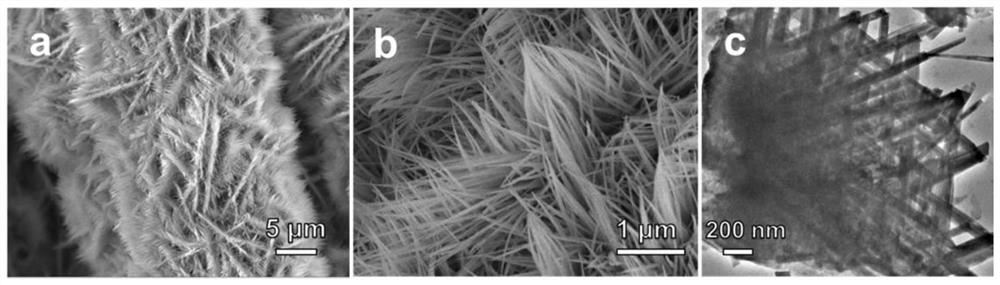
Figure 1 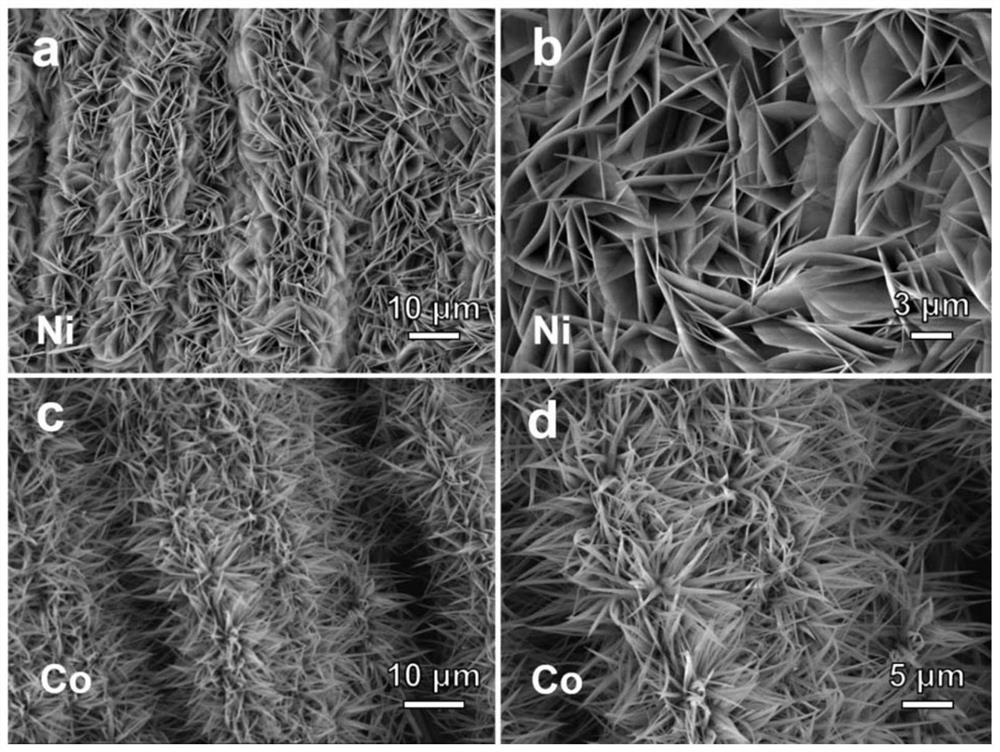
Figure 2 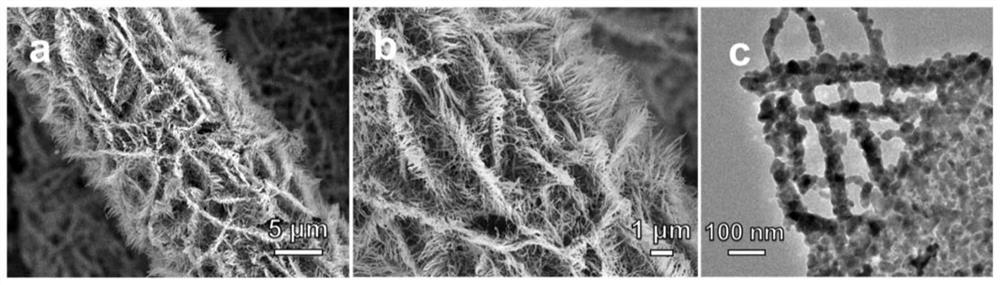
Figure 3
Abstract
Description
technical field
[0001] The invention belongs to the technical field of catalysts, and relates to a bifunctional electrocatalyst with heterostructure nickel-cobalt nitride nanosheet arrays and its preparation and application. Background technique
[0002] Due to the increasingly serious environmental pollution and energy crisis, the development of environmentally friendly renewable energy has attracted much attention. Hydrogen is considered as a promising clean and renewable energy carrier because of its high gravimetric energy density and environmental friendliness. Among various strategies for hydrogen production, electrochemical water splitting is particularly attractive, which can be provided by renewable electrical sources such as solar and wind power. Electrochemical water splitting can be divided into two half-reactions, the oxygen evolution reaction (OER) at the anode and the hydrogen evolution reaction (HER) at the cathode. However, water electrolysis systems usual...
Examples
Embodiment 1
[0047] Preparation of precursor nickel cobalt hydroxide, nickel hydroxide, cobalt hydroxide:
[0048] Weigh 0.476g nickel chloride hexahydrate, 0.476g cobalt chloride hexahydrate and 0.296g ammonium fluoride, dissolve 0.96g urea in 45mL deionized water to form a uniform mixed solution, add this solution to the reaction containing clean carbon cloth The nickel-cobalt bimetallic precursor supported on the carbon cloth can be obtained after hydrothermal reaction at 120°C for 5 hours, and dried in a vacuum oven at 80°C for later use. Similarly, only a single metal salt precursor (corresponding to the addition of only nickel chloride hexahydrate and cobalt chloride hexahydrate, respectively) was added in the hydrothermal process to synthesize nickel nanosheets and cobalt nanowire precursors supported on carbon cloth.
Embodiment 2
[0050] Preparation of nickel-cobalt nitride heterojunction nanosheet bifunctional catalyst and nickel-cobalt nitride catalyst:
[0051] The nickel-cobalt precursor in Example 1, the nickel precursor, and the cobalt precursor are gasified with nitrogen in an ammonia atmosphere to obtain Co-Ni 3 N / CC bifunctional electrocatalysts, and comparative samples of nickel and cobalt nitride catalysts, wherein the nitriding temperature is 500°C, the nitriding time is 2h, and the heating rate is 5°C / min.
[0052] Picture 1-1 The scanning electron microscope and transmission electron microscope images of the nickel-cobalt bimetallic precursor are shown. It can be seen from the figure that the nickel-cobalt precursor is uniformly loaded on the surface of the carbon cloth, and the nickel-cobalt precursor shows a two-dimensional line sheet morphology and the surface smooth. Figure 1-2 The scanning electron microscope images of nickel and cobalt single metal precursors are shown. It can be ...