
Silicon Nanosheet , Nanosheet Solution and Process for Producing the Same, Nanosheet -Containing Composite, and Nanosheet Aggregate
a technology of nano-crystalline silicon and nano-crystalline aggregate, which is applied in the direction of silicon compounds, instruments, transportation and packaging, etc., can solve the problems of low luminous efficiency of nano-crystalline silicon, inability to meet the requirements of nano-crystalline silicon, and the production of nano-crystalline non-oxide silicon, etc., and achieves high luminous efficiency and is useful as an electronic material
Patent Information
- Authority / Receiving Office
- US · United States
- Patent Type
- Applications(United States)
- Current Assignee / Owner
- Publication Date
- 2008-02-28
- Estimated Expiration
- Not applicable · inactive patent
Smart Images
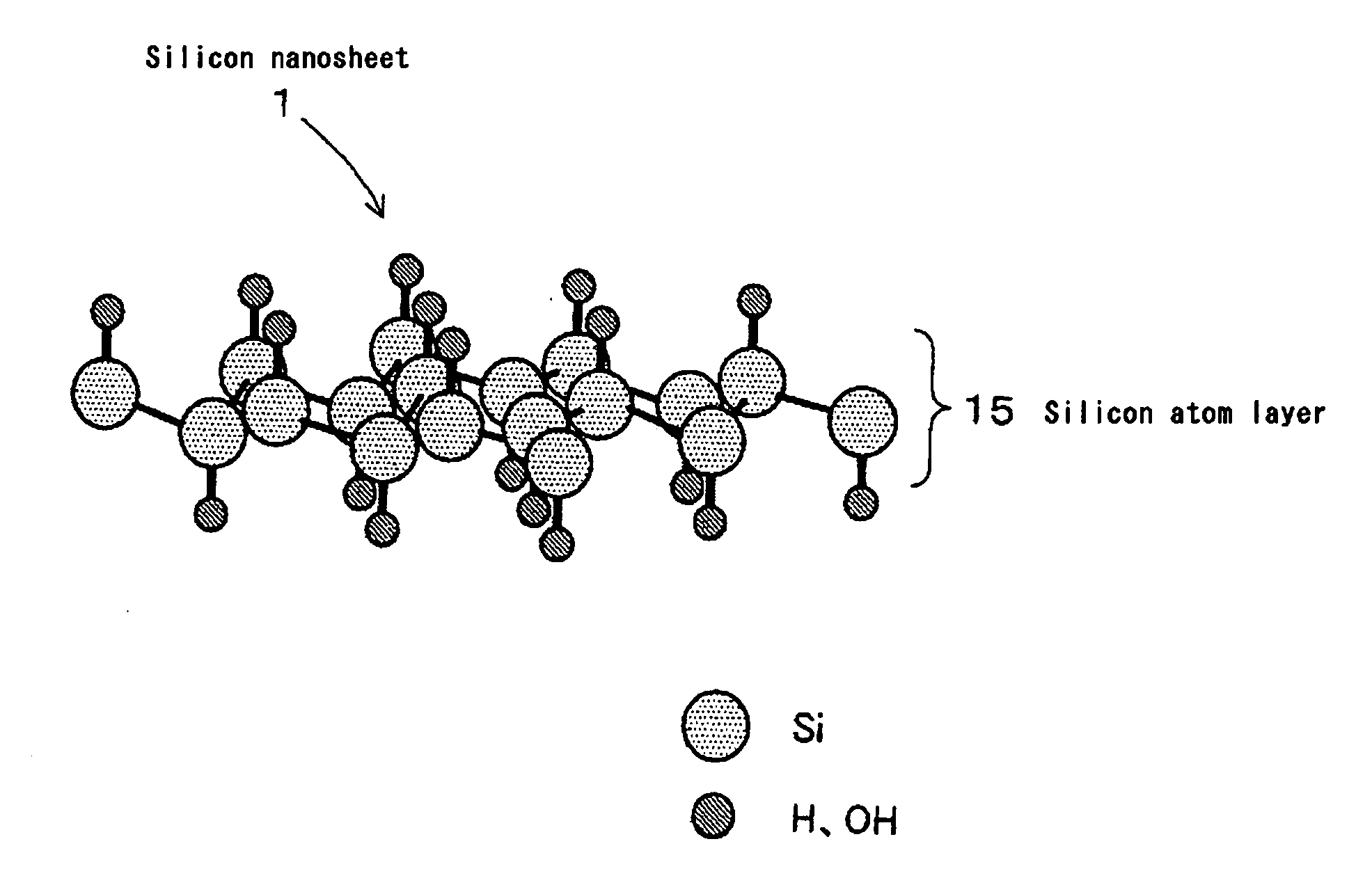
Figure 1 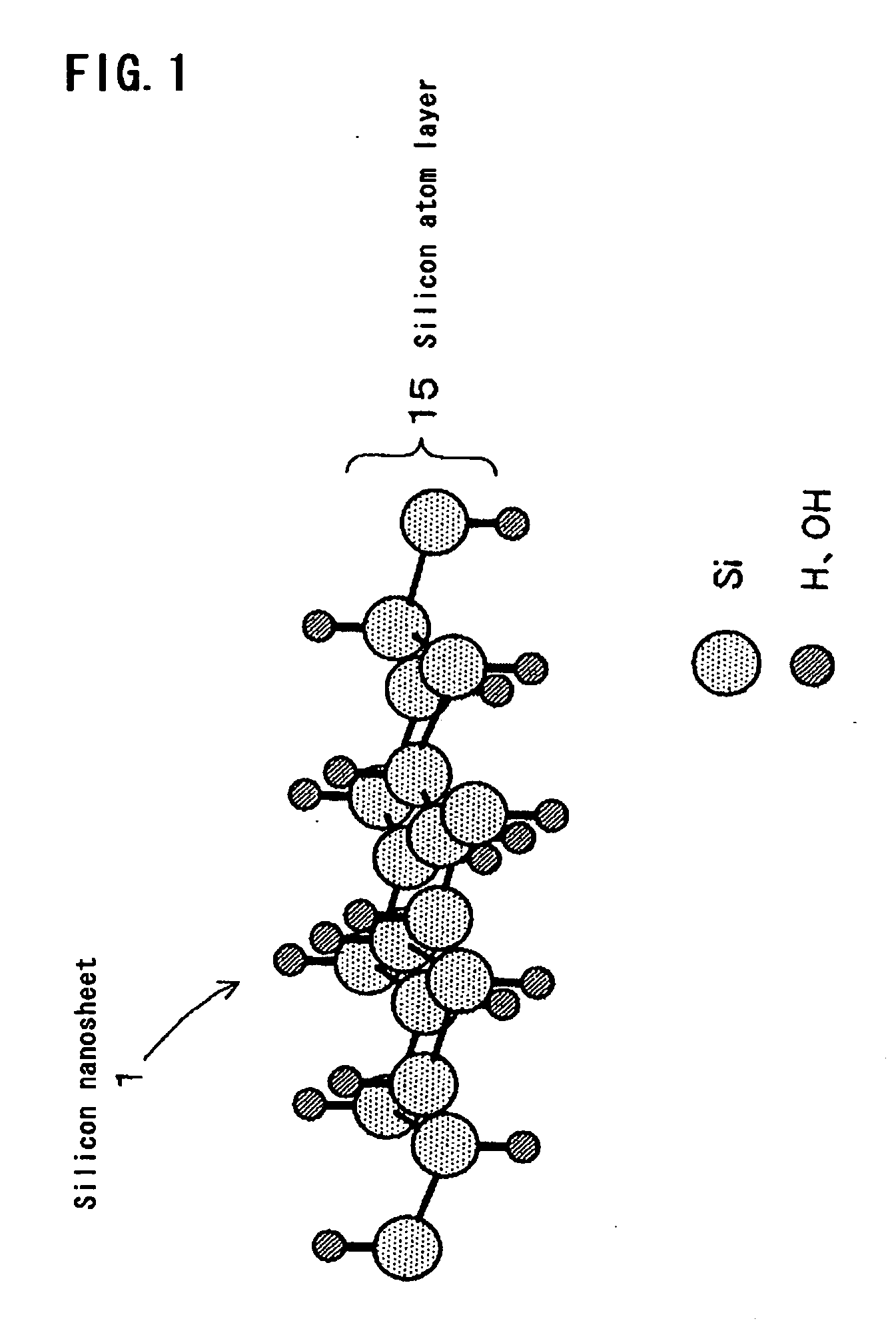
Figure 2 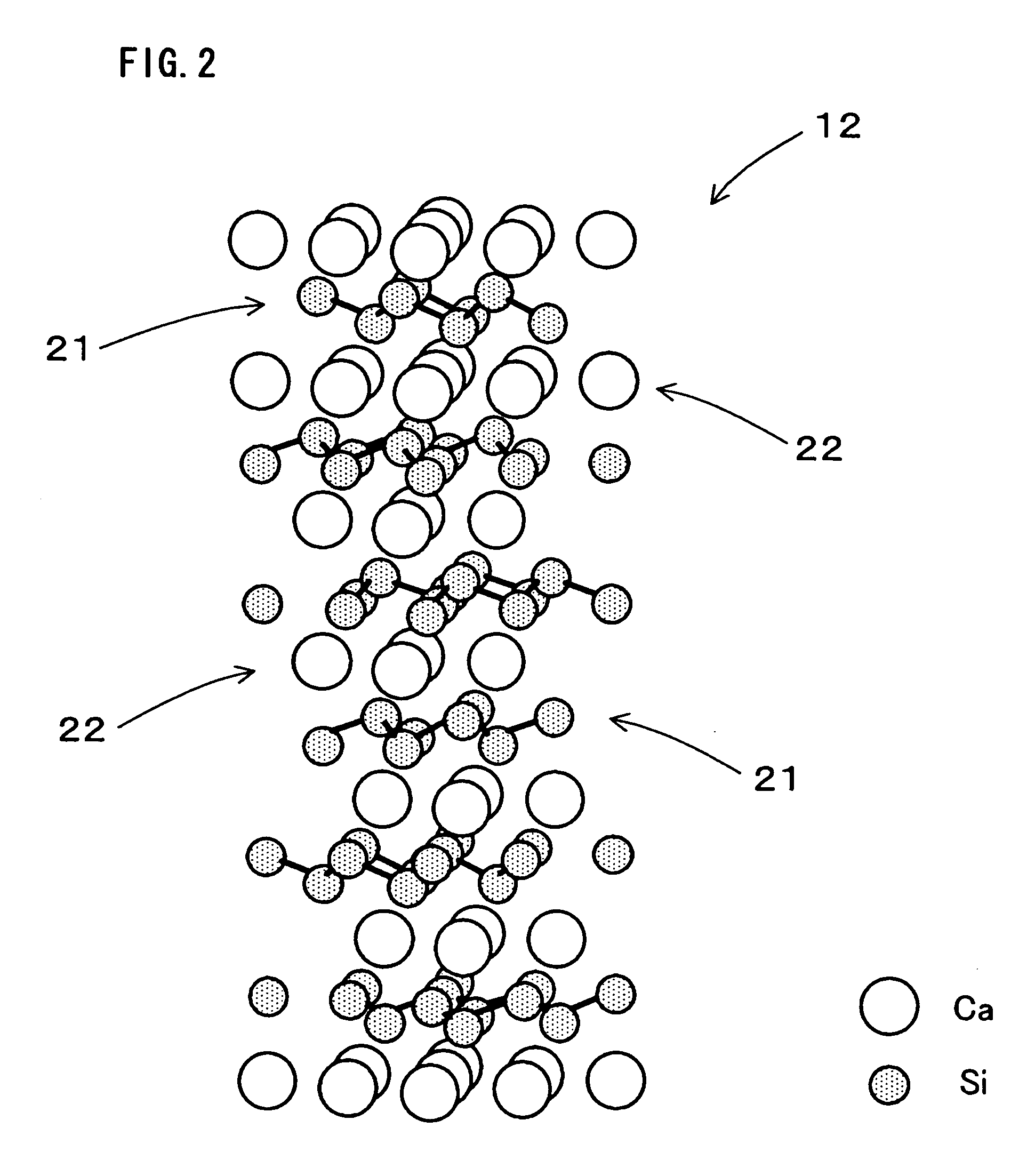
Figure 3
Abstract
Description
FIELD OF THE INVENTION
[0001] The present invention relates to: a silicon nanosheet comprising a single silicon atom layer formed by arranging silicon atoms two-dimensionally and periodically; a silicon nanosheet formed by aggregating plural such silicon atom layers; a nanosheet solution containing the silicon nanosheet and a process for producing the nanosheet solution; a nanosheet aggregate; and a nanosheet-containing composite. BACKGROUND OF THE INVENTION
[0002] Silicon has heretofore been widely used as an important electronic material for a semiconductor integrated circuit, a thin-film transistor, and the like. Silicon has excellent characteristics as a material for an electronic device and is used also as an electronic data processing device such as a DRAM, an LSI, or the like. Meanwhile, a hydrogenated / hydroxylated compound, such as siloxene (Si6O3H6) or the like, which is a compound having a layered silicon skeleton, porous silicon, hydrogenated amorphous silicon, and others...
Examples
example 1
1. Derivation of Weiss Type Siloxene
[0186] A nanosheet solution was produced by using CaSi2 (refer to FIG. 2) as a layered silicon compound. Firstly, CaSi2 powder was brought into contact with concentrated hydrochloric acid (12 N) at a rate of 100 cm3 of the latter to 1 g of the former and was reacted at 0° C. in an argon atmosphere (an acid treatment step). After the reaction for 8 hours, Weiss type siloxene (Si6H3(OH)3.HCl, refer to FIG. 3) of yellowish green was obtained.
[0187] Successively, the powder was filtered and thereafter washed with concentrated hydrochloric acid cooled to 0° C. in an argon atmosphere, and thus CaCl2 as a by-product was removed (a first washing step). Thereafter, the powder was further washed with acetone (a second washing step).
2. Exfoliation of Weiss Type Siloxene
[0188] Next, Weiss type siloxene of 0.2 g was added to a sodium dodecyl sulfate (SDS) aqueous solution having the concentration of 0.1 mol / dm3 and a pH of 5 or less which was adjusted wi...
example 2
[0205] Following the same procedure as described in the item 1 of Example 1, Weiss type siloxene (Si6H3(OH)3.HCl) was produced. Successively, the Weiss type siloxene of 0.2 g was added to a tetrabutyl ammonium (TBAOH, a cationic surfactant) aqueous solution. In this case, the concentration of the tetrabutyl ammonium aqueous solution was set at the same mol concentration as the Cl in the Weiss type siloxene (Si6H3(OH)3.HCl), namely 0.1 mol / dm3. The solution was shaken for 10 days at the rate of about 100 rpm with a shaker (made by As One Corporation) and resultantly a nanosheet solution was obtained.
[0206] In the case of the nanosheet solution obtained in the present example too, in the same way as Example 1, it was confirmed that silicon nanosheets nearly comprising single layered silicon atom layers dispersed in a solvent and had a peak in the visible light region in the measurement of a fluorescence spectrum.
example 3
1. Production of a Nanosheet-Containing Composite
[0207] Following the procedure below, as shown in FIGS. 10 and 11, a nanosheet-containing composite 5 wherein three resin layers 53 and three nanosheet layers 55 were laminated alternately on the surface of a substrate 51 was produced.
[0208] Firstly, a quartz glass substrate 20 mm×20 mm in area and 2 mm in thickness was prepared as the substrate. Further, a nanosheet solution prepared in Example 1 and a polymer solution containing PDADMAC and NaCl were prepared. In the polymer solution, the concentration of the PDADMAC was 1 mg / mL and the concentration of the NaCl was 0.5 M. Furthermore, water was prepared for washing.
[0209] Successively, the glass substrate was immersed in the polymer solution and dried, and thus a resin layer comprising the PDADMAC was formed on the surface of the glass substrate (a resin layer forming step). The glass substrate was washed with water and dried (a washing step). Thereafter, the glass substrate wa...