Supercharge Your Innovation With Domain-Expert AI Agents!

Method of deriving a compressed acoustic model for speech recognition

An acoustic model and leading technology, applied in speech recognition, speech analysis, instruments, etc., can solve problems such as large amounts of memory

Inactive Publication Date: 2010-07-21
CREATIVE TECH CORP
View PDF0 Cites 2 Cited by
  • Summary
  • Abstract
  • Description
  • Claims
  • Application Information

AI Technical Summary

Problems solved by technology

However, the proposed method still requires a relatively large amount of memory

Method used

the structure of the environmentally friendly knitted fabric provided by the present invention; figure 2 Flow chart of the yarn wrapping machine for environmentally friendly knitted fabrics and storage devices; image 3 Is the parameter map of the yarn covering machine
View more

Image

Smart Image Click on the blue labels to locate them in the text.
Viewing Examples
Smart Image
  • Method of deriving a compressed acoustic model for speech recognition
  • Method of deriving a compressed acoustic model for speech recognition
  • Method of deriving a compressed acoustic model for speech recognition

Examples

Experimental program
Comparison scheme
Effect test

Embodiment Construction

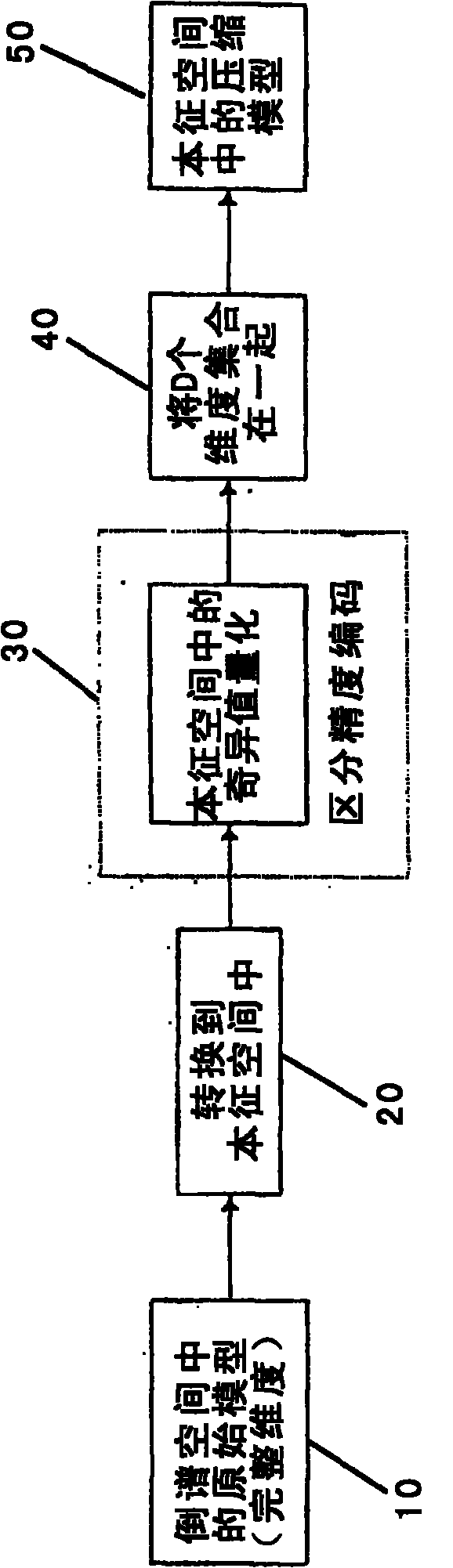
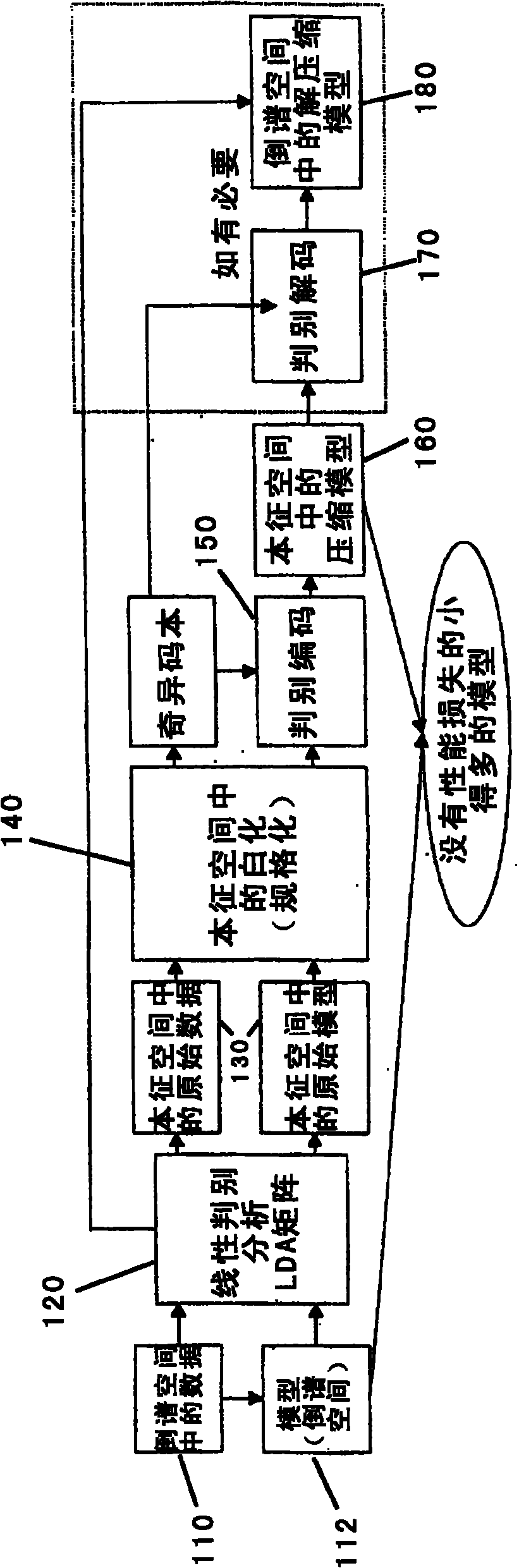
[0019] figure 1 is a block diagram showing a general overview of the preferred process of the present invention for deriving a compressed acoustic model. In step 10, the original uncompressed acoustic model is first transformed and represented in cepstrum space, and in step 20, the cepstrum acoustic model is transformed into eigenspace to determine which parameters of the cepstrum acoustic model are important / useful. In step 30, the parameters of the acoustic model are encoded based on importance / usefulness properties, and then the encoded acoustic features are assembled together in steps 40 and 50 as a compressed model in eigenspace.

[0020] will now be passed by reference figure 2 to describe each of the above steps in more detail.

[0021] At step 110, an uncompressed model of the original signal, such as a speech input, is represented in cepstrum space. A sample of the uncompressed original signal model is taken to form the model 112 in cepstral space. The model 11...

the structure of the environmentally friendly knitted fabric provided by the present invention; figure 2 Flow chart of the yarn wrapping machine for environmentally friendly knitted fabrics and storage devices; image 3 Is the parameter map of the yarn covering machine
Login to View More

PUM

No PUM Login to View More

Abstract

A method of deriving a compressed acoustic model for speech recognition is disclosed herein. In a described embodiment, the method comprises transforming an acoustic model into an eigenspace at step (20), determining eigenvectors of the eigenspace and their eigenvalues, and selectively encoding dimensions of the eigenvectors based on values of the eigenspace at step (30) to obtain a compressed acoustic model at steps (40 and 50).

Description

technical field [0001] The present invention relates to a method of deriving a compressed acoustic model for speech recognition. Background technique [0002] Speech recognition (or, more commonly, automatic speech recognition) has many applications, such as automatic voice response, voice dialing and data entry, to name a few. The performance of a speech recognition system is generally based on accuracy and processing speed, and the challenge is to design a speech recognition system with lower processing power and smaller memory size without compromising accuracy or processing speed. This challenge has grown in recent years with smaller and more compact devices that also require some form of voice recognition applications. [0003] In the paper "SubspaceDistribution Clustering Hidden Markov Model" by Enrico Bocchieri and Brian Kan-Wing Mak, IEEE transactions on Speechand Audio Processing, Vol.9, No.3, March 2001, a method is proposed which reduces the parameter space, lea...

Claims

the structure of the environmentally friendly knitted fabric provided by the present invention; figure 2 Flow chart of the yarn wrapping machine for environmentally friendly knitted fabrics and storage devices; image 3 Is the parameter map of the yarn covering machine
Login to View More

Application Information

Patent Timeline
no application Login to View More
Patent Type & Authority Applications(China)
IPC IPC(8): G10L15/00G10L11/00
CPCG10L15/02
Inventor 许军张化云
Owner CREATIVE TECH CORP
Features
  • R&D
  • Intellectual Property
  • Life Sciences
  • Materials
  • Tech Scout
Why Patsnap Eureka
  • Unparalleled Data Quality
  • Higher Quality Content
  • 60% Fewer Hallucinations
Social media
Patsnap Eureka Blog
Learn More