Data transmission method and communication node
A data transmission method and communication node technology, which is applied in the field of data transmission methods and communication nodes, can solve the problems of no retransmission data, poor reliability of data transmission, etc., and achieve the effect of improving reliability
- Summary
- Abstract
- Description
- Claims
- Application Information
AI Technical Summary
Problems solved by technology
Method used
Image



Examples
Embodiment 1
[0055] This embodiment provides a data transmission method, and this embodiment combines the foregoing embodiments and preferred implementation manners therein. Figure 4 It is a flow chart of data transmission using a synchronous HARQ data retransmission mode when the uplink and downlink resource allocation ratio of a communication node adopting a time division duplex mode changes according to an embodiment of the present invention, as shown in Figure 4 As shown, the method includes:
[0056] Step S402: When the allocation ratio of uplink and downlink resources is mode A, the first communication node uses the first resource to send data to the second communication node in the first transmission time interval.
[0057] Step S404: After the uplink and downlink resource allocation ratio changes to mode B, the first communication node needs to use the second resource to retransmit data to the second communication node at the second transmission time interval, wherein the first t...
Embodiment 2
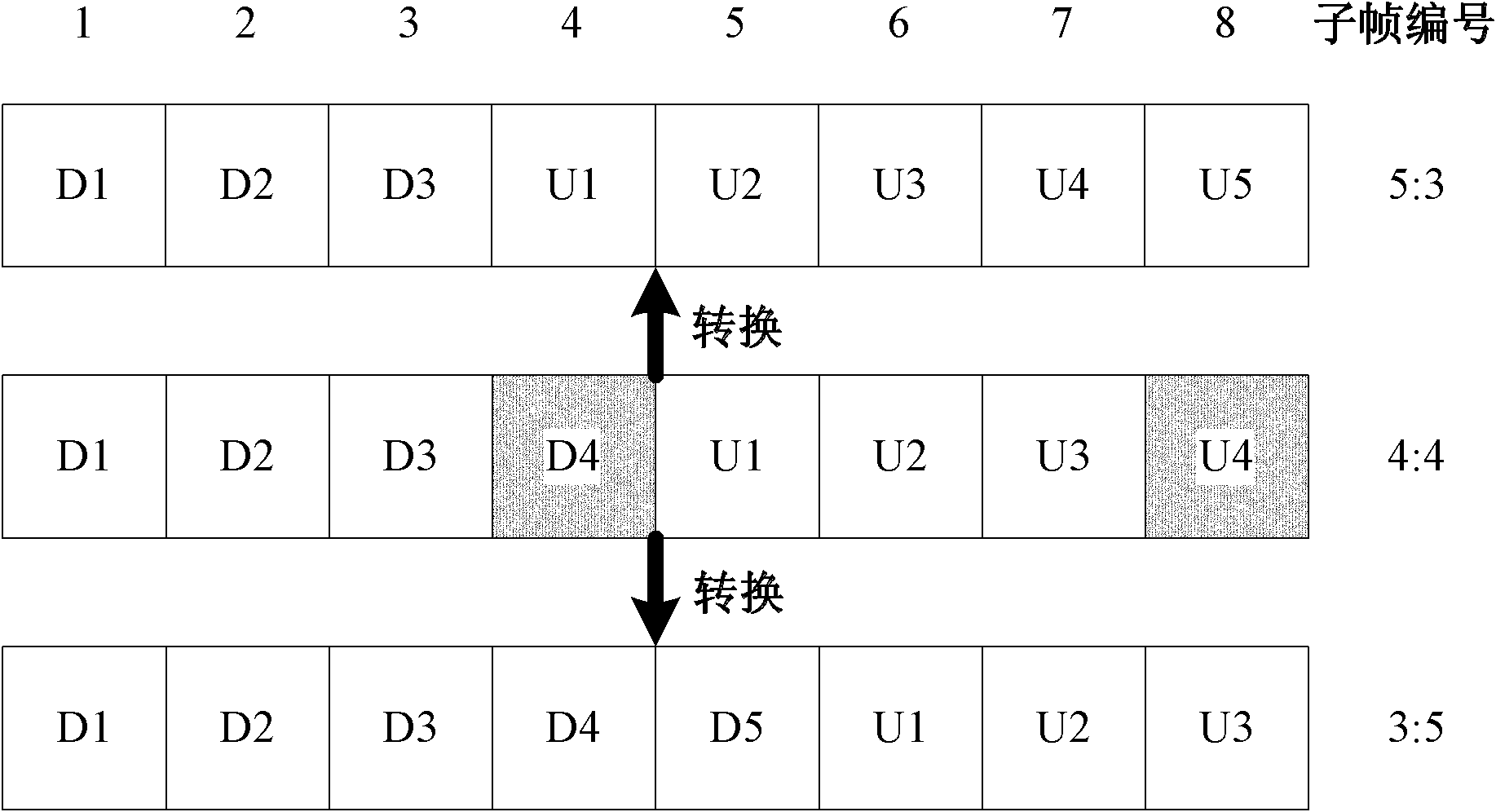
[0066] This embodiment provides a data transmission method, and this embodiment combines Embodiment 1 and preferred implementation manners therein. In this embodiment, in a time-division duplex wireless communication system, one frame is composed of several subframes, assuming 8 subframes, and the initial uplink and downlink resource allocation ratio is mode A (4:4). Due to the uplink and downlink load conditions , cell BS-A (base station) adjusts the uplink and downlink resource allocation ratio to mode B (3:5).
[0067] The terminal MS-A with BS-A as the serving base station sends data through the resource block RB-A on the fourth uplink subframe of the i-th frame (in which BS-A adopts mode A) and is not used by BS-A After successful reception, according to the requirements of mode A, the timing relationship of synchronous HARQ retransmission MS-A needs to retransmit the data on the fourth uplink subframe of the (i+1)th frame, if the (i+1)th frame BS-A If mode B is adopted,...
Embodiment 3
[0070] This embodiment provides a data transmission method, and this embodiment combines Embodiment 1 and preferred implementation manners therein. In this embodiment, in a time-division duplex wireless communication system, one frame is composed of several subframes, assuming 8 subframes, and the initial uplink and downlink resource allocation ratio is mode A (4:4). Due to the uplink and downlink load conditions The cell BS-A (base station) adjusts the uplink and downlink resource allocation ratio to mode B (2:6).
[0071]The terminal MS-A with BS-A as the serving base station sends data through the resource block RB-A on the second uplink subframe of the i-th frame (in which BS-A adopts mode A) and is not used by BS-A After successful reception, according to the requirements of mode A, the timing relationship of synchronous HARQ retransmission MS-A needs to retransmit the data on the sixth subframe of the (i+1) frame, if BS-A adopts the mode in the (i+1) frame B, then the 6...
PUM
 Login to View More
 Abstract
Description
Claims
Application Information
 Login to View More