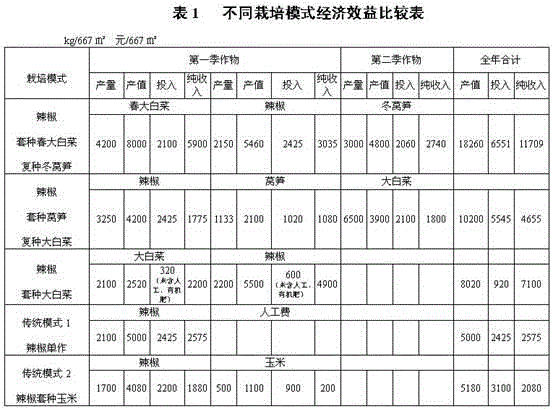
Three-time harvest cultivation method for intercropping of peppers and spring Chinese cabbages and multi-cropping of peppers and winter asparagus lettuces in two seasons

A technology of multiple planting of winter lettuce and cultivation methods, applied in the field of agricultural cultivation, can solve the problems of lettuce yield, low output value, low output value, small market space, etc., and achieve the effects of changing the market period, planting earlier, and increasing the number of plants
CN103548547AInactive Publication Date: 2014-02-05GUIZHOU HORTICULTURAL INST (GUIZHOU HORTICULTURAL ENG TECH RES CENT)

Patent Information

Authority / Receiving Office
CN · China
Current Assignee / Owner
GUIZHOU HORTICULTURAL INST (GUIZHOU HORTICULTURAL ENG TECH RES CENT)
Publication Date
2014-02-05
Estimated Expiration
Not applicable · inactive patent

Smart Images

  • Figure 1
    Figure 1
Patent Text Reader

Abstract

The invention discloses a three-time harvest cultivation method for intercropping of peppers and spring Chinese cabbages and multi-cropping of the peppers and winter asparagus lettuces in two seasons. According to the three-time harvest cultivation method, transition periods are reasonably scheduled: in the first season, the peppers and the spring Chinese cabbages are intercropped, specifically, the spring Chinese cabbages are sown firstly from early February to early March, the field planting of the spring Chinese cabbages is performed in the first ten days of the March to the first ten days of the April, and the spring Chinese cabbages appear on the market from the second ten days of the April to the end of the May; the peppers are sown from the first ten days of the February to the first ten days of the March, the field planting of the peppers is performed from the beginning of the April to the last ten days of the April, and the peppers appear on the market from the middle ten days of the July to the middle ten days of the October; in the second season, the winter asparagus lettuces are sown in the last ten days of the September; soil preparation, fertilization and filed planting are performed after the peppers are harvested in the last ten days of the October; the winter asparagus lettuces are harvested from the last ten days of the February of the next year to the first ten days of the March. As proper good varieties are selected and used, and a scientific intercropping method is adopted, the seedling raising manner is improved; the sowing time, the field planting period and the listing time are earlier; the intercropping plants are increased; the output and the production value are increased; not only is the market demand satisfied, but also the economic benefit is remarkably improved.
Need to check novelty before this filing date? Find Prior Art

Description

technical field

[0001] The invention relates to the technical field of agricultural cultivation, in particular to a cultivation method for interplanting peppers with spring Chinese cabbage and replanting winter lettuce for two seasons and three harvests. Background technique

[0002] Pepper is a vegetable with a large planting area in the country. At present, the cultivation is mainly based on a single species, and there are also peppers interplanted with corn; pepper interplanted vegetables are harvested twice a year, and pepper interplanted vegetables are replanted with two seasons and three harvests a year. The technology closest to the existing technology and the patent application of the present invention, such as the "Cultivation Technology for Interplanting Chinese Cabbage with Capsicum" in Fuquan City, Guizhou Province, sow seedlings for peppers from mid-to-late February to early March, and transplant in mid-to-late April. 70cm, two rows of single peppers per box, ro...

Claims

the structure of the environmentally friendly knitted fabric provided by the present invention; figure 2 Flow chart of the yarn wrapping machine for environmentally friendly knitted fabrics and storage devices; image 3 Is the parameter map of the yarn covering machine
Login to View More