Molecular marker of paddy-rice stalk-strengthening lodging-resistant gene prl4 and application of molecular marker

A molecular marker and rice technology, applied in the determination/testing of microorganisms, DNA/RNA fragments, recombinant DNA technology, etc.

CN104087575AInactive Publication Date: 2014-10-08FARMING & CULTIVATION RES INST OF HEILONGJIANG ACADEMY OF AGRI SCI
0 Cites 5 Cited by

Patent Information

Authority / Receiving Office
CN · China
Current Assignee / Owner
Publication Date
2014-10-08
Estimated Expiration
Not applicable · inactive patent

Smart Images

  • Figure 1
    Figure 1
  • Figure 2
    Figure 2
  • Figure 3
    Figure 3
Patent Text Reader

Abstract

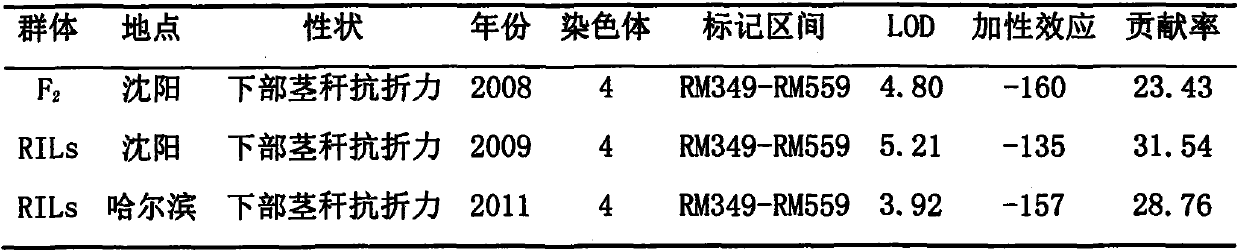
The invention relates to a molecular marker of paddy-rice stalk-strengthening lodging-resistant gene prl4 and application of the molecular marker. QTL (quantitative trait loci) analysis is performed on F2 and RILs crowds of lodging-resistant correlated character of japonica type super rice Shennong 265 and Yunnan local japonica rice variety Lijiangxintuanheigu, so that major QTL is identified, which is stably expressed in different crowd type (F2 and RILs), at different years (2008, 2009 and 2011) at different place (Shenyang and Haerbin), and a synergistic allelomorphic gene of major QTL comes from Yunnan local japonica rice variety Lijiangxintuanheigu. Further analysis shows that the major QTL simultaneously controls push-resistant strength of the lower part of a plant, breaking-resistant strength of a stem, stem wall thickness, area of larger vascular bundle and smaller vascular bundle, and xylem area of larger vascular bundle and smaller vascular bundle. The major QTL is named as prl4 (pushing resistance of the lower part 4). The invention also discloses a molecular marker of prl4. The molecular marker is closely linked with prl4, and is separated with prl4 in a plant later generation, so that a molecular-marker assistant means is applicable to selectively culture paddy rice varieties possessing both high-yield property and lodging resistance.
Need to check novelty before this filing date? Find Prior Art

Description

technical field

[0001] The invention relates to a molecular marker and application of rice strong stalk lodging resistance gene prl4, belonging to the technical field of detection in rice breeding. Background technique

[0002] Lodging is one of the important factors affecting the high yield of rice, wheat, corn and other crops. Under the action of strong wind and heavy rain, rice and other crops are easy to cause lodging, which will cause 20-30% crop yield reduction. In addition, after crop lodging, its canopy structure is destroyed, resulting in a decrease in photosynthetic and dry matter production capacity. Severe lodging will also cause the transportation of water, nutrients and assimilates to be blocked, and reduce the nutrient supply during grain filling. At the same time, lodging will increase the humidity inside the colony, induce fungal diseases or cause ear germination, and then affect the quality and appearance of rice. As Heilongjiang's status as a "national st...

Examples

Embodiment

[0028] According to the location where rice lodging occurs, lodging is usually divided into two types: "stem lodging" and "root lodging". According to the two different types, two strategies of "stalk strengthening" and "supporting force strengthening" are used to solve them respectively. In the embodiment of the present invention, the F 2 QTL analysis for traits related to lodging resistance and RILs population identified a different population type (F 2 and RILs), in different years (2008, 2009 and 2011), and in different locations (Shenyang and Harbin), the potentiating alleles came from the landrace "Lijiang Xintuan Heigu". 1 is to use the F of Shennong 265 / Lijiang Xintuan Heigu 2 The major QTLs controlling lodging-related traits on chromosome 4 were detected in Shenyang and Harbin in 2008, 2009 and 2011 by the population (176) and the recombinant inbred line population (94). The bending resistance of the culm, that is, the application potential of "strengthening the cu...