
Low-threshold low-viscosity nematic phase liquid crystal material as well as preparation method and applications thereof
A liquid crystal material, low viscosity technology, used in liquid crystal materials, chemical instruments and methods, instruments, etc., can solve the problems of high viscosity and small dielectric anisotropy, and achieve low operating voltage, low threshold voltage and low viscosity. Effect
- Summary
- Abstract
- Description
- Claims
- Application Information
AI Technical Summary
Problems solved by technology
Method used
Image

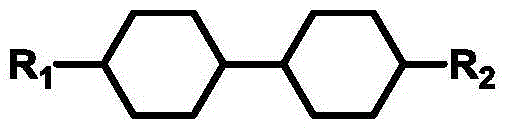
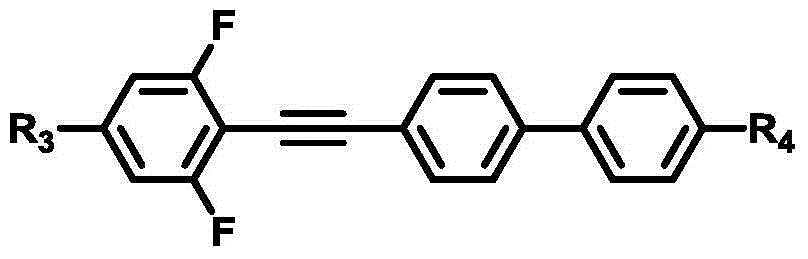
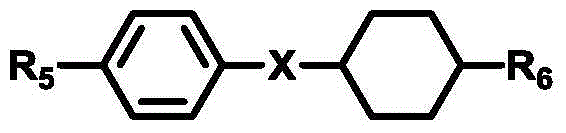
Examples
Embodiment 1
[0045] The liquid crystal material consists of 40.24% component A (A-1: R 1 =C 3 h 7 , R 2 =C 2 h 3 34.15%; A-2: R 1 =C 3 h 7 , R 2 =C 5 h 11 2.85%; A-3: R 1 =OC 2 h 5 , R 2 =C 5 h 9 3.24%), 36.21% of component B (B-1: R 1 =C 2 h 5 , R2 =C 3 h 7 11.23%; B-2: R 1 =C 2 h 5 , R 2 =C 4 h 9 8.64%; B-3: R 1 =C 3 h 9 , R 2 =C 4 h 9 8.78%; B-4: R 1 =C 3 h 9 , R 2 =C 2 h 5 Accounting for 7.56%), 11.55% of component C (C-1: R 1 =OC 4 h 9 , R 2 =C 3 h 7 2.98%; C-2: R 1 =OC 2 h 5 , X=C 2 h 4 , R 2 =C 3 h 7 2.87%; C-3: R 1 =CH 3 , X=C 6 h 12 , R 2 =C 2 h 3 2.67%; C-4: R 1 =F,X=C 6 h 12 , R 2 =C 3 h 7 Accounting for 3.03%), 5.93% of component D (D-1: R 1 =CN,R 2 =C 2 h 3 5.57%; D-2: R 1 = F, R 2 =C 6 h 12 -C 2 h 3 0.09%; D-3: R 1 = F, R 2 =C 6 h 12 -C 2 h 5 Accounting for 0.27%), 3.06% of component E (E: R 1 =C 3 h 7 , R 2 =C 3 h 7 Accounting for 3.06%), 2.68% of component F (F: R 2 =C 4 h 7 2.68%), 0.3...
Embodiment 2
[0053] The liquid crystal material consists of 37.92% component A (A-1: R 1 =C 3 h 7 , R 2 =C 2 h 3 31.37%; A-2: R 1 =C 3 h 7 , R 2 =C 5 h 11 3.91%; A-3: R 1 =OC 2 h 5 , R 2 =C 5 h 9 2.64%), 37.89% of component B (B-1: R 1 =C 2 h 5 , R 2 =C 3 h 7 12.47%; B-2: R 1 =C 2 h 5 , R 2 =C 4 h 9 9.57%; B-3: R 1 =C 3 h 9 , R 2 =C 4 h 9 8.62%; B-4: R 1 =C 3 h 9 , R 2 =C 2 h 5 accounted for 7.23%), 9.63% of component C (C-1: R 1 =OC 4 h 9 , R 2 =C 3 h 7 2.75%; C-2: R 1 =OC 2 h 5 , X=C 2 h 4 , R 2 =C 3 h 7 2.23%; C-3: R 1 =C 2 h 5 , X=C 6 h 12 , R 2 =C 2 h 3 2.14%; C-4: R 1 =C 2 h 5 , X=C 6 h 12 , R 2 =C 3 h 7 accounted for 2.51%), 8.15% of component D (D-1: R 1 = F, R 2 =C 2 h 3 5.88%; D-2: R 1 = F, R 2 =C 6 h 12 -C 2 h 3 Accounting for 2.27%), 3.45% of component E (E: R 1 =C 3 h 7 , R 2 =C 3 h 7 Accounting for 3.45%), 2.96% of component F (F: R 2 =C 4 h 7 Accounting for 2.96%) formed by melt mixing. T...
Embodiment 3
[0062] The liquid crystal material consists of 41.92% component A (A-1: R 1 =C 3 h 7 , R 2 =C 2 h 3 35.49%; A-2: R 1 =C 3 h 7 , R 2 =C 5 h 11 3.91%; A-3: R 1 =OC 2 h 5 , R 2 =C 5 h 9 Accounting for 2.52%), 35.45% of component B (B-1: R 1 =C 2 h 5 , R 2 =C 3 h 7 10.38%; B-2: R 1 =C 2 h 5 , R 2 =C 4 h 9 9.31%; B-3: R 1 =C 3 h 9 , R 2 =C 4 h 9 8.57%; B-4: R 1 =C 3 h 9 , R 2 =C 2 h 5 accounted for 7.19%), 12.17% of component C (C-1: R 1 =OC 4 h 9 , R 2 =C 3 h 73.36%; C-2: R 1 =OC 2 h 5 , X=C 2 h 4 , R 2 =C 3 h 7 2.84%; C-3: R 1 =C 2 h 5 , X=C 6 h 12 , R 2 =C 2 h 3 2.18%; C-4: R 1 =C 2 h 5 , X=C 6 h 12 , R 2 =C 3 h 7 3.09%), 9.29% of component D (D-1: R 1 = F, R 2 =C 2 h 3 6.98%; D-2: R 1 = F, R 2 =C 6 h 12 -C 2 h 3 accounted for 2.31%), 1.87% of component G (G: R 1 =C 3 h 7 Accounting for 1.87%) formed by melt mixing. The molecular structure formula and ratio of each component compound are shown in T...
PUM
 Login to View More
 Abstract
Description
Claims
Application Information
 Login to View More