A preparation method of au@p-mercaptobenzenethiol@au composite Raman probe

A technology for mercaptobenzenethiol and Raman probes, applied in the field of biological nanometers, can solve the problems of sensitivity and accuracy, easy loss or denaturation of Raman molecules, etc. The effect of denaturation and stable physicochemical properties

CN104897646BInactive Publication Date: 2017-07-28CENT SOUTH UNIV
7 Cites 0 Cited by

Patent Information

Authority / Receiving Office
CN · China
Patent Type
Patents(China)
Current Assignee / Owner
Publication Date
2017-07-28
Estimated Expiration
Not applicable · inactive patent

Smart Images

  • Figure 1
    Figure 1
  • Figure 2
    Figure 2
  • Figure 3
    Figure 3
Patent Text Reader

Abstract

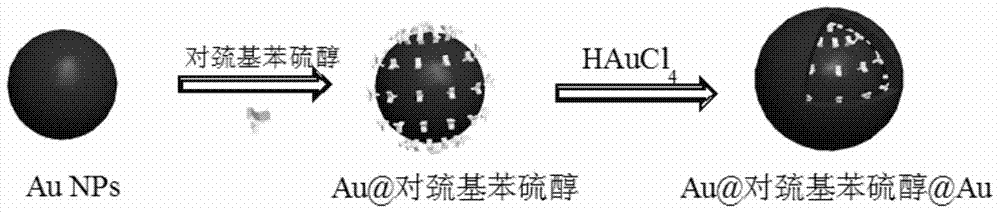
The invention discloses an Au@p-mercaptobenzenethiol@Au composite Raman probe and a preparation method thereof. The composite Raman probe is composed of inner core gold nanoparticles, Raman molecular interlayer and outer gold shell. p-mercaptobenzenethiol, and then prepare a gold shell layer on the surface of p-mercaptobenzenethiol to obtain Au@p-mercaptobenzenethiol@Au composite Raman probe; the Raman signal molecule p-mercaptobenzenesulfide in the prepared Raman probe The alcohol is in the sandwich layer between the core nano-gold and the gold shell, which is not affected by the surrounding environment and has good stability; the gold surface of the probe has uniform chemical properties and can modify various biomolecules, so it can be used for detection of various biomarkers detection, a wide range of applications.
Need to check novelty before this filing date? Find Prior Art

Description

technical field

[0001] The invention relates to a preparation method of Au@p-mercaptobenzenethiol@Au composite Raman probe; it belongs to the field of biological nanometers. Background technique

[0002] Cancer has become one of the major diseases threatening human health in the 21st century. Therefore, accurate detection of the content of cancer markers has become an urgent problem to be solved. The application of gold nanoparticles in Raman detection can amplify the Raman signal and realize the sensitive detection of cancer markers. However, if Raman molecules are directly modified on the surface of gold nanoparticles, Raman molecules are easily lost or denatured during centrifugation, washing and other operations in subsequent experiments, which affects the sensitivity and accuracy of detection. Therefore, solving the defects of the existing nano-gold modified Raman molecules is the key technology for its further development. Contents of the invention

[0003] Aiming...

Examples

Embodiment 1

[0037] Preparation of nuclear gold nanoparticles.

[0038] The steps are as follows: add 150mL 2.2mM Na in a 250mL three-neck flask 3 C 6 h 5 o 7 , while stirring (1500r·min -1 ), heated to boiling under the action of condensing reflux, added 1mL 25mM HAuCl 4 , after 10min the color of the solution turned red and became stable. After 30min, the temperature was lowered to 90°C (denoted as g0), and 1mL of 25mM HAuCl was added 4 , react for 30min; add 1mL 25mMHAuCl again 4 , After reacting for 30min, stir and cool to room temperature (denoted as g1).

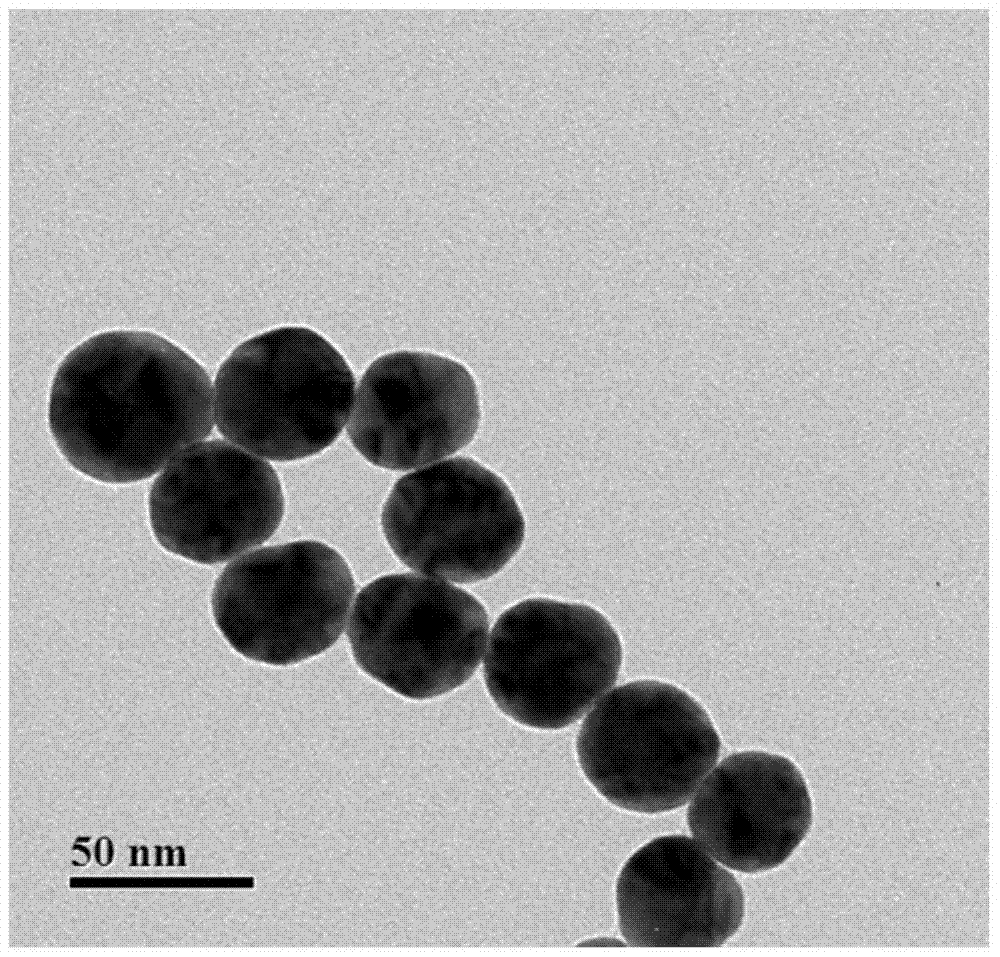
[0039] Take 55mL of the above solution, add 2mL of 60mM Na 3 C 6 h 5 o 7 , add 53mL of ultrapure water, raise the temperature to 90°C, and repeat the operation of g1 once. That is, a solution containing gold nanoparticles (denoted as g2) is obtained. Morphology of nuclear gold nanoparticles figure 2 as shown, figure 2 It can be seen that the nanoparticles are uniformly spherical in shape.

[0040] Preparation of Au...