
Use of 3-carboxy-n-ethyl-n,n-dimethylpropan-1-aminium or a pharmaceutically acceptable salt thereof in the prevention and treatment of diabetes
A technology of dimethyl propane and diabetes, applied to the use of 3-carboxy-N-ethyl-N,N-dimethylpropan-1-ammonium or its pharmaceutically acceptable salt in the prevention and treatment of diabetes areas that can address issues such as inadequate insulin control
- Summary
- Abstract
- Description
- Claims
- Application Information
AI Technical Summary
Problems solved by technology
Method used
Image


Examples
Embodiment Construction
[0012] Female ApoE weighing 18-20 g - / - Mice were kept in an air-conditioned room (22.5±0.5°C, 50±5% humidity) with a light-dark cycle of 12h dark / 12h light, with unrestricted access to food and water.
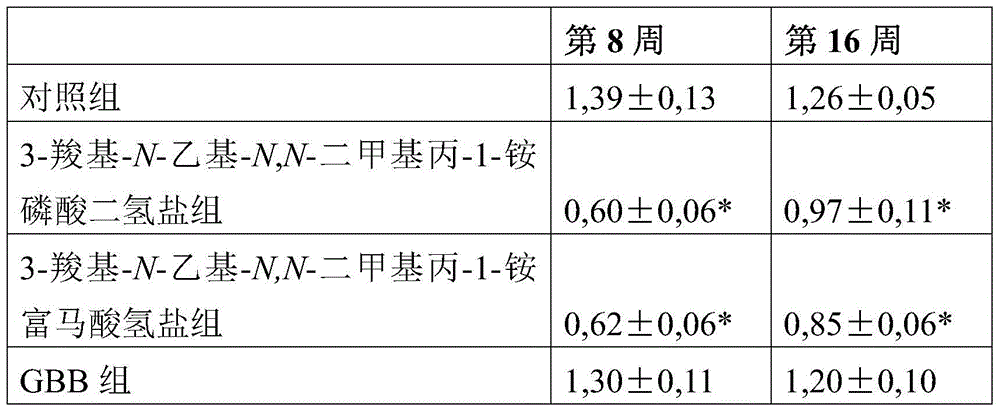
[0013] Mice were acclimated to the field environment for 1 week before starting the study. At 8 weeks of age, mice were randomly assigned to 5 equally sized groups (n=10). Experimental animals in all groups were fed for 4 months with WESTERNRD(P) feed (Cat 82316) from Special Diets Services (UK). During this 4-month period, mice in different experimental groups received the following treatments:
[0014] Control group – drinking water;
[0015] GBB group – GBB10mg / kg;
[0016] 3-Carboxy-N-ethyl-N,N-dimethylpropan-1-ammonium hydrogen fumarate group – 3-carboxy-N-ethyl-N,N-dimethylpropan-1-ammonium fumarate Hydrogen maleate 17.5mg / kg;
[0017] 3-Carboxy-N-ethyl-N,N-dimethylpropan-1-ammonium phosphate dihydrogen salt group – 3-carboxy-N-ethyl-N,N-dimethylpropan-1-ammonium p...
PUM
 Login to View More
 Abstract
Description
Claims
Application Information
 Login to View More