A Method for Determining the Corrosion Rate of Natural Gas Injection and Production Well Pipe String Under the Coupling Action of Erosion-Carbon Dioxide Corrosion

A corrosion rate, carbon dioxide technology, used in design optimization/simulation, special data processing applications, instruments, etc., can solve problems such as few discussions and inapplicability of electrochemical corrosion process

CN106021659BActive Publication Date: 2019-05-07PETROCHINA CO LTD
4 Cites 0 Cited by

Patent Information

Authority / Receiving Office
CN · China
Patent Type
Patents(China)
Current Assignee / Owner
Publication Date
2019-05-07

Smart Images

  • Figure 1
    Figure 1
  • Figure 2
    Figure 2
  • Figure 3
    Figure 3
Patent Text Reader

Abstract

The invention belongs to the technical field of oil field equipment and particularly provides a method for determining a corrosion rate of a natural gas injection and production well pipe column under an erosion-carbon dioxide corrosion coupling action. The method comprises the steps of 1) establishing a pipe column internal component heat transfer, flow and dispersion model; 2) establishing a pipe column wall surface carbon dioxide corrosion model and determining influence of a product layer on the corrosion rate in a carbon dioxide corrosion process; 3) establishing a model of wear of medium erosion on a pipe wall substrate and a corrosion layer; and 4) coupling the three models and determining the corrosion rate of the natural gas injection and production well pipe column. According to the method, a gas well pipe column corrosion rate prediction model is established through an erosion-electrochemical corrosion coupling action mechanism in the natural gas injection and production well pipe column, so that the corrosion rate of the natural gas injection and production well pipe column can be effectively predicted and a technical reference is provided for the security of the natural gas injection and production well pipe column carrying carbon dioxide and liquid water.
Need to check novelty before this filing date? Find Prior Art

Description

technical field

[0001] The invention belongs to the technical field of oilfield equipment, and relates to a method for evaluating the safety service of a vertical pipe string of a natural gas well, in particular to a method for determining the corrosion rate of a pipe string of a natural gas injection-production well under the coupled action of erosion-carbon dioxide corrosion. Background technique

[0002] With the growth of my country's demand for clean energy, the extraction of natural gas continues to increase. However, during the extraction of natural gas, most of the blocks contain CO 2 、H 2 O and other corrosive media enter the gathering, transportation and storage system, which not only affects the service life of natural gas collection and transportation pipes and processing equipment, causes large economic losses to the oil and gas industry, but also causes great pollution to the environment. With the development of natural gas year by year, the depth of the rese...

Examples

Embodiment 1

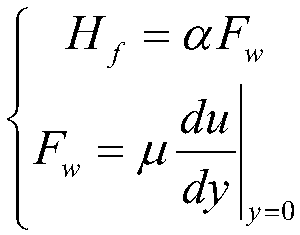
[0027] Example 1: A method for determining the corrosion rate of a natural gas injection-production well pipe string under the coupled action of erosion-carbon dioxide corrosion. First, based on the theory of fluid mechanics and the state of motion involved in natural gas injection and production, a mathematical model of the flow field is established using a theoretical analysis method ; then according to the carbon dioxide corrosion theory, on the basis of detailed analysis of the natural gas well corrosion data, the carbon dioxide corrosion model is established; then according to the carbon dioxide corrosion theory, on the basis of the detailed analysis of the natural gas well corrosion data, the carbon dioxide corrosion model is established; finally the above The model is written into a user-defined function and imported into commercial software for simulation calculation. The inventive method comprises the steps:

[0028] Step 1: According to the theory of fluid mechanics ...