
Semi-bionic extraction process for extracting rhodioloside from rhodiola crenulata
A semi-bionic extraction technology of Rhodiola grandiflora, which is applied in the preparation of sugar derivatives, sugar derivatives, sugar derivatives, etc., can solve the problems of destruction of active ingredients and low extraction yield of salidroside, and achieve effective Less loss of components, weak acidity and alkalinity, and volatile effect
- Summary
- Abstract
- Description
- Claims
- Application Information
AI Technical Summary
Problems solved by technology
Method used
Image

Examples
Embodiment 1
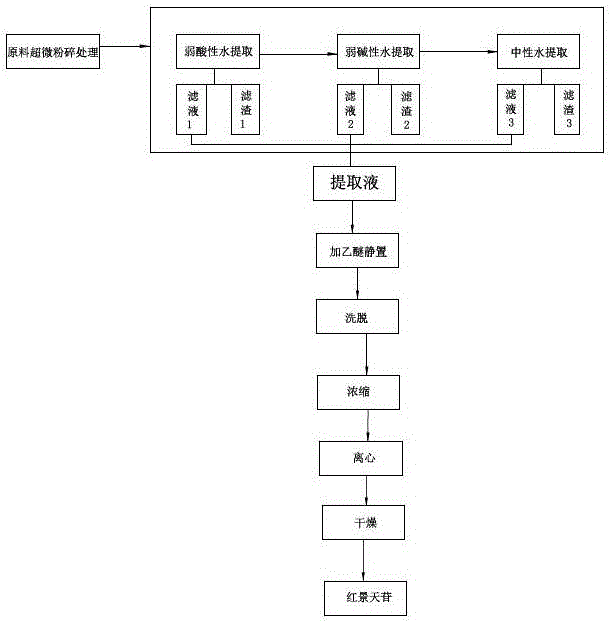
[0039] A semi-bionic extraction process for extracting salidroside from Rhodiola grandiflora, characterized in that it comprises the following process steps:
[0040] A, raw material pre-treatment: take dry Rhodiola rosea, pulverize to obtain Rhodiola rosea powder;
[0041] B, extracting the Rhodiola grandiflora extract: get the Rhodiola grandiflora powder, and extract by using a semi-bionic extraction method to obtain the extract;
[0042] C. Add ether and let it stand: add ether to the extract, stir and let stand for at least 3 hours; filter after standing to obtain the filtrate;
[0043] D. Elution: The filtrate is adsorbed by a medium-polar macroporous resin, first washed with deionized water, and then eluted with a gradient of methanol, and the eluate is collected to recover methanol; after concentration, it is absorbed by a medium-polar macroporous resin, Rinse with deionized water, gradient elution with methanol, and collect the eluate;
[0044] E. Concentration, cent...
Embodiment 2
[0047] On the basis of Example 1, preferably, in step B of the present invention, the semi-bionic extraction process is carried out under airtight conditions, including the following steps:
[0048] Weakly acidic water extraction: Use weak acid to adjust the extraction water to a pH of 4.5-5.5, weigh Rhodiola rosea powder, add weakly acidic water according to the ratio of solid to liquid 1:12-1:20, and heat to 35 Extract at -45°C for 2-4 hours under reduced pressure, and separate to obtain filtrate 1 and filter residue 1.
[0049] Weak alkaline water extraction: Use a weak base to adjust the extraction water to a pH of 8.0-9.5, take the filtrate 1, add weak alkaline water according to the ratio of solid to liquid 1:8-1:10, and heat to 35- Extract at 45°C for 2-4 hours under reduced pressure, and separate to obtain filtrate 2 and filter residue 2.
[0050] Neutral water extraction: adjust the extraction water to neutral with a weak acid, take the filtrate 2, add neutral water ...
Embodiment 3
[0054] On the basis of Example 1, preferably, the weakly acidic water is made by passing carbon dioxide into the water; the weakly alkaline water is made by passing ammonia gas into the water.
[0055] In the present invention, carbon dioxide and ammonia are used to create a weakly acidic and weakly alkaline environment in the semi-bionic extraction, the acidity and alkalinity are weak, and the damage to the effective components of Rhodiola daflora is reduced. At the same time, acetic acid and ammonia are highly safe and volatile, and can reduce residues in the system after extraction.
PUM
| Property | Measurement | Unit |
|---|---|---|
| pore size | aaaaa | aaaaa |
| particle size | aaaaa | aaaaa |
| pore size | aaaaa | aaaaa |
Abstract
Description
Claims
Application Information
 Login to View More